At a glance: Sonic the Hedgehog · Game Gear · Aspect / Sega, 1991 · Platformer · Score: 8.0/10
The first thing to understand about Sonic the Hedgehog on Game Gear is that it is not the Mega Drive game shrunk down, and it is not quite the Master System game either. Aspect’s 8-bit Sonic is its own design — a slower, more exploratory platformer built around the limits and the strengths of Sega’s 8-bit hardware, with zones, layouts and music found nowhere else in the series. On the Game Gear’s small backlit screen in 1991 it was a revelation: the mascot of the moment, in colour, in your hands. Played today it remains the most interesting kind of port — the kind that is really a secret sibling, with ideas of its own and a personality distinct from the 16-bit original that made Sonic famous.
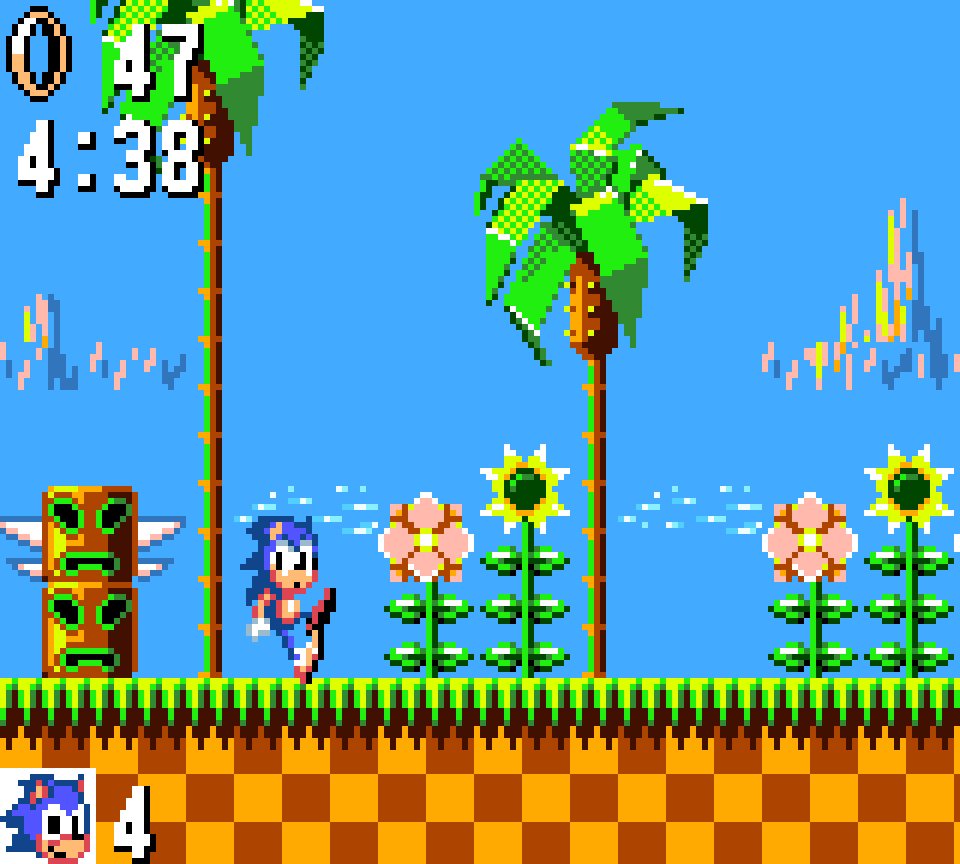
The structure will be familiar to anyone who knows the Master System version, because the Game Gear edition shares its skeleton: six zones of two acts plus a boss act, a world map between zones, bonus stages reached by finishing with fifty rings, and Chaos Emeralds hidden inside the levels themselves rather than walled off in special stages. Green Hill opens proceedings, and its first act is the game’s calling card — recognisably Green Hill, checkerboard soil and palm trees and all, but laid out as a gentler, more vertical climb than the Mega Drive’s speedway.
A different hedgehog
Sonic himself moves differently here. There is no spin dash — that arrived in the 16-bit sequel — so momentum is earned the old way, by running, rolling downhill and committing to slopes. The 8-bit game is consequently less about raw velocity and more about route-finding: springs tucked behind waterfalls, monitor boxes on ledges that demand a running jump, rings arranged to tempt you into danger. It can feel sedate if you arrive straight from the Mega Drive, but judged on its own terms the pacing works. This is a platformer first and a rollercoaster second, and its levels repay the slower approach.
The zone list is where the Game Gear version announces its independence. Bridge Zone, an auto-scrolling crossing over water and waterfalls, has no equivalent anywhere else in the classic series. Jungle Zone sends Sonic up a vertical waterfall climb that punishes a missed jump with a long fall. Labyrinth Zone keeps its underwater menace but with layouts of its own, and the finale in Sky Base — an airship of sparking wires and gun turrets — gives the game a closing act with real atmosphere. Scrap Brain, the one zone borrowed by name from the Mega Drive, shares almost nothing with its namesake beyond the industrial theme.
The Game Gear difference
Because this review is of the Game Gear version specifically, the screen matters — and it cuts both ways. The Game Gear displays a cropped window of the Master System image: the playfield is the same, but you see less of it at once, which makes leaps of faith genuinely blind in places. Jungle Zone’s waterfall and a handful of Bridge Zone jumps are harder here than on a television, not because the design changed but because the view shrank. Against that, the colour work is lovely. The Game Gear’s palette lets Aspect push gradients and richer tones than the Master System build, sunsets glow, and on a modern replacement screen — or in emulation — this is the prettiest of the 8-bit Sonics by a clear margin.
It is not the Mega Drive game shrunk down. It is a secret sibling — slower, stranger, and quietly one of the most likeable games Sonic ever starred in.
Then there is the music, composed by Yuzo Koshiro, which alone justifies the cartridge. Koshiro treats the humble sound chip like a miniature orchestra: Bridge Zone’s theme is so strong that it was later adapted, with new lyrics in spirit if not in fact, into the melody lineage fans associate with later Sonic songs, and Scrap Brain and Sky Base carry a drive the hardware had no right to produce. Played through headphones on the original machine, this is one of the great 8-bit soundtracks, full stop.

Emeralds in the scenery
Hiding the Chaos Emeralds inside the acts rather than in bonus stages changes the game’s rhythm for the better. Each emerald demands exploration — a detour, a risky climb, a leap you would otherwise never attempt — and collecting all six earns the good ending. The signpost bonus stages, meanwhile, are pure pinball-flavoured ring hunts against the clock, useful for stocking extra lives. It is a generous design: skilled players are rewarded, casual players are never blocked, and the world map’s presentation gives the adventure a sense of journey that the Mega Drive original, for all its speed, never quite had.
Faults? The cropped view, as noted, creates a few unfair moments, and the frame rate dips when the screen fills with enemies and springs. Boss fights are simple patterns, charming rather than challenging, though the Sky Base encounters build nicely. And by modern standards the whole adventure is short — an experienced player can see the credits in under an hour. But brevity suits a handheld game built for bus rides and battery budgets, and the emerald hunt extends it honestly.
The details that reward a second look
Replay value hides in the corners the first run rushes past. The signpost bonus stages are worth mastering in their own right — ring-rich pinball rooms where a good run banks the extra lives the late zones will spend — and the emerald locations are placed with a teacher’s fairness: each sits just beyond a visible temptation, a spring you did not need, a ledge the level never requires. The boss roster repays attention too. They are simple, as noted, but their designs are early statements of the series’ mechanical wit: the Green Hill wrecking ball teaches timing, the Labyrinth encounter teaches breath management under pressure, and the Sky Base fights layer hazards the way the finale of a good platformer should. Even the much-maligned underwater sections are better judged here than in the 16-bit game, because the 8-bit layouts are built around Sonic’s slower underwater pace rather than resenting it.
One more virtue deserves recording: the difficulty is calibrated for the machine it lives on. Sessions are short, continues are kind, and the game can be finished in a sitting on a train — which is precisely what it was for. Modern players meeting it through collections sometimes mark it down for that brevity, but brevity was the brief, and within it Aspect packed six distinct zones, a bonus game, an emerald hunt and two endings. That is not a small game. That is a complete one.
Verdict
Sonic the Hedgehog on Game Gear is the thinking player’s 8-bit Sonic: a distinct, well-crafted platformer that borrows the mascot and the mood but designs its own adventure, with a Koshiro soundtrack that ranks among the system’s best. The cropped screen is a real compromise inherited from the hardware, yet the colour and portability made this the version a generation actually grew up with. If you only know the Mega Drive original, this is not a footnote — it is a second first Sonic game, hiding in plain sight since 1991.