At a glance: Space Dungeon · Atari 5200 · Atari (Taito licence), 1983 · Twin-stick dungeon shooter · Score: 8.0/10
Every 5200 owner knows the Robotron story: the cartridge that came with a tray to hold two controllers together. Fewer know that Atari ran the same play for a stranger and, in some ways, more interesting game. Space Dungeon began life as a 1981 Taito arcade cabinet — a twin-stick shooter set not in an arena but in a dungeon of connected rooms, mapped on a grid, where the point is not merely to survive but to loot: collect the treasures scattered through the complex, then escape through the “Collect Bonus” gate with your haul. The 5200 version, like Robotron, shipped with the dual-controller holder to make its twin-stick design playable at home — and it is one of the most distinctive cartridges the system ever got.
Not an arena — a place
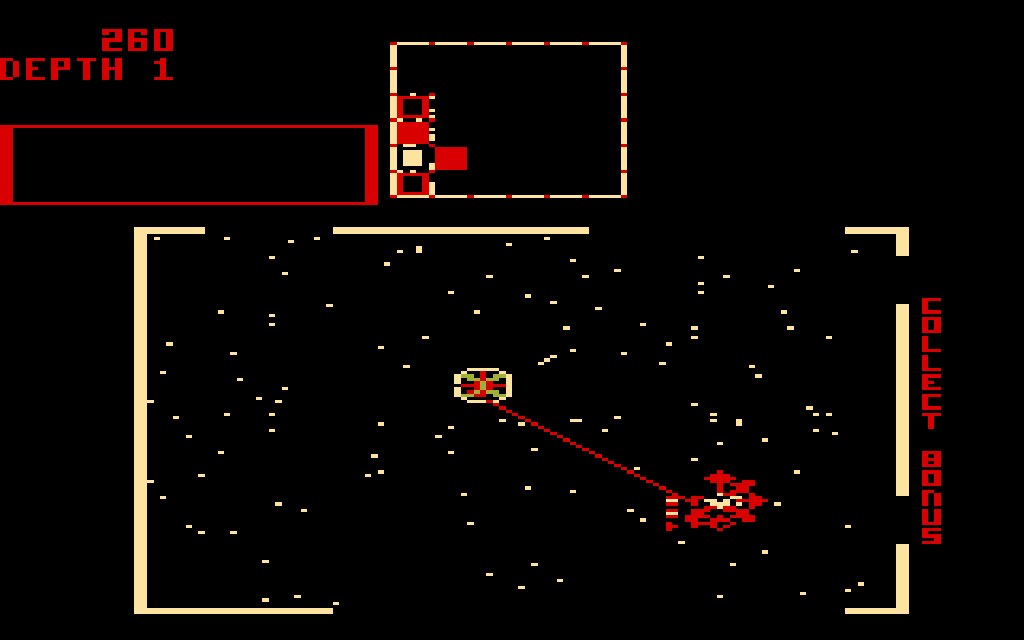
The structure is what sets it apart. Instead of a single screen, Space Dungeon gives you a dungeon of rooms arranged in a grid — shown on the map display at the top of the screen — through which you travel by exiting through doorways. Rooms hold combinations of enemies and treasure: laser defences, guards, thieves who will steal the treasure you have already collected if they touch you, and the treasures themselves, from modest trinkets to the heavy scores lying in the dangerous rooms. Your ship — a little pod with eight-way movement on one stick and eight-way fire on the other — clears room after room, the map filling in, the haul growing, until greed or attrition sends you hunting for the exit room and its Collect Bonus gate, where everything you are carrying is banked. Die on the way, and the dungeon keeps your treasure.

That risk-and-banking loop was years ahead of its time — it is the skeleton of the modern extraction game, sitting in a 1983 cartridge. Every room asks the same question in a new accent: the haul is good, the next room is unknown, the exit is three rooms back the way you came, and your shields are not what they were. Push on or cash out? Robotron asks how long you can last. Space Dungeon asks how greedy you dare to be, which is the more interesting question.
The twin-stick dungeon, faithfully
The conversion is thorough. The dungeon map tracks your position and the layout you have uncovered, the depth counter tracks which level of the complex you are on, and completing a dungeon drops you into a deeper, nastier one. Enemies have their arcade behaviours — the guards press you, the laser corners punish campers, the thief is a genuine heartbreak engine — and the rooms are laid out with the original’s meanness intact. Graphics are spare but effective: starfield rooms, bold sprites, and a HUD that keeps score, depth and reserves in view. POKEY’s sound work is atmospheric — deep space hums, sharp laser fire, the clunk of treasure collected.

The dual-controller holder, as with Robotron, transforms the game: movement and fire fully independent, the pod dancing across rooms while your shots cover the doorways. Played with a single controller the game is manageable but diminished, movement and fire locked together in a way the room layouts were not designed around. This is a cartridge to play properly or not at all — which means a second controller and, ideally, the tray. Two players can alternate expeditions, competing on haul and depth.
The forgotten twin
Why is Space Dungeon not as famous as Robotron? Partly the arcade original’s lower profile — Taito’s cabinet never became the cultural fixture Williams’ game did — and partly timing: it reached the 5200 as the market was collapsing, and a twin-stick dungeon crawler was a connoisseur’s pitch in a panic. The cartridge is accordingly one of the less common first-party releases, and one of the most rewarding to actually find. Against its arcade parent it holds up honourably; against everything else on the 5200 it is simply sui generis — no other cartridge on the system plays like it.
For today’s player, it is also the 5200 game that feels most modern in structure. Roguelite runs, loot banking, escalating depths — the vocabulary of a whole current genre is sitting here in embryo, wrapped in a genuinely good twin-stick shooter. If Robotron is the reason to own the console, Space Dungeon is the reason to keep exploring it after Robotron has finished with you.
Cartography and greed
The map deserves its own appreciation, because in 1983 a persistent, player-revealed map was a luxury almost no action game offered. The grid at the top of the screen fills in room by room as you explore, marking where you have been and — crucially — where the Collect Bonus exit waits, so a deep run becomes an exercise in mental geography under fire: you are three rooms from the exit, carrying a fortune, with a thief somewhere behind you and your exit route running through two rooms you cleared but did not sterilise. The treasures themselves escalate in value the deeper you go, and the game’s nastiest trick is placement — the richest hauls sit in rooms whose enemy mix is specifically designed to separate you from them. Every element is in service of that central tension between the haul in hand and the haul in the next room, and the cartridge implements all of it without flinching.
There is a social dimension the arcade original could not offer, too. Alternating expeditions turn the dungeon into a storytelling machine: one player’s legendary run — four depths down, a fortune banked on the last unit of shield — becomes the standard the next player has to chase, and the game’s structure means no two runs narrate alike. Robotron produces scores; Space Dungeon produces anecdotes. That quality, more than any technical measure, is why the cartridge has grown in reputation every decade since its release, and why complete copies with the holder have become a deliberate purchase rather than an accidental find.
New players should expect an apprenticeship: the first expeditions end quickly, usually one room from the exit with a pocketful of unbanked glory. The game is teaching you its only real lesson — that survival is a resource and greed is a difficulty setting — and once learned, it is a lesson that transfers to a hundred modern games that borrowed this structure without knowing its name.
The inhabitants, catalogued
The dungeon’s population is worth a roll-call, because the port keeps every behaviour. The Enforcers and Guards are your standard opposition — direct, armed, increasingly numerous with depth. The laser rooms mount their defence in the corners and demand a specific, dancing approach. The Thief is the signature creation: it does not want to kill you, it wants what you are carrying, and a touch strips your unbanked treasure and sends the wretch fleeing with it, leaving you the choice between pursuit through uncleared rooms and swallowing the loss. And the treasures themselves are graded with a miser’s eye, from the common pieces in the safe shallows to the great hauls in the deep rooms behind the worst defences. Knowing the population turns the dungeon from a shooting gallery into an ecology, and playing it well means reading a room the way a burglar reads a house: what is here, what is it worth, what will it cost, and where is the door. That a Taito design from 1981 was already asking those questions is remarkable. That the 5200 version asks them undiminished is why it belongs in this library’s first rank of deep cuts.
Verdict: A twin-stick treasure raid years ahead of its time — Robotron’s controls wrapped around a dungeon, a map and a banking decision. One of the 5200’s essential deep cuts. 8.0/10