At a glance: Qix · Atari 5200 · Atari (Taito licence), 1982 · Territory action-puzzle · Score: 7.5/10
Qix is the arcade game that looks like an art installation and plays like a panic attack. Taito’s 1981 original gives you an empty rectangle, a marker that travels its border, and a helix of coloured lines — the Qix itself — bouncing unpredictably inside. You venture into the void drawing lines; complete a shape and the territory becomes yours, in colour; get touched by the Qix, or by the Sparx patrolling the border, or hesitate on your own unfinished line when the fuse reaches you, and you die. Claim three-quarters of the screen and the board is yours. It is one of the purest ideas in the medium, and the 5200 version is a strikingly faithful translation — arguably the most elegant cartridge on the system.
The void, claimed properly
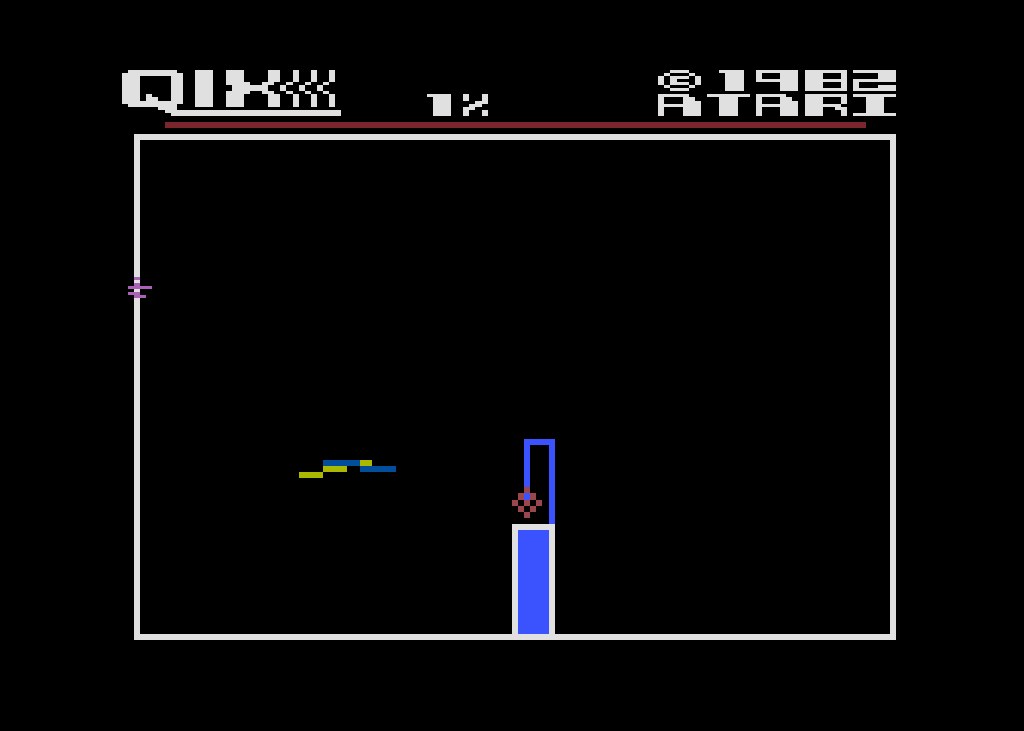
Everything that defines the game is here. The Qix moves with its proper, horrible randomness — not wandering but dancing, changing tempo and shape, so that no two boards ever present the same problem. The two draw speeds are present and correct: the slow draw, worth double points, for brave territory; the fast draw for escapes. Splitting the screen into regions, the bonus for exceeding the 75 percent threshold, the escalating Sparx, the extra markers — the rulebook is the arcade’s rulebook. Filled territory lights up in shifting colour, and there is a particular satisfaction, unique to Qix, in watching a reckless slow-draw pay off as a third of the screen floods blue.
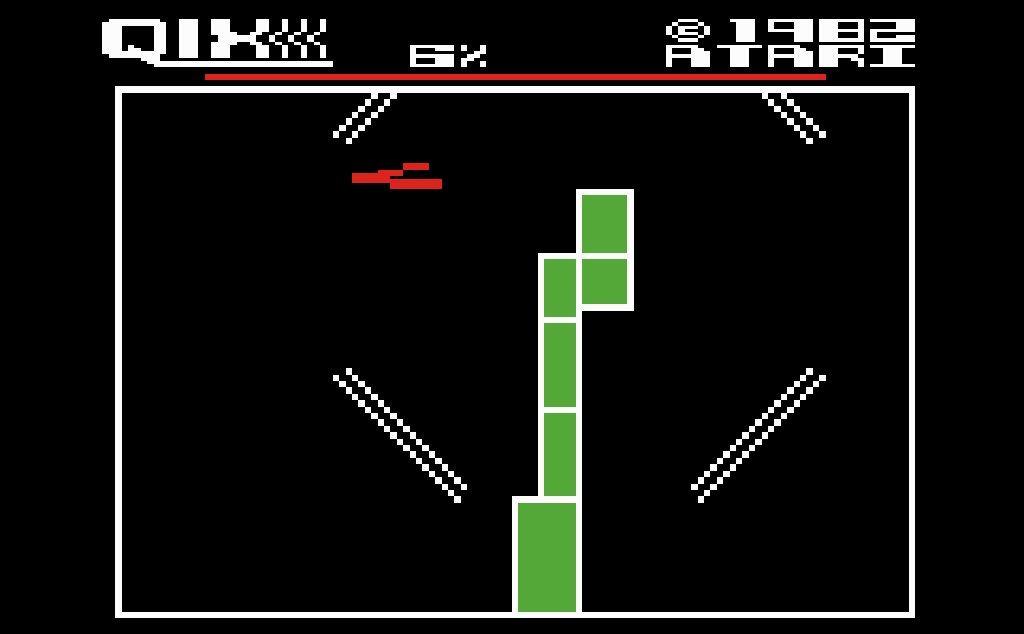
Visually, this is where the 5200’s clean display earns its keep. Qix is a game of lines and colour on blackness, and the port renders it crisply: the helix is bright, the borders sharp, the claimed areas bold. Sound is minimal by design — a hum, a spark, the rising whine of the fuse — and POKEY does it without fuss. There is no flicker, no slowdown, nothing between you and the geometry. Of all the arcade ports on the system, this is the one where “arcade-perfect for its day” comes closest to being plain fact.
Risk, the whole game
What makes Qix endure is that it is a gambling engine disguised as an action game. Every venture off the border is a bet sized in percent: play safe around the edges and the Sparx will eventually force the issue; carve greedily up the middle and the Qix’s next lurch decides whether you look brilliant or dead. The 5200 version preserves the tension perfectly because it preserves the Qix’s behaviour — and that behaviour, that specific elastic menace, is what most later home versions softened. Here it is untamed.

Control, the system’s usual tragedy, is here merely a footnote. Qix wants four directions and two buttons, and even a wandering analogue stick mostly delivers them, because movement happens along borders and straight lines rather than through mazes of corners. Occasional imprecision at a junction will annoy; it will rarely kill. The keypad handles game selection in the era’s usual way, and two players can alternate their attempts at land-grabbing.
In the catalogue
Qix was never one of Atari’s headline licences — it did not sell consoles the way Pac-Man was meant to — and the 5200 cartridge has spent forty years as the quiet one in the library, the game collectors pass over on the way to the famous names. That is a miscarriage. The 2600 never received a period version at all; the 5200’s was, for years, simply the way to play Qix at home, and it remains a superb way. Its abstract looks have also aged in its favour: where chunkier ports of character games date visibly, Qix’s lines and colour fields could ship as a minimalist indie game tomorrow.
It will not be everyone’s cartridge. There is no character, no story, no explosion worth the name — just you, a line, and a beautiful monster made of mathematics. For players who like their arcade games distilled to an idea and a dare, it is one of the essential 5200 purchases, and the score we give it reflects how completely it achieves exactly what it sets out to do.
Advanced land-grabbing
The expert game, all of it present here, is richer than the premise suggests. Splitting the Qix — dividing the board so the helix is trapped in the smaller region when you cross a threshold — multiplies your percentage bonus enormously, and the masters’ technique of building a staircase of small claims up the middle, then making one long, slow, suicidal draw across the top, is the most theatrical manoeuvre in any game of its era: thirty seconds of construction for three seconds of terror and a screen that floods with colour and points. The port preserves the arithmetic exactly, including the way claimed percentage beyond the threshold multiplies rather than merely adds. This is why Qix high scores look so strange to outsiders — they are records of audacity, not accuracy.
There is also a meditative quality to the game that this version’s cleanliness serves well. A Qix board in progress is genuinely beautiful — bright geometry on black, the helix drawing its endless calligraphy in the unclaimed dark — and the game’s sound design, mostly space and spark, lets a long session settle into something close to a trance between the panics. Few cartridges of 1982 can be described as beautiful without apology. This one can.
Buying advice is simple: it is not a common cartridge, but it is not a costly one either, and it is the title in this library most likely to convert a sceptical modern player, because its idea needs no nostalgia to work. Show it to someone who thinks early games are all reflex and no thought, and watch them start, within two boards, to gamble.
Two Qix are worse than one
Survive long enough and the game reveals its nastiest idea, preserved faithfully in this port: later boards contain two Qix, two helices dancing in the same void, which transforms the geometry of every decision. A region that was safe against one helix’s habits is a crossfire against two, and the split bonus — earned by dividing the pair into separate territories — becomes the game’s whole economy, paying out the kind of percentages that turn a cautious player into a legend or a cautionary tale. The Sparx, meanwhile, multiply and quicken along the borders, so the safe ground itself is on a timer. This escalating structure gives Qix something rare among early arcade games: a genuine late game, distinct in kind from its opening, which the home versions that simplified the Qix’s behaviour never delivered. The 5200’s does, and it is the final reason this cartridge, rather than any of its tidier contemporaries, is the version historians point to. Add a strict but fair extra-marker schedule and a two-player mode that turns land-grabbing into a parlour duel of nerve, and the package is complete: an abstract game, perfectly ported, that has out-thought and out-lasted almost everything flashier from its year.
Verdict: A near-flawless port of Taito’s abstract masterpiece of risk — crisp, tense and untouched by time. The 5200’s most elegant cartridge. 7.5/10