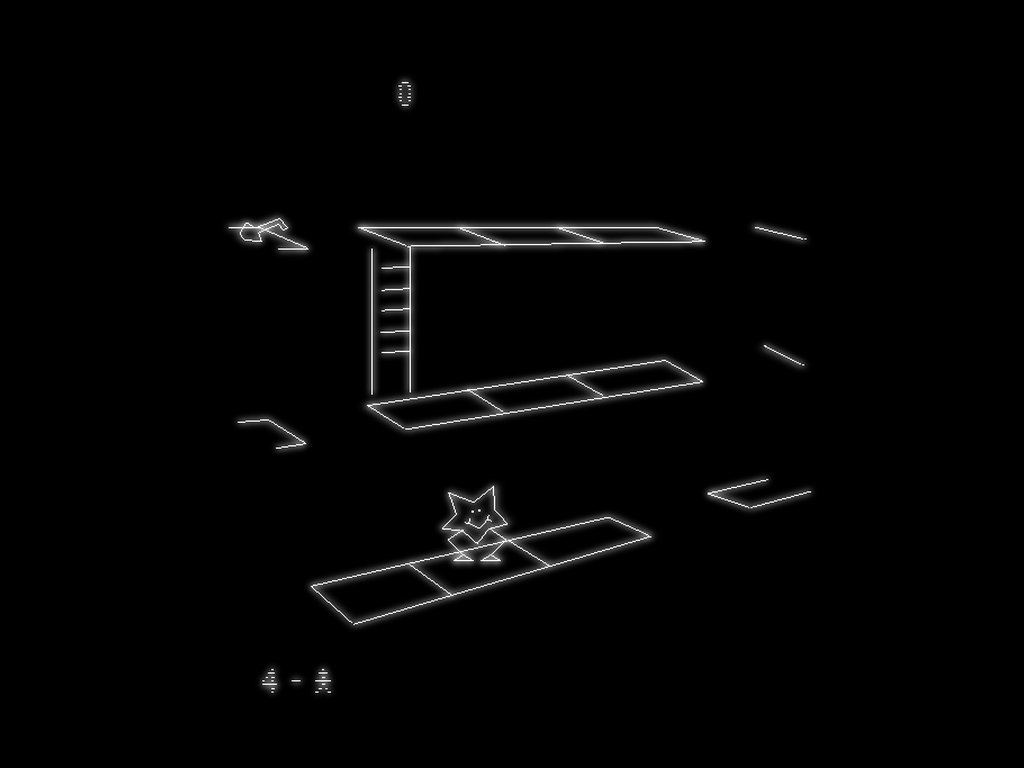
At a glance: Spike · Vectrex · GCE, 1983 · Platform game · Score: 7.5/10
Of every cartridge in the Vectrex library, Spike is the one that talks. “Eek! Help, Spike!” cries Molly, in a digitised squeak squeezed from a sound chip never designed for speech. “Oh no!” answers Spike, in a digitised baritone of his own. In 1983, voice in a home game normally meant a plug-in module, an Intellivision accessory or a marketing promise. Spike just does it, out of the cartridge, through the Vectrex’s ordinary speaker — and then, almost as an afterthought, turns out to be a charming, distinctive little platform game as well. It remains the library’s great party trick and one of its most likeable originals.
The story is a silent-film serial in four lines of plot. Spud, the villain, has carried off Molly and holds her at the top of a scaffold of floating platforms. Spike — a spiky-haired little hero with more courage than reach — must climb the platforms, dodge or defeat the creatures patrolling them, and reach Molly before the serial’s next instalment becomes necessary. The platforms hang over a void; ladders connect some of them; gaps connect the rest, in the way gaps do. Falling is fatal, enemies are fatal, and the whole construction has the cheerful cruelty of a Saturday-morning cartoon with a body count.

A platformer drawn in light
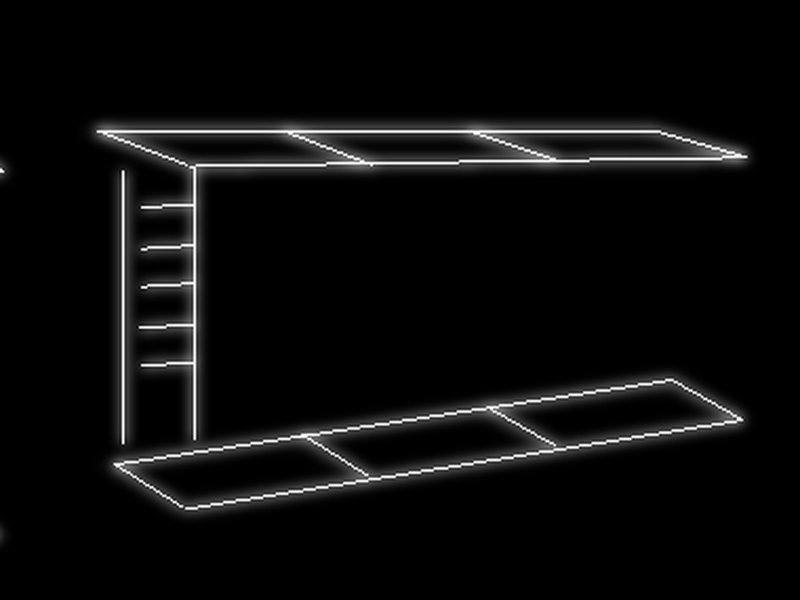
Platform games were not the Vectrex’s obvious genre — the machine’s soul was the shooter — and Spike’s designers answered the mismatch with style. The platforms are drawn as glowing decks stacked up the portrait screen, an arrangement the tall display suits perfectly: the climb reads as a climb, Molly’s perch visible at the summit like a flag. Spike himself is a proper little character sprite built from vectors, animated with a bounce that raster platforms of the day would envy, and his essential move is a kick — enemies can be booted off their platforms with a well-timed strike, which is both the game’s combat and its comedy, since a kicked creature’s arc into the void never stops being funny. Timing, not firepower, is the skill: patrol patterns are fair, jumps are honest, and deaths are the player’s own work.
The speech deserves its fame, and not only as a technical stunt. Molly’s cry is also a game mechanic in disguise — it is the timer made audible, a damsel-in-distress countdown delivered with real personality — and Spike’s answering “Oh no!” when things go wrong gives failure a punchline instead of a buzz. The voices are crude by any later standard, all buzz and formant, and absolutely perfect in context: two tiny performances, a hero and a heroine, conjured from a chip designed for explosion noises. That GCE bothered — that they spent ROM and ingenuity on character in a genre the machine wasn’t built for — says a great deal about the library’s ambitions in 1983.

Where the scaffold creaks
Honesty requires the other ledger. Spike is a modest game by the library’s sterner standards: the platform layouts cycle their ideas rather than multiplying them, the enemy roster is small, and a practised player will see the game’s whole hand within an evening, where Star Castle or Narzod keep secrets for months. The collision of charm and difficulty is occasionally awkward — the kick’s timing window is generous in the early stages and feels suddenly strict when the patrols quicken — and the speech, glorious as it is, repeats its tiny script on a loop that will test the affection of anyone else in the house. Spike is a sprint of a game in a library of marathons.
Two tiny performances — a hero and a heroine — conjured from a chip designed for explosion noises. Spike talked, and the whole library seemed more ambitious for it.
And yet. There is a reason Spike is the cartridge long-time owners demonstrate to visitors, the one that gets mentioned in the same breath as the machine’s serious masterpieces despite its slighter frame. It has a face. The Vectrex library is full of superb abstractions — rings, mazes, canyons, stars — and Spike is its cartoon: a hero, a villain, a rescue, a joke, all in light. In a collection being built for depth as well as brilliance, that personality is not decoration. It is a genre the machine needed exactly once, done exactly right.
The scaffold, stage by stage
Spike’s structure rewards a closer look, because its simplicity is engineered rather than accidental. The early scaffolds are tutorials in disguise: the patrols are slow, the ladders are where a beginner would put them, and Molly’s cries arrive at intervals calculated to hurry a new player without panicking them. The middle game starts removing kindnesses — patrols cross the platforms Spike must use, the safe waiting spots evaporate, and the kick stops being a comedy move and becomes a commitment, since a missed kick leaves Spike standing in the path of the thing he failed to boot. By the late stages the scaffold is a small clockwork of intersecting routes, and clearing it feels like picking a lock with your feet. That curve, from cartoon to clockwork, is the same one the great platformers of the following years would make famous; Spike was walking it in 1983, on hardware built for spaceships.
The character’s afterlife confirms the design’s charm. Spike became, in the community’s affection, something close to the Vectrex’s mascot — the machine’s one true platform hero in a library of ships and tanks — and homebrew developers kept returning to him: sequels and tributes such as Spike’s Circus and the later Spike Hoppin’ extended the little hero’s career decades after GCE closed, a distinction no other original Vectrex character can claim. When a console’s fan-made future keeps resurrecting one particular hero, it is telling you where the original library’s heart was. Spike’s voice may have been the trick that sold the cartridge. Spike himself was the reason it stayed sold.
The verdict
Spike scores as the library’s most charming cartridge rather than its deepest: a competent, characterful platformer elevated by a technical miracle it wears lightly. New Vectrex owners should play it early, for the voice and the smile; veterans should keep it loaded for the evenings when the siege guns and gravity wells feel like work. Not every classic has to be a marathon. Some of them just have to shout for help, in a voice made of buzzes, and be worth rescuing.
A word, too, for how the game treats its youngest players, because Spike may be the library’s best first cartridge for a child in 2026 as it was in 1983: the goal is visible at the top of the screen, the hero is funny, the villain is clearly labelled by his behaviour, and the voice — that miraculous, buzzy voice — turns instruction into theatre. Libraries need gateways as much as they need summits. Spike is the Vectrex’s gateway with a kick, a cry for help, and a hero worth the climb.
Eek. Help. Play Spike.
Score: 7.5/10 — The talking platformer: slight, sweet, and impossible to imagine on any other machine of its year.