
At a glance: Solar Quest · Vectrex · GCE, 1982 · Rescue shooter · Score: 7.5/10
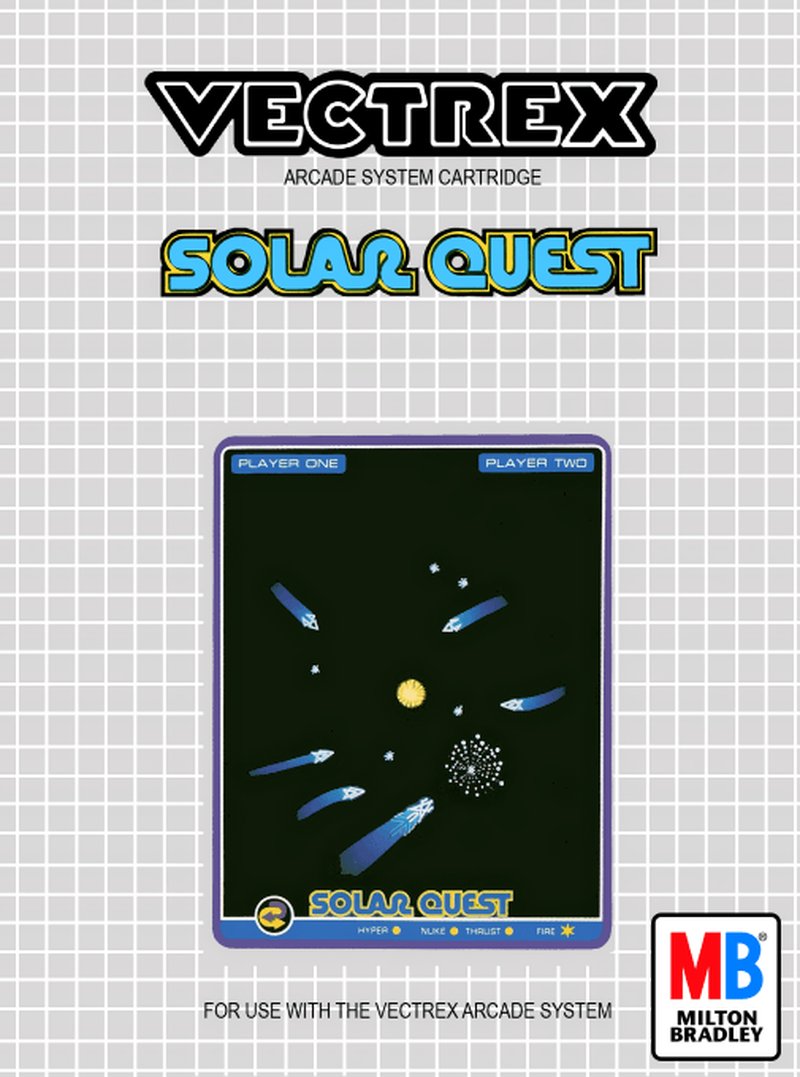
Most space games of 1982 are about killing. Solar Quest is about fetching — fetching under fire, against thieves, around a sun. Cinematronics’ 1981 arcade game casts you as a rescue ship orbiting a blazing central star, in a system littered with stranded survivors drifting in the dark. Your job is to scoop them up. The aliens’ job — the game’s whole engine of tension — is to scoop them up first, or to shoot the ship doing the scooping. It is a race staged as a shooter, a salvage operation with a body count, and on the Vectrex’s little round-ish arena of a screen it becomes one of the early library’s most distinctive evenings.
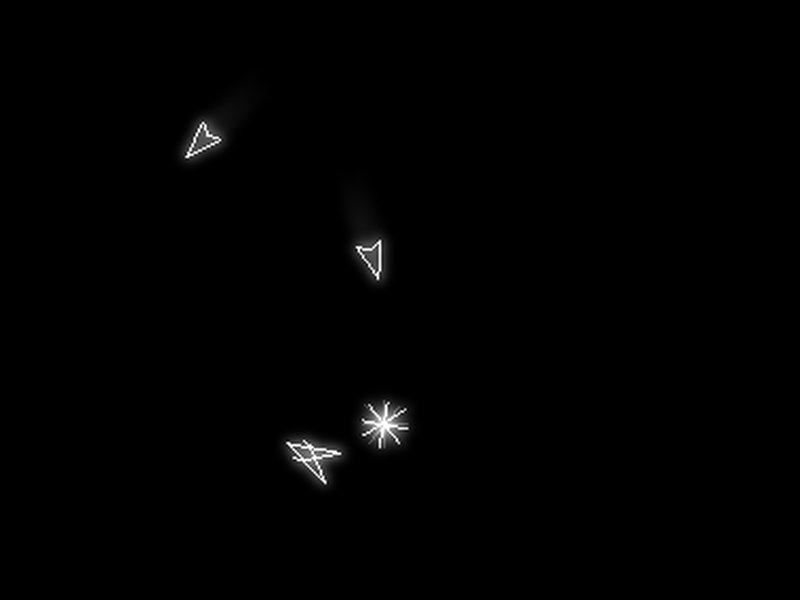
The arena is the design. The sun squats in the middle of the screen — on the overlay, a genuine presence, colour and glare — and play happens in the ring of space around it. Survivors appear drifting at the arena’s edges and hazards, and your ship must cross to them, match their drift, and take them aboard, then survive long enough for the rescue to count. Alien vessels patrol the same ring with the same shopping list: reach a survivor first and he is theirs, and an alien ferrying a captive home becomes the highest-value target in the system, because shooting it rescues the rescue. The moral geometry is exquisite for 1981: every alien you kill might be a thief, a kidnapper mid-crime, or a bystander — and the game makes you decide at firing speed.

Salvage, with guns
What elevates Solar Quest above its rescue premise is the texture of the flying. Your ship handles like a proper vector vessel — rotation, thrust, drift — and the sun is not a passive backdrop: the arena’s compactness means every crossing passes the star’s neighbourhood, every dogfight slides around its gravity-flavoured geometry, and positioning becomes a circular art. Aliens escalate from opportunists to hunters, survivors appear in crueller places, and the game’s tempo does something shooters rarely manage: it alternates. A quiet salvage run builds to a contested pickup, builds to a running fight around the sun, subsides into another quiet run — and the player, not the wave timer, sets most of that rhythm by choosing which survivor to chase and which to concede.
The Vectrex port is a faithful, well-judged conversion in the GCE manner: the arcade’s structure intact, the overlay doing honest work for the sun and the arena’s zones, the analogue stick flattering the ship’s orbit-hugging handling. Two-player alternating play gives the rescue race a scoreboard rivalry, and the scoring system quietly rewards the game’s better angels — a survivor saved is worth more than an alien scrapped, so greed and virtue, usually enemies in an arcade design, here pull in the same direction until the moment they don’t, and a loaded alien crosses your sights.
The honest debits
Solar Quest’s limits are the limits of its single arena. There is one system, one sun, one ring of space, and while the escalation is well-paced the scenery never changes its mind; players raised on Scramble’s journey or Cosmic Chasm’s caves may find the circular stage repetitive across a long evening, because the game’s variety is tactical rather than geographical. The rescue mechanic, too, has a cruelty curve: late-wave survivors appear in positions so contested that conceding them feels less like strategy than surrender, and the aliens’ marksmanship in the deep game can turn salvage into a war of attrition the score rarely justifies. None of this is hidden by the port, which presents the arcade’s virtues and its single-screen ceiling with equal fidelity.
A race staged as a shooter: every alien you meet might be a thief, a kidnapper mid-crime, or a bystander — and the game makes you decide at firing speed.
What survives those debits is the game’s strange warmth. The Vectrex library is rich in duels, sieges and hunts; Solar Quest is its errand of mercy, a game where the highest-scoring play is a rescue and the tensest moment is not a boss but a drifting figure and two ships converging on him from opposite sides of a star. That idea — simple, humane, and mechanically complete — was ahead of its moment in 1981 and remains under-imitated now. The port does it full justice.
Reading the ring
Competence in Solar Quest is mostly triage, and the game teaches it with unusual elegance. Every survivor who appears is a small auction: his position prices the rescue, the nearest alien’s position prices the contest, and your fuel of time and hull prices the bid. Beginners chase everything and die heroes of a lost cause; veterans let the hopeless cases drift — the game is unsentimental enough to allow it — and fight like demons for the winnable ones. The aliens’ behaviour sharpens the lesson as waves advance. The early opportunists can be out-raced; the later hunters must be out-thought, drawn away from a pickup by a feint at another, or ambushed on the one route home they cannot avoid taking. A laden alien, survivor in tow, rearranges every priority on the screen: killing it is rescue and robbery at once, and the long chase around the sun that follows a theft is the game’s signature set-piece, a dogfight with a hostage.
The sun, finally, deserves its billing as the arena’s third combatant. Fights in Solar Quest bend around it because ships must: the crossing routes all pass its parish, and a pilot who learns to use the star as a shield — breaking line of sight behind its glare, timing a pickup run for the moment an enemy is committed to the far side — gains an advantage no amount of marksmanship can substitute for. It is a quieter kind of spatial mastery than Star Castle’s geometry or Space Wars’ gravity, but it is the same family of pleasure: a small round world, completely understood, then completely exploited. That the whole education arrives wrapped in a rescue mission rather than an extermination gives Solar Quest a flavour nothing else in the 1982 line-up shares.
The verdict
Solar Quest is a middle-rank classic: not the library’s deepest or hardest game, but one of its most original in spirit, and a conversion handled with GCE’s usual respect for the source. Play it for the rescue race, for the circular dogfights around the sun, and for the moment an alien makes off with your survivor and the whole evening finds its villain. Somebody is drifting out there. Go and get them home.
There is also, for the historically minded, a quiet satisfaction in Solar Quest’s company: it sits in the Cinematronics line alongside Space Wars and Armor Attack as part of the vector arcade’s founding generation, yet its rescue premise points at a future the arcades mostly declined — games about saving rather than destroying. The Vectrex preserved both the game and the road not taken. Play it as a shooter and it satisfies; play it as a road not taken, and it haunts a little, in the best way.
Score: 7.5/10 — Salvage with a heartbeat: a rescue race around a sun that still out-charms most shooters.