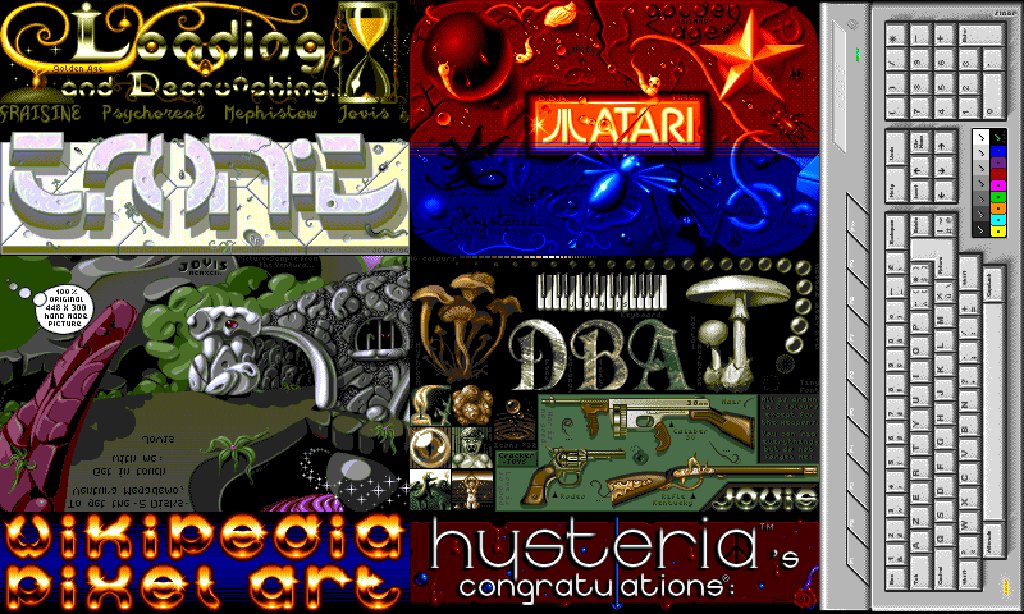
The Atari ST was not supposed to do most of the things the demoscene made it do. It had no hardware scrolling to speak of, no sprites worth the name, a sound chip inherited from the previous decade and a video system with firm opinions about where the picture ended. The demoscene — the loose, competitive, trans-European culture of programmers, artists and musicians making real-time audiovisual demos to out-do each other — treated every one of those limits as a dare. What they extracted from the 68000 over the following decade remains one of the great bodies of folk engineering in computing: effects the machine’s designers did not know it could perform, discovered by teenagers and shared on floppy disks at parties.
Start with the borders. The ST’s display, as Atari specified it, sits inside a frame. Scene coders learned to open those borders — timing the video hardware with cycle-exact code to draw into the top, bottom and eventually the sides of the screen, until the picture filled the monitor edge to edge. The first time a scroller ran through the lower border of an ST screen, it was a magic trick performed in public; within a year it was a scene handshake, the entry fee. Sync-scrolling techniques followed — hardware-defying methods to move the whole display smoothly on a machine with no scroll registers — then overscan, then plasma effects, texture tricks and, eventually, polygon routines that made the old 3D games look shy.

The crews and the culture
The names still carry weight in the community: The CareBears, whose Big Demo of 1989 was many owners’ first sight of their machine misbehaving gloriously; TEX, The Exceptions, whose work in the legendary Union Demo stitched a scene together; the Lost Boys, Omega, and later generations on the STE who exploited its improved hardware — hardware scrolling at last, better sound — to keep pace as the Amiga’s scene flexed its custom chips. Around the productions grew the whole apparatus: disk magazines like Maggie that chronicled the scene in its own words, parties where new demos premiered to rooms of rival coders, and a postal economy of swapped disks that functioned as the era’s internet for the people who would later build the real one.
The demoscene’s ST work is a love letter written in clock cycles: proof that a machine’s real specification is whatever its most obsessed users can persuade it to do.
Music was half the art. The YM2149 chip, three square-wave channels that game composers treated politely, was bent by scene musicians into something unrecognisable — software-mixed samples, digidrums, sid-style voices conjured by abusing the chip’s envelope hardware at rates its datasheet never envisioned. Chip tunes composed on and for the ST became a genre with its own masters, and the discipline of writing a tracker tune that sings in a few kilobytes fed directly into the era’s game soundtracks. If you have ever heard an ST make a noise it should not be able to make, a scene musician probably got there first, at 3 a.m., for no money and total glory.

Why the ST scene mattered
It would be easy to file the demos as decoration, and it would be wrong. The scene was the ST’s research department and its finishing school. Techniques proven in demos migrated into games — border and sync tricks, sample playback, fast polygon code — and scene coders migrated into the industry, carrying a discipline of optimisation that modern hardware abundance rarely teaches. It also kept the machine culturally alive through the years when commercial software thinned: into the mid-90s, when the ST’s shop shelves were emptying, its scene was still premiering work, still holding parties, still arguing that the old beige box had unused miracles in it. They were right often enough to keep everyone honest.
The ST scene also had a distinct flavour against its great rival’s. Where the Amiga scene could lean on custom hardware, the ST scene’s identity was ingenuity against the spec sheet — every effect a small heist. That underdog craft gives ST demos their particular pleasure today: you are not only watching a pretty screen, you are watching a machine get away with something.
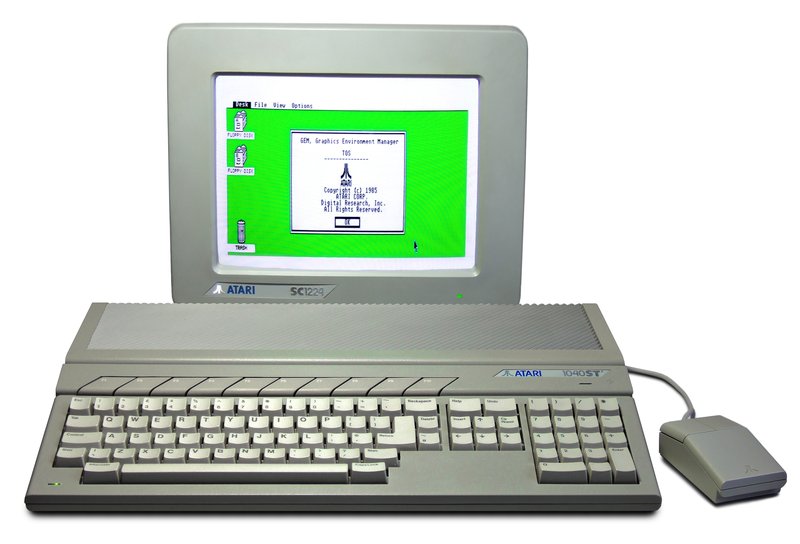
How a demo gets made
To understand the scene’s discipline it helps to picture the work. A demo’s screen — a fullscreen picture with a scroller, a starfield and a tune, say — is a single program in which every processor cycle of every frame is budgeted like money. The 68000’s instruction timings are counted by hand; the video hardware is provoked at exact scanline moments; the music routine, the scroll routine and the effect routines are interleaved so that each finishes in the sliver of time the others leave. There is no operating system help and no headroom. This is why scene code carried such prestige among programmers, and why its authors speak of their productions the way watchmakers speak of movements. The ST, lacking the rival machine’s helper chips, demanded more of this craft per effect than any mainstream platform of its day — and attracted exactly the personalities who heard that as an invitation.
The artefacts of that craft fill today’s archives in their tens of thousands: the megademos that chained a dozen groups’ screens into one disk-long festival, the tiny intro competitions that squeezed a universe into a boot sector’s neighbourhood, the graphics and music disks that functioned as the scene’s galleries and concert halls. Disk magazines reviewed them, charts ranked their makers, and feuds between crews ran for years in scrolltext — the scene’s literature, crawling across the bottom of the screen at reading pace, half greetings to friends, half declarations of war. It was a complete culture with its own media, and the ST was one of its two great nations.
The scene’s social architecture deserves a word, because it explains the work’s quality. Crews were small — a coder, a musician, a graphician, sometimes one person in three hats — and reputations were everything in a gift economy with no money in it. A group that shipped a lazy screen heard about it in every scrolltext for a year; a group that shipped a miracle was greeted, literally, in the greetings lists that closed every production, a roll of honour exchanged between rivals like diplomatic notes. Parties concentrated the pressure into weekends of live judgment. That reputational furnace, burning for no commercial reason at all, is why the ST’s demo catalogue reads like a research archive: thousands of productions, each one trying to make the previous month’s impossible effect look like a warm-up. No marketing department has ever motivated programmers half as well as a rival crew two hundred miles away.
The scene that never quite stopped
Of all the ST’s cultures, the demoscene is the one that never fully ended. Parties still premiere ST and STE productions; new demos arrive from veterans and from coders who were not born when the Big Demo shipped; the archives preserve tens of thousands of productions, screens and tunes. The machine’s story is usually told in products — the games, the sequencers, the systems in this collection — but the scene is the ST’s proof of soul: a community that took a mass-market computer and, purely for the love of the trick, spent a decade finding the extra machine hidden inside it. Open the borders. They did.