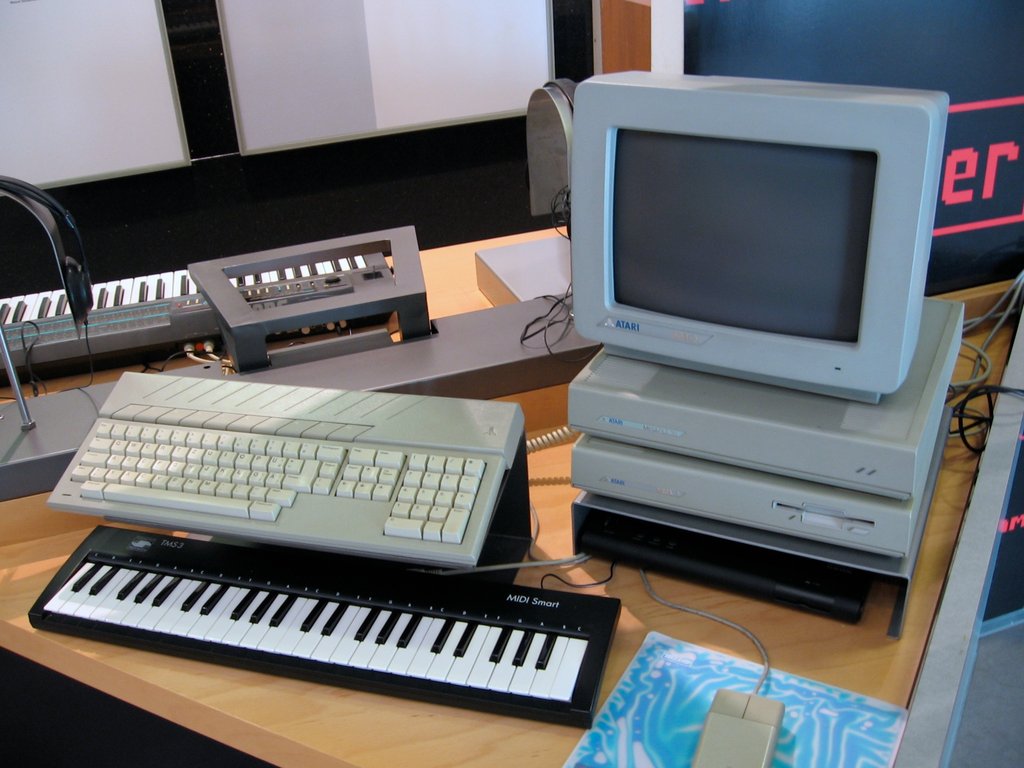
Every revolution has a small, unglamorous cause. The revolution that put the personal computer at the centre of music production was caused by two five-pin DIN sockets on the back of a home computer. When Atari launched the ST in 1985, it fitted MIDI In and MIDI Out ports as standard — not as an expansion, not as a musician’s edition, but on every machine, from the cheapest 520ST upward. MIDI, the Musical Instrument Digital Interface, was then a young standard for connecting synthesisers, drum machines and sequencers. Atari’s decision meant the most affordable serious computer in the world was also, out of the box, a recording studio’s conductor. Studios noticed before the games magazines did.
The timing was perfect in a way Atari could not have planned better. MIDI instruments were multiplying through the mid-80s, and musicians needed a reliable brain to sequence them: send note data to a rack of synths, keep drum machines in time, record a performance as data and edit it note by note. Dedicated hardware sequencers were expensive and limited. The ST was cheap, had a mouse and a high-resolution screen suited to piano-roll editing, and its operating timing proved rock-steady — the machine earned a reputation for MIDI timing so tight that engineers trusted it on hit records. Within a few years the ST was not an option in professional studios. It was furniture.
The software that sealed it
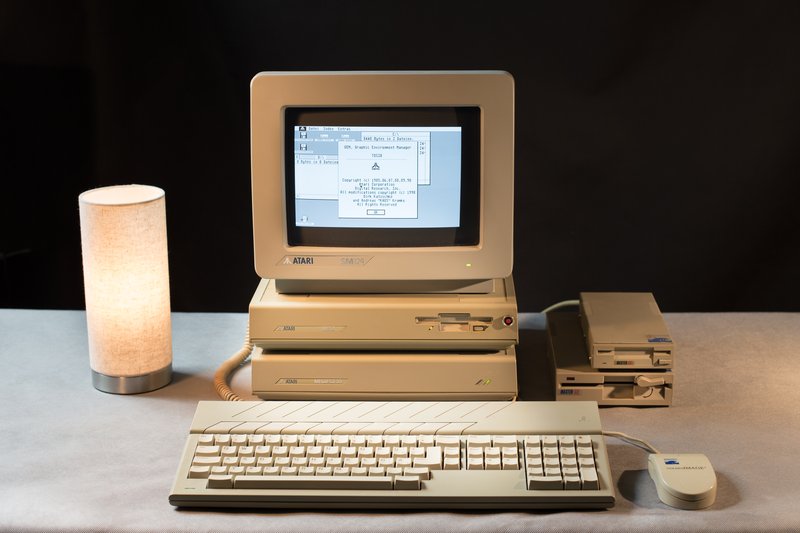
Hardware ports alone do not build an industry; the ST’s software did. Steinberg’s Cubase, launched on the ST in 1989, turned sequencing into a visual, arrange-with-the-mouse discipline whose descendants still dominate music production — the modern Cubase running in studios today traces its interface DNA directly to an ST screen. C-Lab’s Creator and Notator brought score notation and sequencing together and evolved, after C-Lab became Emagic, into Logic — the other giant of modern production, born on the Atari. Add Dr. T’s, Hybrid Arts and a generation of editors and librarian programs for specific synths, and the ST was not merely present in the studio workflow. For thousands of working musicians, it was the workflow.
Two sockets and a steady clock made the ST the first computer musicians trusted with a hit record — and the software written for it became the industry.
The roll of honour is usually told as anecdote, and the anecdotes are good: electronic acts built their live rigs around STs because the timing held and a spare machine cost little; studios kept an ST running for years after faster computers arrived because the MIDI rig simply worked; the machine’s second life in project studios extended well into the era when it was supposedly obsolete. The STE and Mega models served on, and in a delicious footnote, Atari’s own Falcon — a machine with serious audio ambitions — arrived just as the industry it had helped create was migrating to Macs and PCs running the ST’s own software’s descendants. The students had inherited the school.

Why the ST, and not the others
It is worth being precise about the advantage, because it was not raw power. Rivals could add MIDI through interfaces, and the Amiga had fine music software of its own in the tracker tradition — a different, sample-based culture that conquered game music and the demoscene rather than the pro studio. The ST won the studio on a compound: built-in ports at no extra cost, a stable timing reputation earned in the field, the monochrome monitor that made dense arrange pages legible for ten hours a day, and the early arrival of Cubase and Notator making the platform the one professionals recommended to each other. Industries standardise on ecosystems, not chips, and the ST had the ecosystem first.
There is a broader significance here that the ST’s story carries proudly. The same beige box that played Dungeon Master sequenced platinum records; the same machine parents bought for homework ran the synths on the records those children bought. The ST’s double life — games machine and professional instrument — was not a split identity but a single idea: an affordable, general computer, open to whatever its owners plugged into it. The MIDI ports are the purest expression of that idea ever fitted to a home micro.
On stage and in the rack
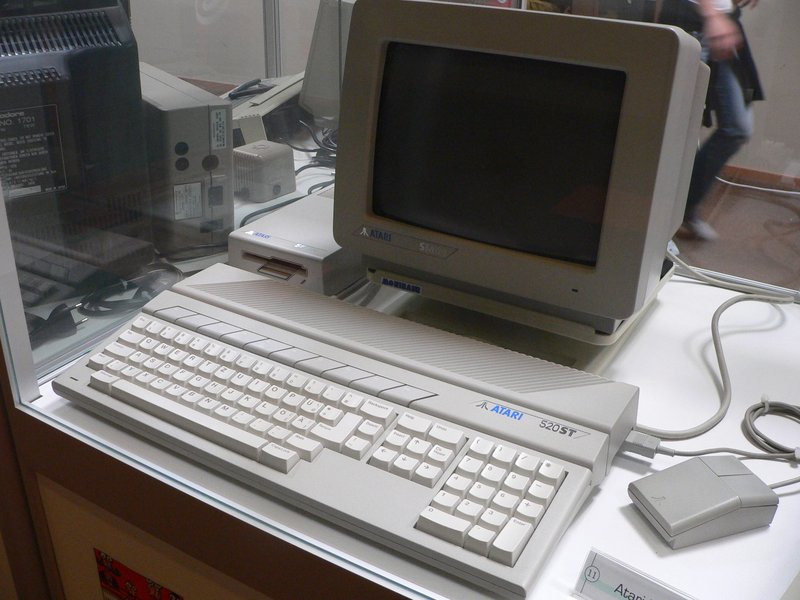
The studio was only half the conquest. On stage, the ST became the silent member of a generation of live electronic acts: a beige box at the side of the stage, blinking in time, driving racks of synthesisers through sets in clubs and arenas while the performers played the parts MIDI could not. Reliability was the whole requirement — a crashed sequencer is a stopped show — and the ST’s simple, ROM-based operating system and total absence of moving parts beyond a floppy drive made it a roadworthy brain in a way that later, more complex machines had to work to match. Touring rigs were built in pairs: one ST to run the show, one as the spare that the road crew prayed over less than the lighting desk.
In the project studio the machine democratised something subtler than recording: arrangement. A generation of bedroom producers — the musicians who would define the 90s dance explosion — learned composition as an editable, visible structure on an ST screen, copying Cubase arrange pages by hand-cranked disk swaps and discovering that a song could be built like a document. The economics were decisive. A used ST and a second-hand synth module put a working sequencing rig within reach of a teenager’s Saturday job, and the charts of the following decade are full of records whose first drafts scrolled across that green and white desktop. Revolutions in music usually arrive as new sounds. This one arrived as a new workflow, at a price a schoolkid could save for.
There is an irony the story should not skip: the ST won the studio partly by being unremarkable. It had no exotic audio hardware to program around, no custom chips demanding tribute — just a fast-enough processor, a stable operating system in ROM and two standard ports that behaved identically on every machine ever sold. Software houses could write one sequencer and know it would run, in time, on every ST in every studio. Platform consistency is a boring virtue that industries are built on, and Atari — the company of the VCS and a thousand variations — accidentally shipped the most consistent professional platform of its decade. The musicians who standardised on it were not buying glamour. They were buying the certainty that Tuesday’s session would open on Wednesday’s machine, and the ST never once charged them extra for it.
The ports’ long echo
Walk into a studio today and the ST itself is mostly retired, kept by loyalists and the occasional producer who swears by its timing for hardware synths — a living niche, serviced by the same retro community that keeps the games alive. But its real legacy is on the screens: the arrange window, the piano roll, the parts-based editing that Cubase and Logic taught the world began, for a generation of musicians, on an Atari. When we say the ST became the studio standard, the deepest sense is this: it taught the studio what a computer was for. Two sockets, one steady clock, and an industry followed.