
The games get the retrospectives, but for a large part of its life the Atari ST earned its desk space between nine and five. Sold from the start as “power without the price,” the ST became the working computer of an entire stratum the PC industry had priced out: small businesses, home offices, students, writers, print shops and musicians’ quieter colleagues in publishing. Its serious side was not a sideline. In Germany especially — the ST’s strongest market — the machine was a business standard, and its desktop publishing scene grew so capable that ST software ended up setting pages for professionals who had never loaded a game in their lives. This is the ST at work.
The foundation was a display. The ST’s high-resolution monochrome mode — 640 by 400, sharp and steady on the SM124 monitor — was a revelation at the price: text you could read all day, a desktop you could lay out like paper. GEM, the graphical environment bundled with the machine, gave the ST windows, menus and a mouse years before the PC world standardised on them, and TOS in ROM meant the machine booted in seconds into a working desktop. For word processing this combination was close to perfect, and the software roster proved it: 1st Word and its Plus successor became the default letters-and-essays tool of a generation of British owners; WordPerfect and Microsoft Write served the demanding; and Germany’s Signum and Tempus lines pushed ST word processing toward typesetting itself.

The DTP crown
Desktop publishing was the ST’s professional headline. Calamus, released by DMC in 1987, was a frame-based DTP system of genuine power — vector fonts, precise colour separation, output to imagesetters — that print shops adopted as a production tool and that, remarkably, lived on for decades through successor versions. Fleet Street Publisher and Timeworks brought page makeup to the home and small-office market, PageStream crossed formats with the Amiga world, and a thousand parish magazines, fanzines, menus and manuals were laid out on STs by people who had never been able to afford typesetting before. The laser printer on the desk, the ST driving it, the page coming out camera-ready: this was a revolution in who got to publish, and the ST was one of its standard engines.
The ST’s serious software did not merely imitate the professional world. For thousands of small publishers and businesses, it was the professional world.
Around the flagships grew the full office ecosystem: databases from the friendly (Superbase) to the programmable, spreadsheets led by VIP Professional and Germany’s strong local contenders, accounts packages for small firms, the ST’s own bundled Logo and BASIC for schools, and programming environments — Lattice C, HiSoft’s tools, GFA BASIC, a beloved dialect that powered half the bedroom software industry — that made the machine a developer’s platform as well as a user’s. Emulation even let it moonlight: Spectre and Magic Sac turned the ST into one of the fastest Macintoshes you could buy, a heresy Mac owners of the day confirmed with their wallets, while PC emulators served the DOS-curious. The serious ST was not one application. It was an economy.

Why businesses chose it
The reasons were unglamorous and decisive: price per useful work, that readable monochrome screen, instant-on reliability, and software that — because the German market demanded it — was localised, supported and serious about output quality. Print professionals cared about accurate typography and separations, and Calamus delivered them for a fraction of a Macintosh system’s cost. Schools cared about price and robustness. Writers cared about the keyboard, the quiet, and a word processor that opened before the kettle boiled. The ST’s professional users were not a cult; they were a customer base with budgets, and they renewed.
It also matters that the serious and playful machines were the same machine. The ST that laid out a newsletter on Tuesday played Speedball 2 on Friday, and that double life — exactly the life most modern computers lead — was novel enough in 1987 to be a selling point in itself. Atari’s “power without the price” was, on the evidence of the software catalogue, simply an accurate description of a working tool.
The German office
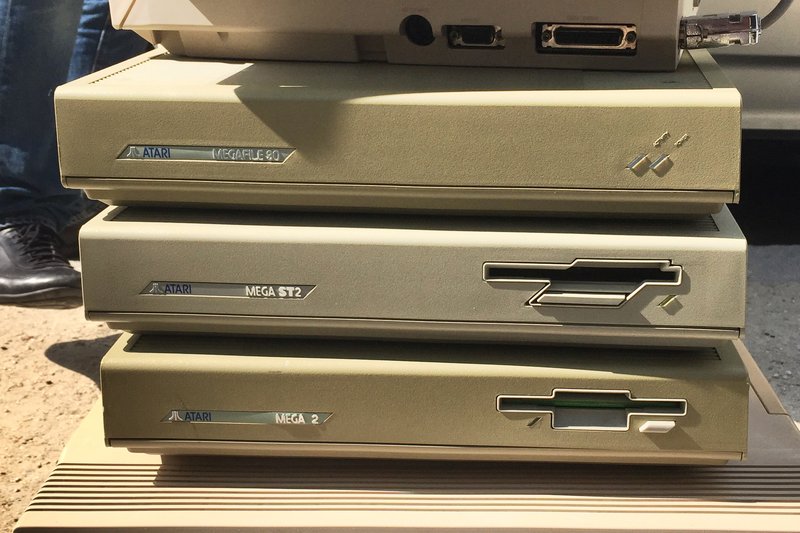
The ST’s professional story has a geography, and its capital is Germany. Atari’s German operation sold the machine explicitly as a business tool, the SM124’s crisp screen was marketed like office equipment, and German software houses answered with the deepest productivity catalogue on any home micro: typesetting-grade word processors, databases with real support contracts, CAD and technical drawing packages, and a DTP scene whose quality embarrassed platforms with ten times the budget. The Mega ST — separate keyboard, hard disk options, a case styled for a desk rather than a bedroom — was aimed squarely at this market, and in German print shops, architects’ offices and small publishers the configuration became so normal that “the Atari” meant a workstation first and a games machine second, an inversion of the British and American picture.
Education formed the second pillar. British and European schools adopted the ST for its price and its bundled languages; music departments, uniquely, could plug it straight into the keyboard lab. Computer clubs and training courses taught GFA BASIC and desktop publishing on rooms full of beige. The result is a generation of European professionals whose first serious computing — first spreadsheet, first laid-out page, first sequenced track — happened on an ST, and whose affection for the machine is not nostalgia for play but gratitude for a trade. That professional memory is why the ST’s serious software is preserved, documented and still demonstrated with such care: for its working users, these programs were not the machine’s other life. They were the machine.
The ecosystem’s unsung heroes were the utilities and the hardware they served: the hard drives that turned a floppy machine into a filing system, the scanner and digitiser boards that fed the DTP revolution its pictures, the accelerator and memory upgrades that print shops fitted instead of replacing the machine, and the shareware and public-domain libraries — vast, catalogued, mailed on disk — that put a tool for every small job within a stamp’s reach. A platform is not its flagship applications; it is the thousand small answers to small problems, and by that measure the serious ST was complete. Its owners could run a business, a magazine, a studio’s paperwork and a household from one beige box, and a great many did, for a decade, without ever feeling like second-class citizens of computing. That completeness — not any single program — is the serious ST’s real achievement.
The long working afterlife
Serious tools outlive fashion, and the ST’s did: Calamus documents were being produced commercially long after the ST ceased manufacture, Atari-based typesetting clung on in print corners of Europe into the PC’s total victory, and the retro community that preserves the ST today preserves its productivity software with the same care as its games — because for many owners, this was the machine’s real biography. When we celebrate the ST as a games and music computer, we tell two-thirds of the truth. The other third sits at a desk, in monochrome, setting type. It earned its place in this collection.