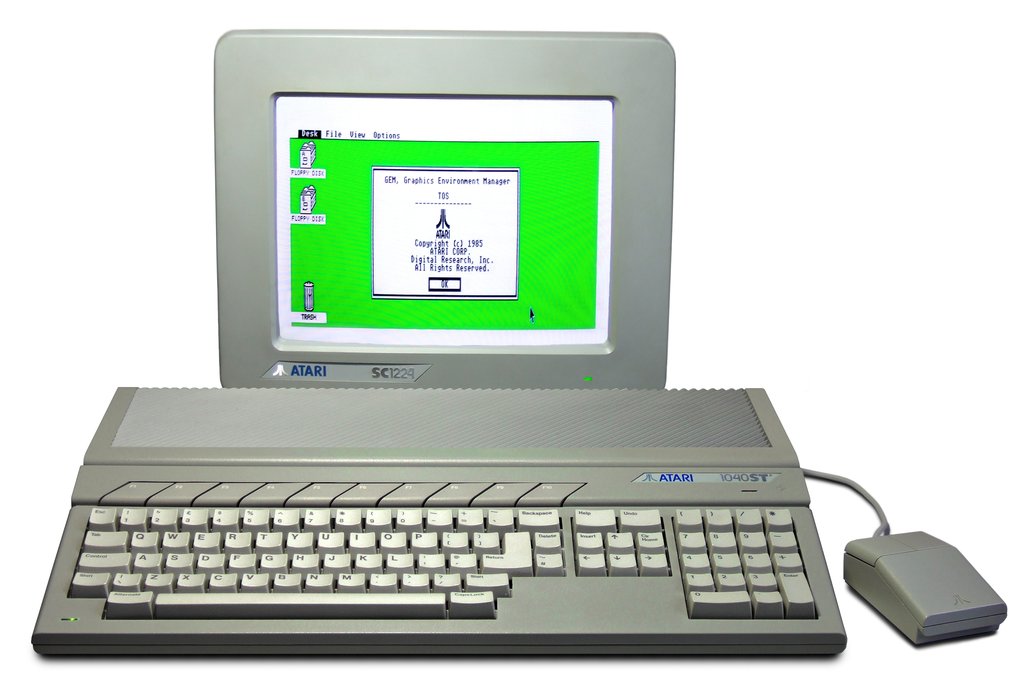
It was the defining argument of the 16-bit playground, the magazine letters page and the computer club: Atari ST or Commodore Amiga? Between 1985 and the early 1990s the two 68000 machines divided a generation of European computer owners into camps that defended their choice like a football club — and the remarkable thing, looking back with the passion cooled, is how right both sides were. The rivalry made both machines better, produced some of the era’s finest software twice over, and left a template for every format war since. This is the story of the split, told fairly: what each machine genuinely did better, why the argument never died, and how it finally ended.
The opening positions were set by price and timing. The Atari ST arrived first, in 1985, Jack Tramiel’s “Jackintosh” built in a sprint after his takeover of Atari: a 68000 at just under 8MHz, a crisp GUI in GEM, MIDI ports as standard, and a price that undercut everything with a mouse. The Amiga, Commodore’s machine, arrived with custom chips — Agnus, Denise, Paula — designed for graphics and sound: hardware sprites, a blitter, four-channel sampled audio at a time when the ST’s Yamaha YM2149 was a respectable but plain three-channel chip. On paper the Amiga was the games machine and the ST the value all-rounder. The market then spent five years complicating that sentence.

Where each machine honestly won
Sound and scrolling belonged, at their best, to the Amiga. Paula’s samples gave its games music the ST could not reproduce, and the blitter made smooth multi-directional scrolling with layered parallax a house style rather than a heroic effort. The ST’s counter-claims were real and specific. Its processor ran a fraction faster, and in 3D — flight simulators, Starglider 2, the polygon epics — ST versions routinely matched or edged their rivals. Its high-resolution monochrome mode, razor sharp and flicker-free, had no Amiga equivalent at the price and made the ST a genuine professional tool for desktop publishing and office work. And MIDI: two small ports on the side of the case that made the ST the default computer of the recording studio for a decade, a market the Amiga never seriously contested.
The rivalry’s secret is that it was never really about which machine was better. It was about which future you believed in: the computer as an instrument and tool, or the computer as a stage.
Games were the battlefield where the argument was loudest and the truth most interesting. Through the late 1980s most big titles were written ST-first or in parallel — Dungeon Master, the early Bitmap Brothers, the French adventures — because the ST’s installed base, especially in France and Germany, demanded it. As the Amiga’s gaming reputation compounded, development gravity shifted; by the early 1990s the Amiga was often the lead format and the ST the conversion, sometimes excellent — Turrican II’s ST edition is a famous act of defiance — sometimes visibly leaner. Publishers served both because Europe bought both, and that dual development is why the era’s library is so rich: almost every classic exists in two dialects, and comparing them remains a connoisseur’s sport.

The war in the wild
The rivalry had a culture all its own. Magazines ran comparison reviews with the solemnity of election coverage. The demoscene treated both machines as opposing national teams. Playground economics enforced loyalty: you owned the machine your discs, your friends and your pocket money were invested in, and swapping camps meant starting again — so almost nobody did, and the argument became identity. Beneath the noise, the machines’ owners were more alike than either admitted: same processor, same magazines, same games in different-coloured boxes, united against the consoles rising beneath them both.
How did it end? Not with a victor’s parade. The STE and the Amiga 500 Plus traded blows into the 90s; Atari’s Falcon and Commodore’s A1200 arrived in 1992 as answers to a question the market was already replacing with PCs and consoles. Both companies were gone from the computer business by the middle of the decade. The argument, however, never actually stopped — it moved to forums, to YouTube comparisons, to FPGA recreations that now run both machines from one board, where the old rivals sit side by side in a single menu, which feels like the peace treaty the playground never signed.

The same games, two dialects
The fairest evidence in the whole argument is the software both machines share, because the comparisons are controlled experiments. Dungeon Master was ST-first and defined the ST’s early legend; its rival edition arrived later to respectful nods. Xenon 2 and Speedball 2 gave the Amiga the soundtrack bragging rights while ST owners countered, correctly, that the games themselves were whole on their machine. Stunt Car Racer split households down the middle with no honest resolution. Falcon and the 3D shelf leaned ST; the parallax shooters leaned the other way; Turrican II’s ST conversion exists precisely because Factor 5 refused to concede the point. Read the dual-format catalogue whole and a pattern emerges that neither camp’s propaganda allowed: the machines were close enough that craft, not hardware, decided most contests — the better conversion was usually the one given more time, love or lead-format status.
There were also the exclusives that gave each camp its identity. The ST had the MIDI studio, the monochrome DTP office and a public-domain scene of remarkable depth; the Amiga had its video and demo mystique, its tracker musicians and, increasingly, the big gaming exclusives of the early 90s. Owners experienced these not as specifications but as cultures — different magazines’ heroes, different covermount treasures, different friends’ houses. That is why the argument outlived both companies. It was never a benchmark dispute. It was two tribes with genuinely different childhoods, conducted in the shared language of 68000.
Both camps also shared a common enemy they rarely acknowledged: time. By the time the STE and the A500 Plus were trading their last rounds, the argument’s terms — sprites, samples, clock speeds — were being dissolved by hardware that made the whole contest look like a dispute over fountain pens in the age of the word processor. The PC’s rise and the consoles’ 16-bit wave did not care which 68000 had won the playground. What survived the dissolution was not a verdict but a double archive: two complete libraries, two scenes, two professional legacies, preserved by two communities who discovered, in the preserving, how much of each other’s machine they had come to respect. The rivalry’s final form is collaboration — shared emulators, shared events, shared stewardship — and it suits both tribes better than either expected.
What the split left behind
Judge the rivalry by its fruits and it is one of the most productive feuds in technology. Competition kept prices low and standards high; dual development preserved the era’s games across two archives; and each machine’s strengths taught the other’s owners what to demand next. The ST camp was right that a computer should be an affordable, open, MIDI-speaking instrument for making things. The Amiga camp was right that custom hardware and sampled sound were the future of play. Modern computers, which are both of those things at once, are the argument’s true conclusion. A generation split in two, and computing got both halves.