
At a glance: Streets of Rage 2 · Game Gear · Sega / H.I.C., 1993 · Beat-’em-up · Score: 7.0/10
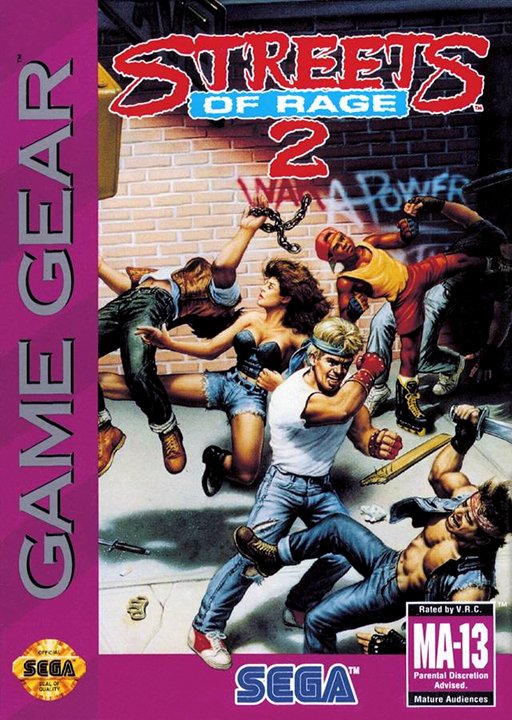
Streets of Rage 2 is the greatest beat-’em-up of the 16-bit era, which makes its 8-bit demake the most scrutinised cartridge in the Game Gear’s fighting library. Developed alongside the Master System version in 1993, it faces the impossible brief squarely: Yuzo Koshiro’s soundtrack, Mr X’s syndicate, eight stages of street war — on hardware a generation behind, through a screen the size of a matchbox. The result is a genuinely enjoyable brawler that keeps the sequel’s roster, moves and music in recognisable form, and a clear-eyed lesson in what demakes gain and lose. It is not the Mega Drive classic. It was never going to be. It is a good night’s fighting in its own right.
The story is the sequel’s own: a year after Mr X’s fall, Adam Hunter has been kidnapped, and Axel Stone, Blaze Fielding and Adam’s little brother Skate take to the streets — joined this time by wrestler Max Thunder on the bigger machines. On the Game Gear, the playable roster is Axel, Blaze and Skate; Max, the Mega Drive sequel’s beloved heavyweight, does not fit the 8-bit programme and is absent, the version’s most mourned cut. The stages retrace the sequel’s geography — downtown, the bridge, the amusement park, the stadium, the factory, Mr X’s island — compressed into shorter, punchier gauntlets.
Fighting on a small screen
The combat keeps the sequel’s grammar: jab combos, throws, the back attack, the blitz moves, and each fighter’s special — Axel’s Grand Upper, Blaze’s fireball-kick, Skate’s rollerblading rush — all present and all useful. Two buttons do the work of the original’s three with the usual 8-bit economy, and the feel is respectable: hits land with a thock, enemies flash and fall, weapons — knives, pipes, swords — drop into the brawl as they should. Enemy variety is trimmed but recognisable, from the signal-whipping Galsias and Donovans up through the biker punks, ninjas and the great brutes of the later stages, with bosses including the bar-owning Barbon and the jetpack nuisance Jet in adapted form.

The Game Gear version differs from its Master System sibling in the two ways this library always differs. The view is cropped tighter, which in a brawler means enemies arrive with less warning — the game compensates with slightly gentler waves, but off-screen lunges still cheap-shot you more often than they should. And the colour is richer: the sunset bridge and neon downtown glow on the handheld’s palette in a way the Master System cannot match. Two-player co-operative play survives via the Gear-to-Gear cable, and it transforms the cartridge — linked SoR2 is the version’s party trick and its best self, restoring the co-op soul the genre lives on. Solo players get the harder sell.
Koshiro, through a keyhole
The soundtrack is the demake’s bravest claim. Koshiro’s Mega Drive score — Go Straight, Never Return Alive, the whole house-inflected canon — is rearranged for the 8-bit sound chip, and the arrangements are skilful: basslines simplified but present, melodies intact, the mood unmistakably SoR. Through the Game Gear’s little speaker it is a shadow; through headphones it is a small marvel, and it carries the stages’ atmosphere more than the graphics can alone. Sound effects are chunky, if occasionally repetitive, and the overall audio package is the best argument that this demake was made by people who cared.
Max is missing, the screen is tight, the waves are thinner — and yet, linked with a friend, it still feels like Streets of Rage.
The charge sheet, honestly kept: the cropped view costs fairness; the enemy count per screen is halved, which thins the glorious crowd-control that defines the original; the difficulty is uneven, sleepy early and suddenly spiteful around the factory; and the ending stages compress the original’s best set pieces into echoes. The first Streets of Rage, also on Game Gear, arguably adapts its simpler source more completely. This sequel reaches higher and lands lower — but it reaches for a much greater game.
Its place in the library
On the Game Gear, credible brawlers are scarce — this is not a genre the 8-bit handhelds feasted on — and SoR2 stands near the top of a short list by pedigree and execution alike. For Mega Drive veterans it is a fascinating alternate take, worth a playthrough to hear Koshiro’s arrangements and see the redesign choices. For Game Gear natives in 1993, it was something better: the biggest name in fighting, in colour, in co-op, in their hands.

The ladder of thugs
The campaign’s pacing, compressed as it is, still understands the original’s dramatic shape. The early streets teach the crowd; the bridge at sunset — the demake’s visual high point, all orange sky and railings — introduces the bikers’ menace; the amusement park and stadium vary the arenas with the series’ trademark confidence; and the factory and island finale stack the brutes in combinations that will spend a careless player’s continues. Enemy AI is the 8-bit usual — aggression by numbers rather than cunning — but the weapons economy keeps fights fresh: a dropped pipe changes a screen’s whole geometry of risk, exactly as it should.
And the demake sits in an honourable lineage. The 8-bit Streets of Rage games were the series’ ambassadors to the enormous Master System and Game Gear audience of Europe, where for many players these were not conversions but the versions — the ones owned, finished, and fought over at link-cable length. Judged by the standard of what they were for, they succeeded entirely. Judged as time capsules of how a masterpiece gets translated across a hardware generation, they remain two of the most instructive cartridges Sega ever shipped.
Skate deserves his paragraph, because the demake is his finest hour in some respects: the little brother on roller skates is the roster’s fastest, most technical fighter, and on the smaller screens his speed tells more than Axel’s power does. Players discovering the sequel through this version often main him for a campaign and carry the loyalty back to the 16-bit game. It is a small example of a demake doing what demakes at their best can do — not merely shrinking the original, but re-lighting it, so that even veterans see a familiar game from a new angle.
Longevity, stated plainly: the campaign runs a couple of hours, the duel and co-op modes extend it indefinitely for the linked and the sociable, and the score-attack pull of a good brawler does the rest. As a solo cartridge it is a good evening. As a pair of cartridges and a cable, it was a social network. The hardware made the difference, and the hardware, unusually, was up to it.
Verdict
Streets of Rage 2 on Game Gear is a respectable, good-hearted demake of a masterpiece: the moves, the music and three of the four heroes survive, the link-cable co-op restores its soul, and the cropped screen and thinned crowds mark its honest limits. Play it as its own 8-bit brawler and it entertains; measure it against the Mega Drive and nothing could survive the comparison. On this system’s shelf, it earns its place.