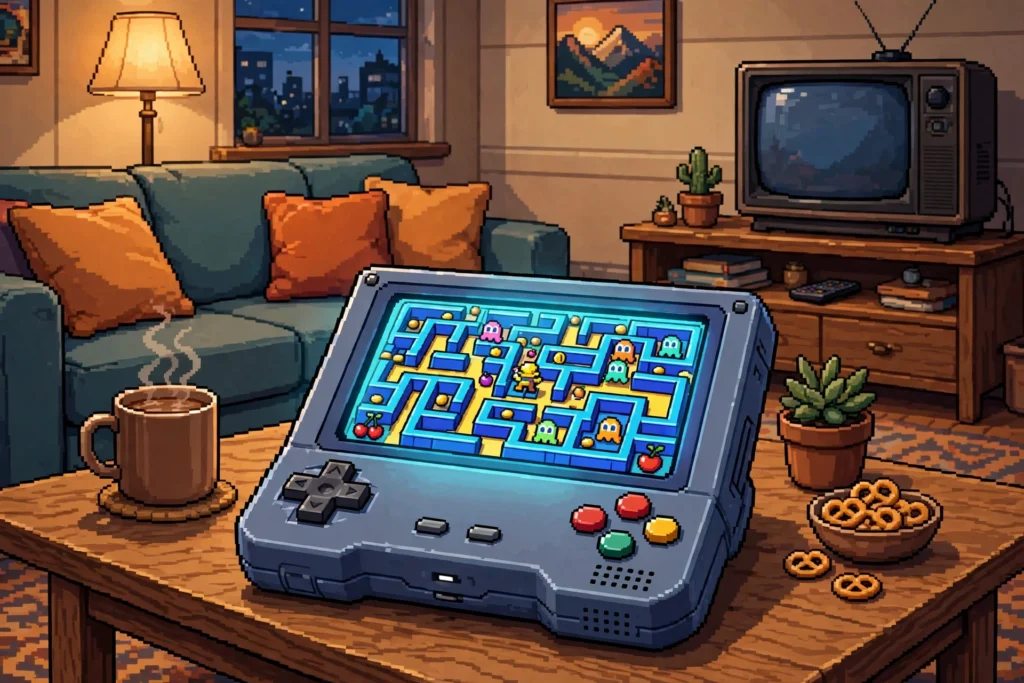
My Arcade has spent years selling us the arcade in miniature — cute little cabinets for the desk, pocket-sized handhelds for the stocking. This week the company swung the other way. Preorders opened on October 26 at GameStop in the US and EB Games Canada for the Gamestation Retro Go, a $199.99 handheld with an 8-inch screen, more than 200 built-in licensed games, and ambitions well beyond the novelty shelf. One honest note on timing before anything else: GameStop’s listing shows a release date of October 31 — today — but My Arcade’s own announcement only promises the machine is “launching this holiday season.” Retailer dates are soft dates, so treat today as the start of the preorder window, not a guaranteed in-hand day. What matters is what My Arcade is attempting here: a handheld that wants to be your living-room arcade, priced like it means it.

A handheld that thinks it’s a console
Start with the size, because everything about this machine flows from it. An 8-inch high-resolution display is enormous by handheld standards — bigger than a Switch screen, in the territory of a small tablet. This is not a device that disappears into a jacket pocket. It’s a device you prop on the coffee table, hold with both hands on the couch, or carry in a bag like you mean it. My Arcade is betting that retro games deserve to be seen, and on that point, honestly, they’re right. Pac-Man’s maze and Galaga’s formations were designed for upright arcade monitors you stood in front of. Shrinking them onto a 3-inch novelty screen has always been a compromise dressed up as charm.
Then there’s the second half of the pitch: plug it into the TV over HDMI, hand a controller to someone else, and it stops being a handheld at all. Two-player support (extra controllers sold separately, naturally) plus the big screen in your hands makes this a hybrid in spirit — the same play-anywhere logic that sold a generation on the Switch, applied to a fixed library of classics. The full spec sheet, for the record:
- Display: 8-inch high-resolution screen
- Library: 200+ built-in licensed games from Bandai Namco, Capcom, Jaleco and Piko Interactive
- Battery: rechargeable, rated at roughly 4–5 hours of play
- Controls: patented SmartGlow technology that lights up the buttons each game actually uses
- Extras: built-in Wi-Fi for updates, game save functionality, HDMI output, 2-player support with additional controllers
- Price: $199.99 USD — item DGUNL-7154, part of the Gamestation Retro collection first unveiled at CES
Context matters here, too. The Retro Go isn’t a one-off experiment — it’s the flagship of the Gamestation Retro collection My Arcade first unveiled at CES, sold under the tagline “Legendary Games Unite,” and it marks a deliberate move upmarket for a brand that made its name at the impulse-buy end of the games aisle. A company doesn’t jump from $30 novelties to a $200 flagship unless it believes the audience has grown up with it — that the people who bought the cute mini cabinet for their desk now have living rooms, families, and a bit more to spend. This machine is that belief made plastic. Everything about it, from the licensed library to the TV-out to the light-up controls meant for beginners, is designed to cross the gap between the retro hobbyist and everyone they live with.
The library is the real headline
Specs are easy. Licensing is hard, and licensing is where the Retro Go separates itself from the grey-market handhelds stuffed with ROMs of dubious origin. This library is legitimate, and the two anchor tenants are heavyweights. From Bandai Namco you get the golden-age arcade canon: Pac-Man, Galaga, Dig Dug, Mappy and Rally-X — the games that built the arcade business in the first place.


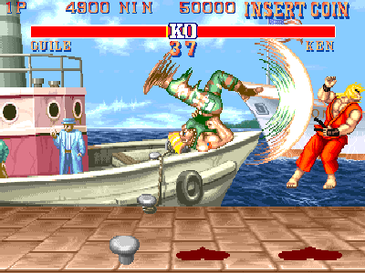
The Capcom side is arguably even stronger. Street Fighter II — six versions of it, per My Arcade — plus Mega Man, Final Fight, Strider, Bionic Commando and 1942. That’s not filler; that’s the backbone of early-90s arcade and console culture in one list. Street Fighter II alone is a living-room argument waiting to happen, which is exactly where a two-player HDMI-out machine earns its keep.

Rounding out the 200-plus are Jaleco and Piko Interactive titles — the deep cuts. This is where these compilations live or die for the already-converted. Nobody buys a machine like this for the Piko catalogue, but everybody who’s played the headliners a thousand times eventually wanders into the bonus section at midnight, and that’s where the pleasant surprises hide. The honest summary: the top twenty games here are unimpeachable, the next fifty are solid, and the long tail is there to be explored rather than bragged about. That’s a healthier shape than most built-in libraries manage.
SmartGlow is the one genuinely new idea
Buried in the feature list is the thing that might actually justify this machine’s existence: SmartGlow. The controls light up to show you which buttons the game you’re playing actually uses. It sounds like a gimmick until you watch a newcomer pick up an unfamiliar arcade game — a kid, a partner, a parent at Christmas — and spend their first credit figuring out which of six buttons does anything. Arcade veterans forget how much of this hobby’s knowledge is invisible: which games use two buttons, which use four, which stick movements matter. Lighting the answer is a small, thoughtful piece of design aimed squarely at people who didn’t grow up feeding quarters into these cabinets. For a machine whose natural home is a family living room, that might be the smartest feature on the box.
The $200 question
Now the hard part. Two hundred dollars is no longer impulse-buy territory — it’s a statement, and this week it’s a crowded statement. The Evercade Nexus launched at the same $199.99, with a cartridge ecosystem, a growing licensed library, and a devoted community behind it. Against the Nexus, the Retro Go’s pitch is simplicity: no cartridges to collect, no ecosystem to buy into, everything already inside, on a much bigger screen. Against MiSTer and the FPGA crowd, the Retro Go loses on accuracy, flexibility and depth — and wins, decisively, on being a thing you can buy at GameStop, wrap, and hand to someone who has never heard the phrase “core” in their life. And against My Arcade’s own cheaper mini cabinets and plug-and-plays, the Retro Go has to argue that a bigger screen, a battery, HDMI out and two hundred games are worth several times the price of the novelties — which, if you actually play the thing weekly, they probably are.
Two hundred dollars is where retro gadgets stop being stocking stuffers and start being purchases you have to justify. The Retro Go’s justification is simple: it’s the one you’d actually hand to somebody else.
Two smaller features deserve credit before we get to the verdict, because they’re the kind of thing cheaper machines routinely skip. Game saves sound like nothing in 2026, but in the plug-and-play world they’re still not guaranteed, and for the console side of this library — a Mega Man run, a long Jaleco RPG-adjacent session — the ability to stop and resume is the difference between a library you sample and a library you finish. And built-in Wi-Fi for updates quietly answers the oldest complaint about fixed-library devices: the day-one firmware is not the final word. Whether My Arcade uses that lifeline well is a question for next year, but shipping the pipe at all puts the Retro Go in the modern-device column rather than the disposable-gadget one. The 4–5 hour battery is the honest compromise in the package — fine for an evening on the couch near an outlet, less fine for a long flight — but with HDMI out and an AC adapter in the box, this machine was clearly designed to live near a TV anyway.
Who is this actually for?
Not the FPGA faithful — they made their choice, and it’s a good one. Not the bargain hunters, either; cheaper ways to play Pac-Man exist by the dozen. The Retro Go is for the household that wants one retro machine, bought once, that everybody in the room can use without a tutorial: the parent who grew up on Galaga, the kid meeting Dig Dug for the first time, the friend who talks big about Street Fighter II and needs to be humbled on the TV. It’s a gift-shaped, couch-shaped, no-assembly-required arcade. Whether it fully lands depends on things preorders can’t tell us — screen quality in person, emulation accuracy, how those glowing controls feel in hour three. We’ll judge it properly when it’s in hand. But as a statement of intent from a company that built its name on miniatures, the Gamestation Retro Go is aiming at exactly the right target: out of the pocket, off the desk, and back into the living room where these games always belonged.