
At a glance: S.T.U.N. Runner · Atari Lynx · Tengen, 1991 · Futuristic racer · Score: 8.5/10
The arcade S.T.U.N. Runner was a sit-down cabinet shaped like the vehicle it imagined: a rocket-powered bobsled hurtling through tubes and tunnels at the far end of the 21st century, blowing up traffic at 300 miles per hour. It was exactly the sort of game that was not supposed to fit on a handheld — all speed, all scaling, all spectacle. Tengen’s 1991 Lynx version is therefore one of the porting miracles of the 8-bit era: the tunnels, the speed and the structure survive, and what emerges is not a souvenir of the arcade game but the arcade game itself, running on a machine that cost less than the cabinet’s seat. Of all the Lynx’s arcade conversions, this is the one that makes converts.
Twenty-four levels of tunnel
The formula is distilled velocity. Your sled accelerates automatically through a sequence of courses — open tracks, enclosed tubes, half-pipes of neon and wire — and your jobs are three: steer, shoot, and survive. Enemy craft clog the racing line and can be shot or, more profitably, shouldered aside at the cost of speed. Stars scattered along the track are the game’s currency of mastery: collect a full screen’s worth and you earn the Shockwave, a screen-clearing smart bomb that the late game will make you grateful for. Each level is a sprint against the clock with checkpoints, and the campaign builds toward the Ultimate Challenge, a final gauntlet that tests everything the previous levels taught separately.
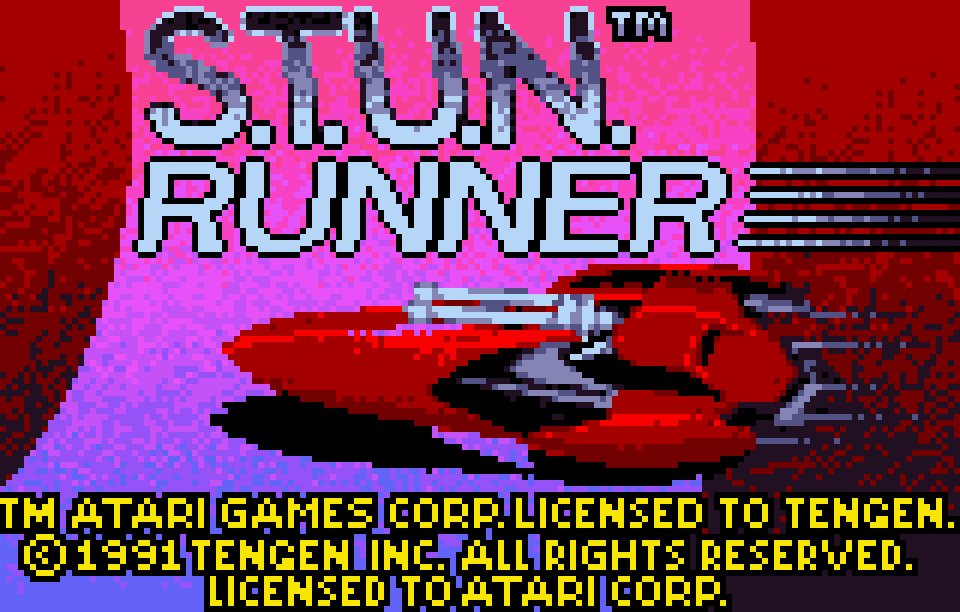
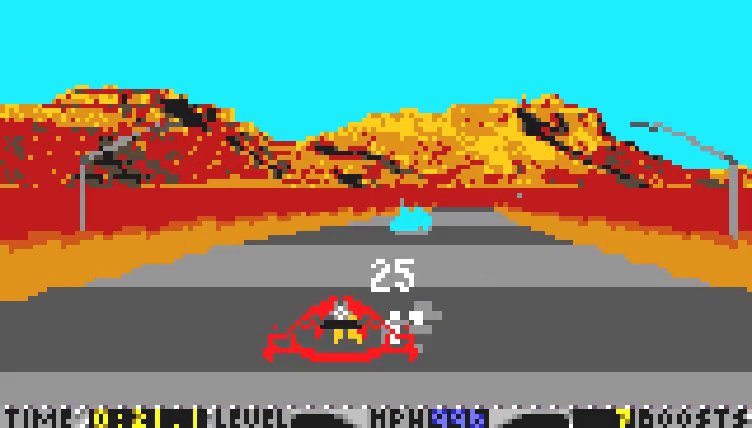
Speed is the headline and the Lynx delivers it the only way 1991 allowed: through the Suzy chip’s scaling, the same trick Blue Lightning flew on, here pointed down a tube. Trackside objects swell toward you, the tunnel walls band past in coloured strata, enemy sleds grow from specks to obstacles with genuine menace, and the frame rate holds its nerve at exactly the moments lesser ports would dissolve. Is it the arcade’s smooth polygon world? No — the arcade original used Atari’s Hard Drivin’ hardware lineage to draw true 3D. It is an interpretation in sprites, and a brilliant one, that preserves the only thing that mattered: the sensation of barely controlled velocity.
Most ports ask you to forgive them. S.T.U.N. Runner on the Lynx asks you to keep up.
Driving the sled
The controls deserve their praise. Steering is analogue in spirit if digital in fact — the sled banks and carves with a responsiveness that makes threading a convoy at full tilt feel earned — and the firing is generous in the way an overwhelmed player needs. Boost pads reward the brave line. The difficulty is pure arcade: early levels teach, middle levels test, late levels conduct an audit. Two continues’ worth of mistakes is all the generosity on offer, and the game is better for its strictness; a speed game without consequences is a screensaver. Lynx-specific pleasures include the flipped-screen option the hardware made famous — the machine was built to be played left- or right-handed, and the sled doesn’t care which you are.

The learning curve of a rocket sled
The campaign’s structure deserves a closer look, because it is smarter than a level list. The early courses are corridors with opinions: they teach braking by placing enemies where speed kills, teach the star economy by laying full sets just off the racing line, and teach the Shockwave’s value by building one ambush you cannot shoot your way out of. By the middle levels the game stops teaching and starts combining — tube sections into open straights, traffic patterns that force a choice between stars and safety — and the clock, always the clock, converts every hesitation into arithmetic. It is the arcade school of design at its best: the tutorial is the game, played at rising tempo, and the Lynx version preserves the syllabus intact.
There is also a purity to its scoring that modern racers have lost. No unlocks, no garage, no currency but stars and seconds. Your reward for finishing a level faster is a harder level, and your reward for mastering the whole campaign is the knowledge that you did — plus a score with your name on it, argued over in exactly the way Tengen’s designers intended. On a handheld in 1991, that purity was the point: the arcade, entire, was in your school bag.
What the port leaves behind
Honesty requires the ledger’s other column. The draw distance is short, and at maximum speed the pop-in of trackside detail is visible where the arcade drew to the horizon. The colour banding of the tunnels, mesmerising in motion, repeats across levels more than the coin-op’s varied environments did. Sound is the port’s weakest suit: the Lynx’s channels do honest work, but the cabinet’s sampled announcer and thunder are reduced to barks and buzzes. And the late game’s difficulty, faithfully preserved, will end most players’ campaigns several levels short of the Ultimate Challenge — there is no password system to save the frustrated, because the arcade had none to give.
Its place in the library
Set beside Blue Lightning and Gates of Zendocon, S.T.U.N. Runner completes the Lynx’s scaling trilogy — the three cartridges that justified the Suzy chip’s existence. Where Blue Lightning was a launch-window original, this is a conversion that arrived two years later and proved the trick had not been a launch trick at all: the hardware’s party piece could be played by other people’s games, at full tempo, without apology. That is what a mature port looks like, and it is why collectors who own the arcade board still keep the Lynx cartridge charged.
For the collector, a footnote: S.T.U.N. Runner is one of those Lynx cartridges whose reputation among owners runs far ahead of its price, because the people who bought it in 1991 tended to keep it. Copies surface regularly, usually worn in the honourable way — this was a game that lived in machines, not on shelves. A clean copy is a small prize.
And for the sceptic who has heard the Lynx described as a battery-hungry novelty: put this cartridge in first. Thirty seconds of tunnel at full speed explains the machine’s entire design philosophy — colour, scale, speed, nerve — more persuasively than any retrospective, including this one.
It is also, quietly, one of the best-sounding Lynx racers through headphones — the engine note sits under everything like a held breath, and the stereo of a Lynx II gives the tunnels a width the little screen cannot. Play it loud, play it linked to nothing but the road ahead, and remember that in 1991 this was science fiction you could hold.
Speed, in the end, is a promise a port either keeps or breaks in the first ten seconds. This one keeps it for twenty-four levels straight.
Twenty-four levels, one sled, no brakes worth mentioning: the purest hit of velocity the handheld era ever bottled, sealed and sold.
Verdict
A landmark conversion — fast, faithful and defiantly playable, the arcade’s speed with the rough edges of 1991 handheld hardware worn proudly. 8.5/10. If your Lynx library has a racing shelf, this is its top step.