How do you follow one of the most acclaimed games ever made? Nintendo’s answer, in 2010, was gloriously unpretentious: you make another one, denser, harder and even more inventive, and you strip away almost everything that is not the game itself. Super Mario Galaxy 2 is not interested in topping its predecessor’s story or scale. It is interested in topping its predecessor’s levels — one idea at a time, for hour after hour, until you are not sure the well can possibly have anything left in it. It always does.
At a glance: Super Mario Galaxy 2 · Nintendo EAD Tokyo · Wii · 2010 · 3D platformer · Players: 1 (with second-player assist)
Less storybook, more toybox
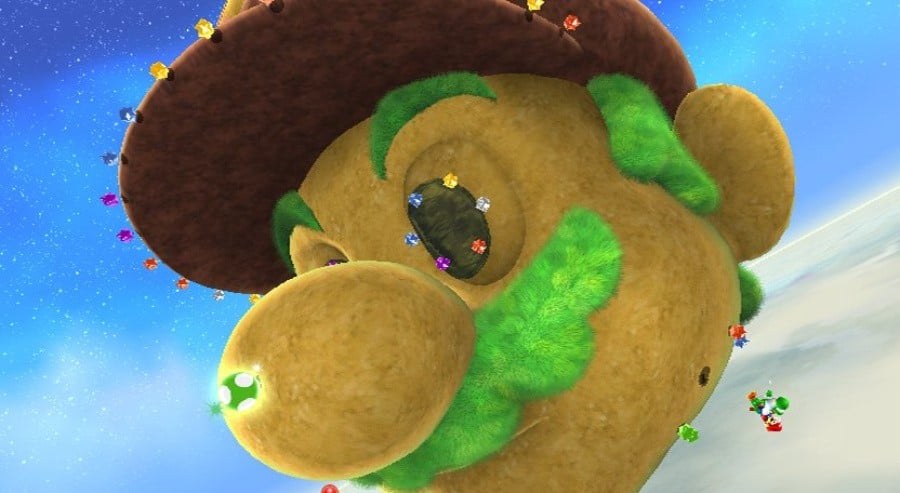
The framing could hardly be lighter. Bowser, now enormous, kidnaps Peach again; Mario gives chase across the galaxies from Starship Mario, a cheerful planetoid shaped like his own head that serves as a compact hub. Rosalina’s melancholy storybook is gone, the observatory’s gentle melancholy replaced by a map screen and momentum. Some players missed the first game’s quiet heart, and fairly — Galaxy 2 is a colder production in that one respect. But the trade is deliberate, and what you get in exchange is pace. Galaxy 2 gets you playing sooner, moves you between ideas faster, and trusts the level design to provide all the wonder the cutscenes used to carry. It is a confident bet, and the levels are more than good enough to cover it.
Yoshi changes everything — again
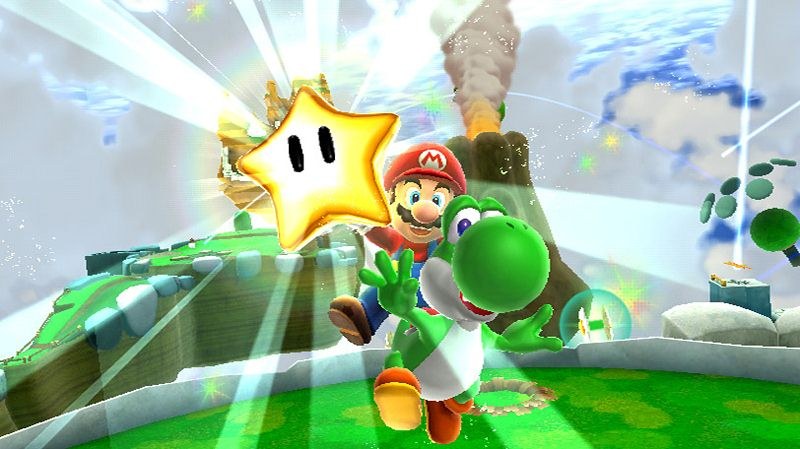
The headline addition is Yoshi, and he is no cameo. Riding Yoshi rewires Mario’s platforming: the flutter jump forgives and extends leaps, the tongue grabs distant objects, swings Mario from pegs and devours enemies whole, and fruit power-ups turn Yoshi himself into a vehicle — a speed-bursting Dash Pepper runner, a floating Blimp Fruit balloon, a Bulb Berry lantern revealing invisible paths in the dark. Levels built around Yoshi are not Mario levels with a dinosaur sprinkled on top; they are a second moveset with its own design language, and the game alternates between the two fluently.

Mario’s own new toys are just as strong. The Cloud Flower lets you manufacture your own platforms mid-air — three little clouds that turn empty space into a route, and turn wind into a level mechanic. The Rock Mushroom turns Mario into a rolling boulder of joyful destruction, all momentum and smashed scenery. The Spin Drill lets you tunnel clean through planets and out the other side, a trick so satisfying the game wisely builds several worlds around it. Throw in the return of the first game’s comets, a tougher spread of challenges, and the infamous Green Stars — a whole second campaign of hidden, deviously placed collectibles that remix every level for expert players — and you have one of the most content-rich platformers Nintendo has ever shipped. The final Green Star challenge is, by wide agreement, among the hardest tests in any Mario game.
The density is the point
What really separates Galaxy 2 from almost every other sequel is its discipline. The development team famously began with leftover and cut ideas from the first game, and the ethic shows: nothing here is filler. A typical galaxy contains a handful of stars, and nearly every star is built around a single mechanic taken seriously — a gravity-flipping corridor, a slide, a rhythm of vanishing platforms, a boss rematch with a twist. Where the first Galaxy sometimes let a pretty planet carry a simple task, Galaxy 2 keeps asking more of you. It is the harder, more demanding game, aimed unashamedly at players who finished the original and wanted the training wheels off. Newcomers are not excluded — a guiding assist feature offers help after repeated failures — but the game’s soul is in its challenge.

Technically it is the first game refined rather than reinvented: the same glorious art direction, the same orchestral richness, now with an even broader musical palette that happily quotes themes from across Mario history. A few throwback stages reimagine beloved locations from earlier 3D Mario games in Galaxy’s gravity-bending language — nostalgia deployed as design, not decoration. On the Wii’s modest hardware it remains, like its predecessor, an argument that art direction beats horsepower every time.
Built for the second playthrough — and the seventh
Galaxy 2’s structure quietly fixes the one pacing complaint levelled at its predecessor. Starship Mario and the world-map layout cut the travel between ideas to seconds; galaxies are shorter, denser and more clearly themed, and the game is constantly honest with you about what a star will demand — a comet medal tucked into every galaxy’s first mission adds a collectible hunt that rewards exploration without ever gating progress behind it. The result is a game that respects momentum. Sessions stretch because “one more star” is always five inventive minutes away, never because a hub made you walk.
Then there is the endgame, which is where Galaxy 2 quietly becomes legendary. Finishing the story is roughly the halfway point. The Green Stars that follow are hidden in every galaxy, placed with a level designer’s cruelty and a prankster’s humour — floating just past the edge of a jump you would never normally attempt, hidden behind scenery you have run past a dozen times. Hunting them re-teaches you every level from a new angle, and the reward for finding them all is a final galaxy containing what many players consider the single hardest challenge in the entire Mario series: a no-checkpoint gauntlet that demands mastery of everything the game has taught you, back to back, without a mistake. That a Wii platformer from 2010 still anchors “hardest Mario level” arguments is the surest measure of how much game is packed onto this disc. Galaxy 2 did not just add content to a masterpiece — it trusted its players to be better than the first game required, and built a monument to that trust.
The honest caveats
Galaxy 2’s focus costs it a little soul. The hub is functional rather than magical, the story is a shrug, and players who fell for Rosalina and the Observatory will find this a more clinical production. The difficulty curve, while fair, is genuinely steep in the late game, and the Green Star hunt will defeat or bore as many players as it thrills. Structurally, too, it cannot surprise you the way the first game did — spherical gravity is a known joy now, not a revelation. If you are choosing only one Galaxy, the choice is real: the first for wonder, the second for play.
Verdict
Super Mario Galaxy 2 is the rare sequel that justifies itself entirely through the quality and quantity of its ideas. It is tighter, tougher and more relentlessly inventive than a game that was already a masterpiece — less a storybook, more a masterclass. As a pair, the two Galaxy games are the Wii’s crowning achievement; as a pure platforming challenge, this second trip to the stars might just be the better game.
One last word for collectors and the curious: Galaxy 2 has remained a Wii exclusive in its original form for most of its life, bundled late in the console’s run with a soundtrack CD in some territories, and its disc is the definitive way to experience the pointer-and-nunchuk control scheme its levels were built around. However you come to it, come ready to be tested.
Score: 9.5/10