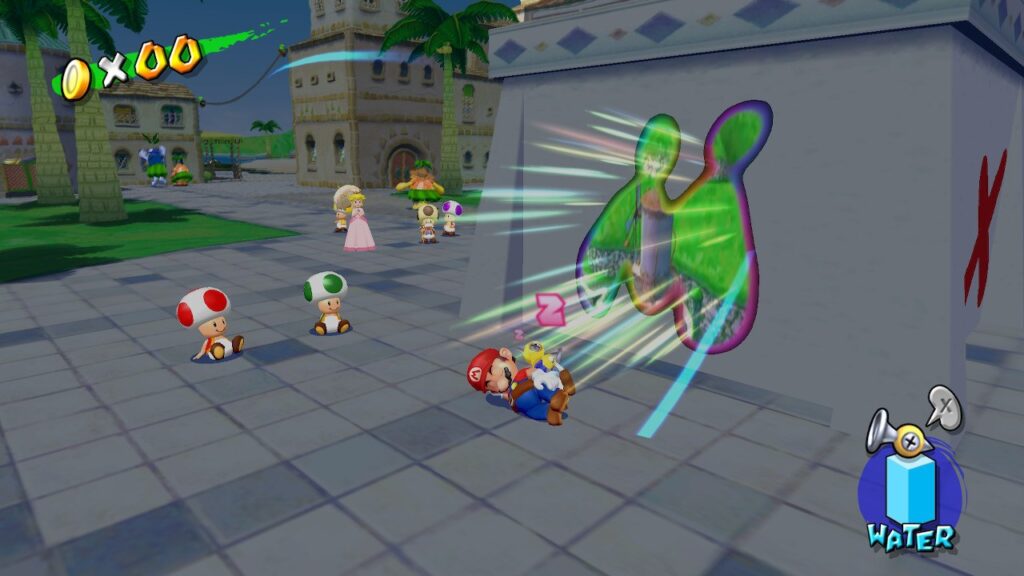
At a glance: Super Mario Sunshine · GameCube · Nintendo EAD, 2002 · 3D platformer · Score: 8.5/10
No 3D Mario divides a room like Sunshine. Released in the summer of 2002 as the GameCube’s flagship Mario adventure, it swapped the variety-box structure of Super Mario 64 for a single, sweltering idea: one tropical island, one water cannon, one long holiday gone wrong. Mario arrives on Isle Delfino for a vacation, is framed for covering the island in graffiti-like goop, and is sentenced to clean the whole place up with F.L.U.D.D., a talking water-spraying backpack designed by Professor E. Gadd. Half the series’ fans call it the most characterful Mario ever made. The other half call it the messiest. A fair review, played on the original GameCube disc, has to hold both truths at once — and still conclude that when Sunshine is good, it is some of the best platforming Nintendo has ever shipped.
F.L.U.D.D. changes everything
The water pack is one of Nintendo’s great controller inventions. In its standard nozzle it is a cleaning tool and a weapon; as the Hover Nozzle it grants a forgiving, joyful correction to any jump, letting Nintendo design platforms for spectacle rather than safety; the Rocket Nozzle turns verticality into a firework; the Turbo Nozzle converts Mario into a speedboat across Delfino’s harbour. Spraying water sounds like a gimmick until you are surfing a blooper, washing a giant eel’s teeth, or managing your tank as a genuine resource — refill points are everywhere, but the rhythm of spray, hover, refill shapes every level. The GameCube’s analogue triggers, with their two-stage click, were practically designed for it: a light press to spray while running, a full click to plant Mario’s feet and aim. It remains the most expressive movement modifier in the series.
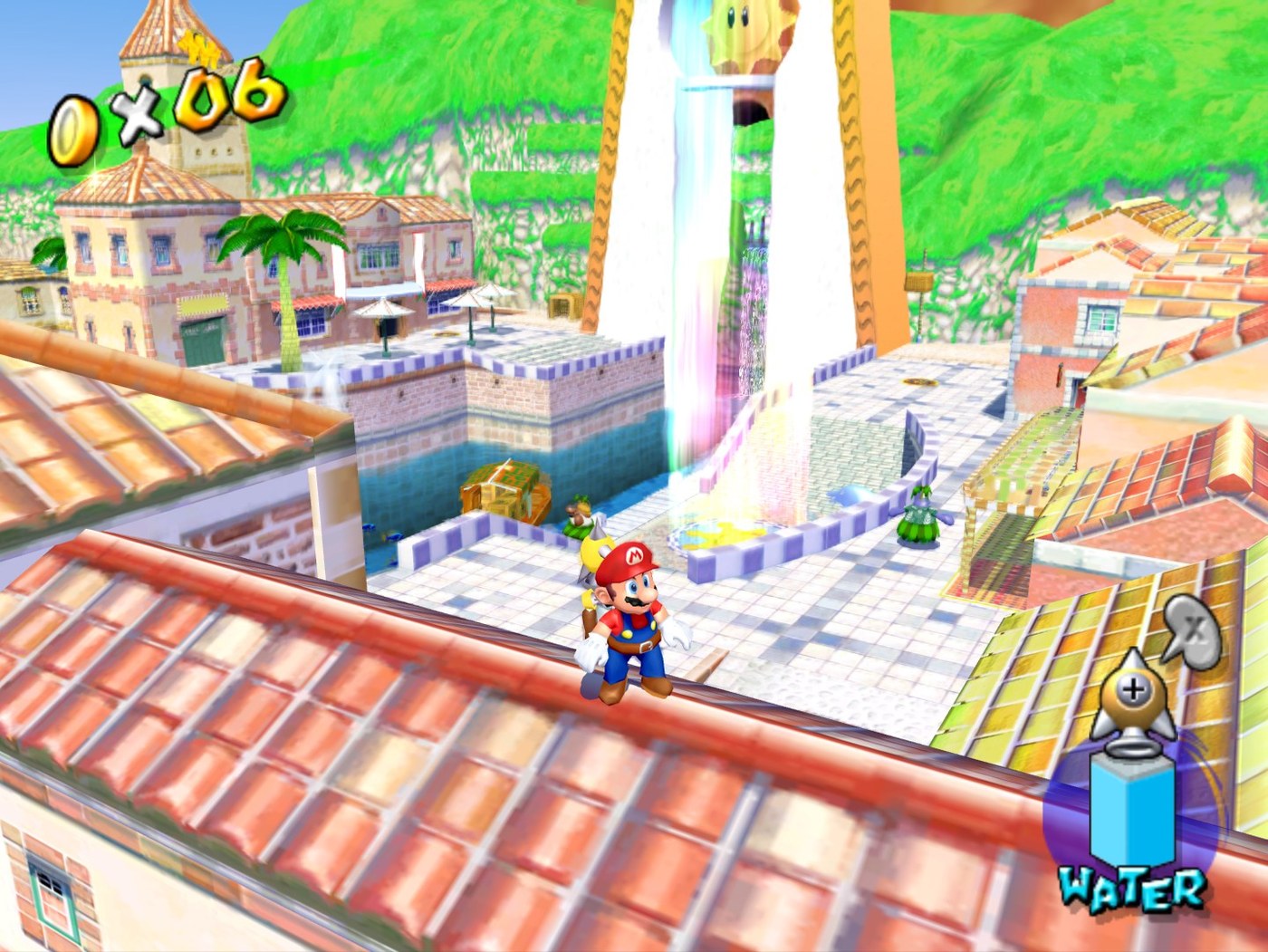
Isle Delfino itself is the other triumph. Rather than disconnected worlds, Sunshine builds one coherent place: Delfino Plaza as the hub, with Bianco Hills’ windmills, Ricco Harbor’s scaffolding, Gelato Beach’s giant watermelon festival, Pianta Village’s sunset underside, Noki Bay’s polluted cliffs, Pinna Park’s rollercoaster and Sirena Beach’s haunted hotel all visible in one another’s distance. Thematically it is all sun, sea and Piantas, which some players find monotonous next to 64’s snow-and-lava variety — a fair taste call — but as world-building it is unmatched in the series until Odyssey. The island feels inhabited, and its Shine Sprites feel like a community recovering, not a counter filling.
The secret levels are the main event
Ask a Sunshine defender for their favourite moment and they will name a void level: the stages where Shadow Mario steals F.L.U.D.D. away and Mario is left with pure Super Mario 64-style platforming over a rotating, collapsing abstract obstacle course, serenaded by an a cappella arrangement of the Mario theme. These are the hardest, purest platforming challenges Nintendo made in the entire GameCube era, and they expose the game’s one structural frustration — they are hidden inside the F.L.U.D.D. levels, which means the best Mario platforming of 2002 is rationed, while the main missions sometimes ask you to chase Shadow Mario for the eighth time or clean an entire beach of goop on a timer.
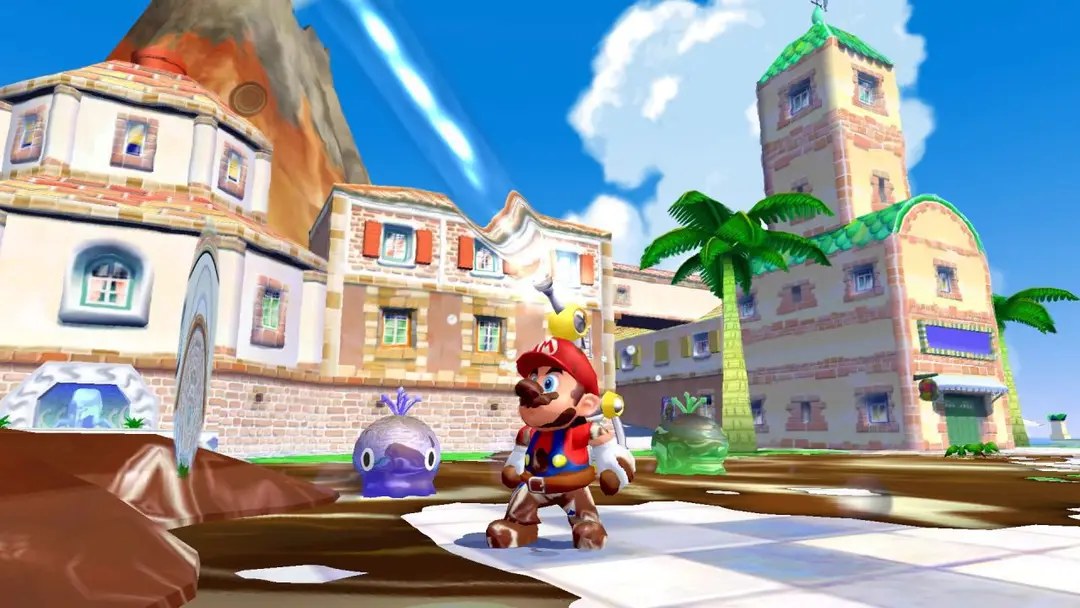
Mission design is where the 8.5 rather than a 9 is earned. For every masterpiece — the Pachinko-adjacent inventiveness, the manta ray that splits across a hotel beach, the extraordinary haunted-hotel puzzles of Sirena Beach — there is a chore: watermelon-rolling with cruel physics, a lily-pad ride down a poison river that has ended more 120-Shine ambitions than any boss, and blue coins. The blue coins deserve their own sentence: 240 of them, many unmarked, some available only in specific episodes of specific levels, tracked by no in-game list. Completionists be warned — the final stretch to all 120 Shine Sprites is the least respectful of a player’s time in any 3D Mario. The main path to Bowser, requiring the first seven Shines of each world, is far kinder and is the version of the game most players should judge it by.
Sunshine’s strange charm
And then there is the presentation, which is gloriously odd. This is the first Mario with extensive voice acting, and the results range from charming (the Piantas, Toadsworth) to so-bad-it-is-legendary (Bowser’s English voice in the finale, a performance that has to be heard to be believed). The courtroom opening, the dubbed cutscenes, Bowser Jr.’s debut and his genuinely strange family claim — Sunshine commits to story in a way Mario games usually avoid, and its confidence is endearing even when its execution wobbles. Visually, the water is the star: GameCube-era water that still looks drinkable, with heat shimmer, reflective shallows and goop that cleans in satisfying patches. The frame rate targets thirty rather than sixty, which series veterans will feel, but the image is rich and stable.
Yoshi, the airstrip and other period pleasures
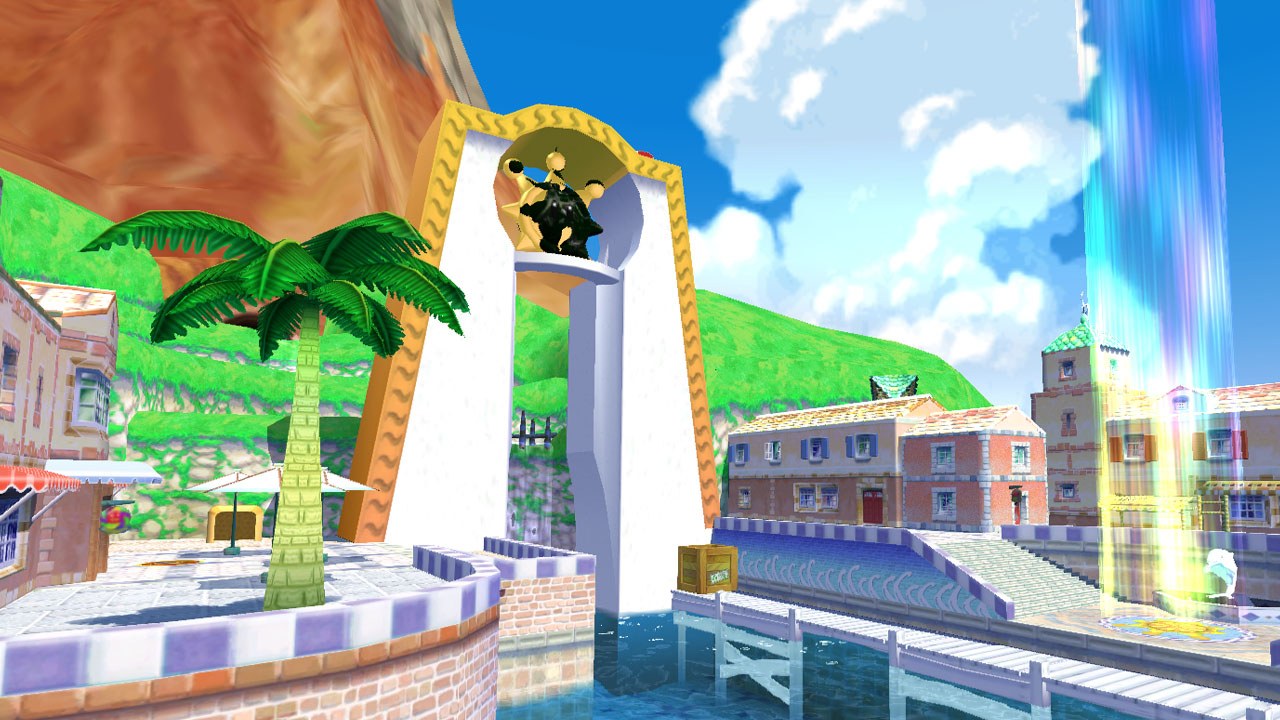
Sunshine’s oddities reward a slower look. Yoshi appears — his first rideable 3D outing — complete with fruit-juice colour changes and the ability to turn enemies into platforms, and he dissolves in water, because of course he does; the game is nothing if not committed to its liquid logic. The opening airstrip, a one-Shine tutorial space, is a little diorama of the whole design. The casino hidden in Sirena Beach’s hotel, the Pianta Village villagers living under their own village, the durian-kicking Pianta who has launched a thousand clips — Delfino is stuffed with authored jokes and secrets that a faster, more segmented Mario would never have room for. Even the much-mocked story has grown in affection over time: this is the game that introduced Bowser Jr., now a permanent fixture of the series, and gave Bowser a motivation — a lie told to a lonely kid — that is almost touching beneath the dub.
It is also worth recording what Sunshine did for the hardware’s reputation. In the summer of 2002, with the GameCube fighting for shelf space against the PS2’s momentum, Sunshine’s water — reflective, reactive, everywhere — was the screenshot Nintendo needed, and its transparent goop, heat haze and enormous draw distances across the plaza showed a machine punching at its weight. The thirty-frame performance was the trade, argued about then and now, but as a visual calling card the game did its job completely.
The verdict
Super Mario Sunshine is the most flawed great Mario game: a magnificent movement system and the series’ most coherent world, carrying a mission list that swings between genius and tedium and a completion tail that only the devoted should chase. Judged on its main path — and on those sublime secret stages — it earns its sunshine. If you skipped it for its reputation, the GameCube original, analogue triggers and all, is the way to discover that the middle child of 3D Mario was the most interesting one all along.
One more thing in Sunshine’s favour, easy to miss from the reputation: it may be the most speedrun- and challenge-friendly 3D Mario of its era precisely because its movement ceiling is so high. The community’s hover-less runs, turbo-nozzle routes and secret-stage mastery have kept the disc in competitive circulation for two decades, long after the “worst 3D Mario” jokes expired. Games with genuine mechanical depth do that. Games without it don’t get reappraised — and Sunshine’s reappraisal, from divisive to beloved, is now the consensus story.
Score: 8.5/10 — A sun-drenched, eccentric adventure with the best movement in the series and a mission list that doesn’t always deserve it.