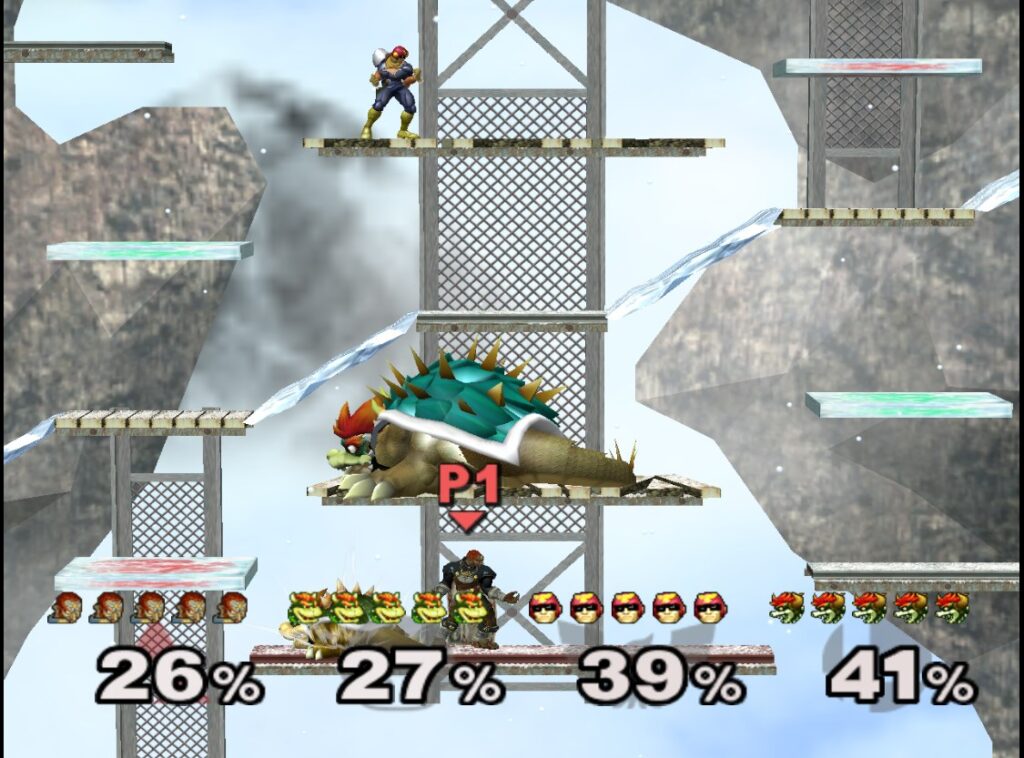
At a glance: Super Smash Bros. Melee · GameCube · HAL Laboratory, 2001 · Fighting / party brawler · Score: 9.0/10
Most launch-window games are remembered fondly and played rarely. Super Smash Bros. Melee, released weeks after the GameCube itself in late 2001, is remembered fondly and played constantly — at tournaments, on CRTs, in dorm rooms and streamed brackets more than two decades later. HAL Laboratory built it in a famously punishing development crunch of around thirteen months, and somehow produced not just the definitive version of Nintendo’s mascot brawler, but a fighting game so deep that its competitive community reverse-engineered an entire physics language out of it. This review judges the GameCube original on its own terms: twenty-five characters, twenty-nine stages, and a disc that has never really left many GameCubes since.
Speed is the whole story
Everything about Melee is faster than its Nintendo 64 predecessor. Characters fall quicker, hit harder, recover in sharper windows, and the whole game runs with a snap that makes the original feel like a rehearsal. The percentage-and-ring-out system was already brilliant; Melee weaponises it with directional influence, meteor smashes, wall techs and an air dodge that — through the wavedash, the community’s most famous discovery — accidentally became the foundation of competitive movement. Nintendo did not design Melee as an esport. That is precisely the point, and the game’s enduring magic: its depth is emergent, discovered rather than administered, and casual players and tournament players are somehow playing the same exuberant game at different depths of the same pool.
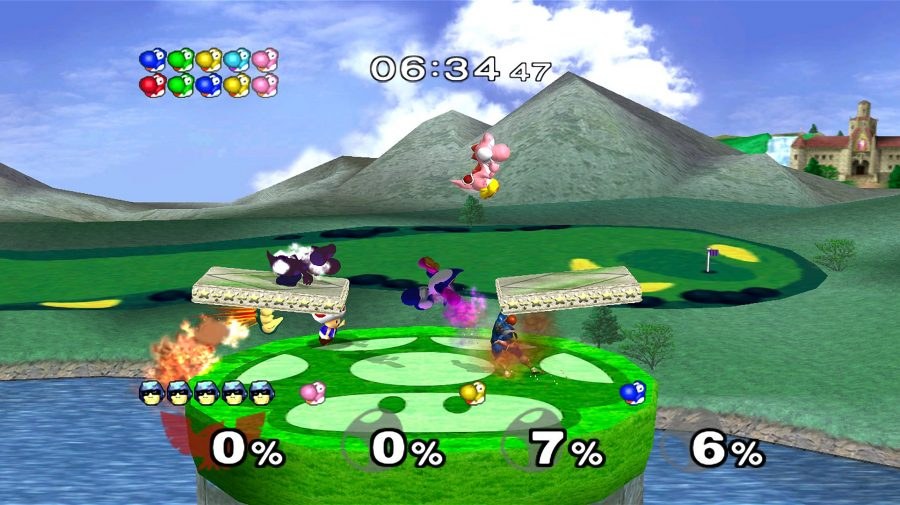
The roster is the strongest the series had assembled to that point and arguably its best-proportioned ever: the N64 twelve return alongside Peach, Bowser, Zelda and Sheik, the Ice Climbers, Marth and Roy — whose appearance here introduced most Western players to Fire Emblem — and unlockable deep cuts including Mr. Game & Watch and Mewtwo. Clones pad the count, honestly noted: Dr. Mario, Falco, Ganondorf, Pichu, Young Link and Roy share skeletons with their templates, though players have spent twenty years proving how differently most of them actually play. Every character arrives with a home stage, most stages arrive with two pieces of music, and the whole production has a museum’s affection for Nintendo history — trophies, hundreds of them, model a pre-internet encyclopedia of the company’s past that younger players genuinely learned from.
A single-player game, too
Melee’s forgotten virtue is how much it offers one person with a controller. Classic mode returns, but Adventure mode — a run through side-scrolling Mushroom Kingdom, an escape from Brinstar, a brawl through F-Zero’s racers — was a genuine attempt at a Nintendo crossover campaign, and All-Star, the Event Matches and the Home-Run Contest round out a package built to be mined for unlocks for months. The Break the Targets stages are character-specific puzzle boxes that teach advanced movement better than any tutorial. Add multi-man melees, a lottery for trophies, and a score system that rewarded everything from no-damage clears to beating a stage with a specific taunt, and you have the most content-dense disc of the GameCube’s launch year by a distance.
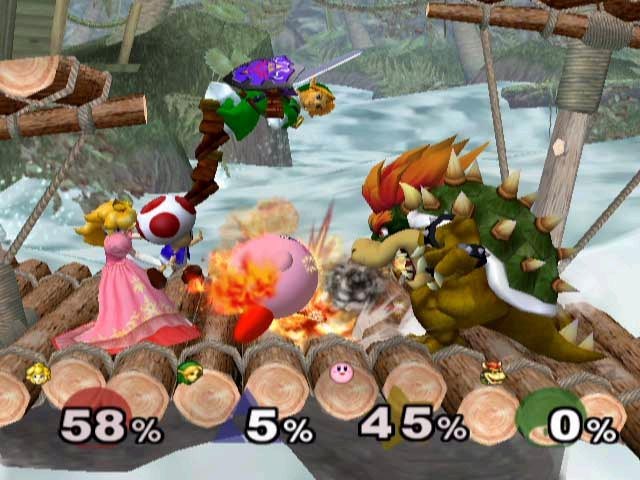
Technically it is a launch-period showpiece: sixty frames per second where it counts, four players and a crowd of items on screen, orchestrated arrangements of classic themes recorded with a live ensemble for the famous opening movie. The GameCube controller, whatever its quirks elsewhere, feels made for this game — the chunky A button, the gated stick, the analogue triggers — and the community’s continued insistence on that exact pad is not nostalgia. It is ergonomics.
The honest caveats
Balance, judged by tournament standards, is not Melee’s strength: a small top tier dominates high-level play and a beloved bottom tier — Kirby, Bowser, Pichu, who damages itself — struggles in serious company. Single players may also find the CPU’s higher difficulties cheap in the specific old-school way, and unlocking everything is a marathon measured in hundreds of versus matches for the final characters if you take the long route. None of it matters much in practice. The game’s failures are the failures of abundance: too much game, tuned by feel rather than by spreadsheet.
The community that refused to let go
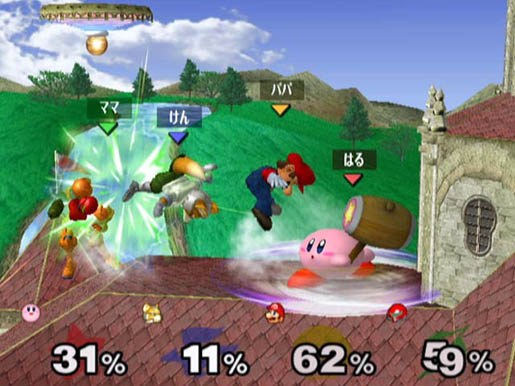
No review of Melee is complete without its afterlife, because Melee’s second act is unique in the medium. When later Smash games took the series in a more deliberately casual direction, Melee’s players simply declined to move on: they kept their CRTs, standardised tournament rulesets, produced some of the earliest great esports documentaries, and eventually built grassroots online infrastructure for a 2001 GameCube game out of emulators and sheer will. Nintendo’s relationship with that scene has warmed and cooled over the years, but the scene’s existence is itself a review — thousands of players, across more than two decades, voting with their weekends for this specific physics, this specific speed, this specific roster. Games do not accidentally acquire that kind of loyalty. They earn it, frame by frame.
There is also a preservation argument for the original disc that grows stronger every year: Melee has never been re-released. No remaster, no download edition, no Classics app appearance at the time of writing. The GameCube disc, a GameCube (or a Wii with GameCube ports), four controllers and a CRT are not the nostalgic way to play Melee — they are, officially, the only way, which gives every surviving copy a small historical weight. Treat yours well. Clean the disc, keep the case, and when the character select screen loads and that orchestra hits, remember you are holding one of the most consequential multiplayer games ever pressed.
The verdict
Later Smash games are bigger, prettier and officially supported; Melee remains the one with a heartbeat you can set a metronome to. It is simultaneously the best party game on the GameCube and one of the most demanding fighting games ever made, and it holds both titles without strain. If the console had sold on one disc alone, this would have been a defensible choice. Twenty-plus years of continuous play is not an accident of nostalgia — it is what happens when a rushed sequel accidentally achieves something close to perfection.
Judged coldly, as a piece of 2001 software, the score almost undersells it: this is a top-three GameCube game by any honest accounting, and the system’s defining release alongside a very small company of peers. Judged warmly, as the disc most GameCube owners have spent the most hours inside, it needs no score at all. The percentage counters, the announcer, the sudden-death bomb rain, the friend who always picks Falco — Melee is not a game the GameCube had. In a real sense, for millions of players, Melee is what the GameCube was.
A practical closing note for collectors: because Melee was a phenomenon, it was reprinted, bundled, and sold in quantities that keep complete copies circulating widely to this day — Player’s Choice editions and later pressings are common, cases and manuals are plentiful, and a clean, complete copy is one of the most attainable “important” games on the system. There is no excuse for a GameCube shelf without it, and no GameCube shelf that contains it is ever entirely finished being played.
Score: 9.0/10 — The GameCube’s defining multiplayer game: frantic for parties, bottomless for competitors, and still played like it launched yesterday.