
Of all the targets a modern console team could set itself, this is the strangest and the best: make the new digital shop as good as the Wii Shop Channel. When Nintendo’s developers discussed rebuilding the eShop for the Switch’s successor, reporting around the machine revealed that its producer had filed requests, in great detail and great amounts, holding up the Wii-era store as the benchmark for how a shop should feel – smooth, welcoming, and pleasant simply to browse. To anyone who never met it, this sounds like nostalgia talking. To anyone who did, it sounds like a design brief written by somebody who understands shops.
Because the Wii Shop Channel, launched alongside the console in 2006, was Nintendo’s first real download store – and nearly twenty years later it remains the one players remember with genuine affection, shopping music and all. This feature revisits what made a store built on Wii Points and standard-definition menus into a gold standard: its patience, its theatre, its respect for the browser – and what its resurrection as a benchmark says about the Wii era’s underrated software philosophy.
A shop designed like a place, not a funnel
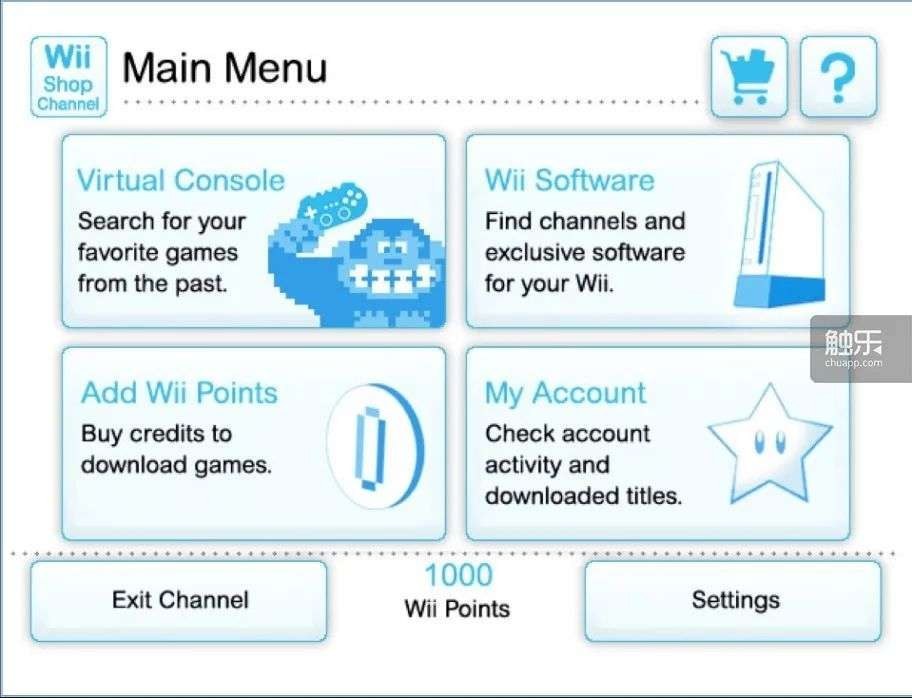
Open the Wii Shop Channel in memory and the differences from a modern storefront arrive immediately. It loaded as a destination: a bright room of its own, with its famously mellow shopping theme – a loop so beloved it escaped into memes, remixes and lo-fi playlists – playing while you wandered. Catalogues were organised by simple, legible logic: Virtual Console by original system, WiiWare in its own aisle, channels and extras shelved sensibly. Pages loaded at the pace the Wii could manage, which is to say slowly, and the design made that slowness feel like ceremony rather than failure.
Compare the archetypal modern store, engineered as a funnel: personalised rows, engagement shelves, search that buries the thing you typed under things you did not. The Wii shop’s great virtue was that it wanted one thing from you – a considered purchase – and otherwise left you alone in a pleasant room. Browsing it on a Sunday afternoon, points balance in the corner, was itself a pastime, the digital equivalent of record-shop flipping. That feeling, not the inventory, is what a new generation of Nintendo producers was reportedly instructed to recapture.
Wii Points and the theatre of buying
The store ran on Wii Points, Nintendo’s own currency – two thousand points for twenty dollars, games priced in round hundreds – and while proprietary currencies deserve their usual suspicion, the Wii’s implementation had a clarity modern microtransaction economies have abandoned. One conversion, learned once, applied everywhere; no premium tiers, no bonus-point bundles engineered to strand your remainder. The shop even staged the purchase as a little performance: Mario, in various plumbing predicaments, entertained you on the download screen while your game arrived down a 2006 internet connection.
Then there was the gifting. The Wii Shop Channel let you send a game to a friend’s console – a feature so obviously delightful that its absence from later Nintendo stores remains genuinely baffling, and one that turned the shop into a social space years before storefronts elsewhere thought to try. Add the catalogue’s own story: Virtual Console making Nintendo’s history legally buyable for the first time, WiiWare giving small teams a television premiere years before indie showcases were an industry. The store was not merely selling software. It was curating a museum with a till, and charging fair prices at the door.
The producers’ requests, decoded
So what, precisely, would ‘as good as the Wii Shop Channel’ mean as a set of engineering requests in the present day? Speed, first: the original Switch eShop was notoriously sluggish, its pages stuttering under their own artwork, and reportedly the new shop’s team obsessed over smoothness – fast loads, effortless scrolling, search that feels instant. Legibility, second: categories a human can hold in their head, wishlists and libraries that respect the owner. And third, the intangible the Wii nailed: the sense that the shop is a room in the console’s house, furnished in the same taste as everything else, rather than a billboard rented to the highest-bidding algorithm.
There is an irony folded inside the benchmark. The Wii Shop Channel’s charm was partly a child’s charm – low stakes, small catalogue, a captive pre-smartphone audience with nowhere else to browse. Recreating its feeling at modern scale, with tens of thousands of titles, is a far harder problem than building the original was. That Nintendo’s producers reached back to it anyway suggests they understand the actual lesson. The Wii shop was never good because it was old or small. It was good because every decision in it was made by people asking how a shop should welcome a guest. That question scales to any catalogue size, if the will does.
Nintendo’s shopping history, honestly graded
Set the benchmark in context and Nintendo’s store history becomes a story of early brilliance, long drift. The Wii shop invented the company’s digital identity in 2006. The Wii U and 3DS eShops added capability while shedding warmth, and their closure in 2023 – rendering purchases stranded on ageing hardware – remains the company’s great digital wound. The Switch eShop sold games in industrial quantities while earning a reputation for clutter that Nintendo itself, in setting the Wii as the new standard, appeared to concede. The benchmark is therefore also an apology, encoded as a design document.
The closures add a necessary shadow to the nostalgia. The Wii Shop Channel itself closed in January 2019, taking new purchases with it; its downloaded games persist on consoles, but the room itself is dark. A modern shop that truly learned from it would need to solve the permanence problem its teacher never could – libraries that survive their storefronts. Perhaps that is the one request even a devoted producer cannot file into existence. It remains the standard by which the next decade of Nintendo digital policy will quietly be judged.
The shop as a console’s character
It is worth asking why a shop, of all things, lodges so deeply in a console’s identity – and the Wii answers clearly. The shop was where the console’s personality spent its weekdays. Between game sessions, the Wii’s channels turned the machine into a household appliance of small pleasures: weather, news, photo slideshows, and a store whose music drifted from televisions in homes that had never owned a console before. For millions of owners, the shop theme is not retail nostalgia. It is the sound of the Wii being on, the ambient hum of a beloved object, as inseparable from the machine as its blue disc-slot glow.
That is the standard’s hidden depth. A modern producer asking for a shop ‘as good as’ the Wii’s is asking for more than fast pages. He is asking for software that a family will remember the way they remember furniture – fondly, specifically, and as part of the home. Almost no commerce software anywhere has achieved that. That a little points-based store on a standard-definition console did remains one of the Wii era’s most quietly astonishing accomplishments, and the best explanation for why its name still appears, in earnest, in design meetings two decades later.
The music you can still hear
Ask a room of Wii owners to hum the shop theme and you will get it, note-perfect, nearly twenty years on. No other store in the industry has a theme to hum. That single fact contains the whole feature: the Wii Shop Channel was built by people who believed even the buying of games should feel like being somewhere, in good company, unhurried. A producer on a modern console, filing request after detailed request to make a new shop feel like that, is not being sentimental. He is reading from the best brief Nintendo ever wrote for itself.
So judge the new eShop by the old standard. Does it load like it respects your evening? Can you find the game you came for before the game it wishes you wanted? Would you browse it with no money in your account, just for the pleasure of the room? The Wii’s little shop, white gloves and all, says a storefront can be a destination. Nearly twenty years later, Nintendo is trying to remember its own directions home – and the map, charmingly, is a song.