
At a glance: Tactics Ogre: Let Us Cling Together · PSP · Square Enix, 2010 (JP) / 2011 (West) · Strategy RPG · Score: 9.5/10
There is a lineage in tactical RPGs, and Tactics Ogre stands at its head. Yasumi Matsuno’s 1995 Super Famicom game invented much of the genre’s grammar — branching law-and-chaos morality, permadeath with a face, politics over prophecy — then seeded Final Fantasy Tactics, which carried the ideas to the world. The PSP remake of 2010, built by much of the original team, is not a port. It is a director’s cut fifteen years in the making: rewritten, rebalanced, expanded and localised in Alexander O. Smith’s rich, archaic English. It is, by acclamation and by this reviewer’s ballot, the finest strategy RPG ever put in a pocket.
You are Denam Pavel of the Walister people, a minority ground between the warring kingdoms of Valeria. When Duke Ronwey orders a atrocity to galvanise your people — the event the game, in its branching paths, lets you obey, refuse or survive — Denam’s story becomes a study of how revolutions eat their children. The Law, Chaos and Neutral routes are not costumes on one plot: they are three wars, with different allies, different villains and different corpses, and the game’s World Tarot system — a timeline you can revisit after completion to explore the roads not taken — turns moral curiosity into a mechanic.
Classes, levels and a hundred decisions a battle
The remake’s boldest change is structural: experience is earned per class, not per character, so a knight’s levels belong to knighthood itself and recruits can be fielded without the genre’s traditional baby-sitting. Fifty-odd classes, from terror knights to liches to the humble beast tamer, are governed by a skill system of learnable, slottable abilities — weapon mastery, elemental affinity, the all-important Rampart Aura that lets a front line actually hold. Battles are ten-a-side chess matches on hand-built isometric terrain where height, weather, facing and elemental ground all vote on every exchange.
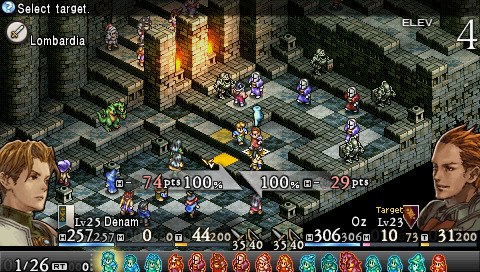
The Chariot Tarot deserves its legend: during battle, you may rewind the fight turn by turn — up to fifty steps — and branch from any earlier position, erasing a catastrophe or testing a theory without restarting the map. Purists of the old permadeath school grumbled; in practice it transforms the remake into a game about experimentation rather than endurance, and the stakes remain real because the clock, the loot and your dignity are always spent. Few remakes have ever so confidently redesigned their original’s philosophy.
War has a hundred extra hours
Content is not the game’s problem; your calendar is. Beyond three campaign routes sit the Palace of the Dead’s one hundred floors, the San Bronsa ruins, recruitable legends from the Ogre Battle saga, a crafting system, and post-game CODA chapters that reunite the cast for new story. The Warren Report — an in-game chronicle, bestiary and news feed that updates with your choices — is a masterclass in world-building furniture, making Valeria feel reported rather than invented. A serious playthrough runs sixty hours; a complete one, three times that, and the PSP simply sleeps between sessions of a war you will think about at work.
The caveats are the price of ambition: menus nest like Russian dolls, the inventory and crafting interfaces test patience, and the difficulty of certain story maps — a rescue in the game’s early hours has ended more campaigns than any final boss — assumes you are using every system the game teaches. The PSP’s small screen also asks a lot of eyes during the largest battles. These are complaints filed from inside a masterpiece, about the furniture, not the house.
Smith’s English, a second script
Alexander O. Smith’s localisation deserves billing alongside the design. Working from a complete retranslation, he gave Valeria a voice of chronicles and scripture — thee-and-thou used sparingly, place names with the dust of history on them — that elevated the genre’s writing standard permanently. Dialogue in Tactics Ogre does political work: debates about the Bakram and Galgastani, about what Denam’s choices cost, are written as arguments between adults with incompatible duties. RPG scripts routinely ask to be called mature. This one simply is.
The craft of the battlefield
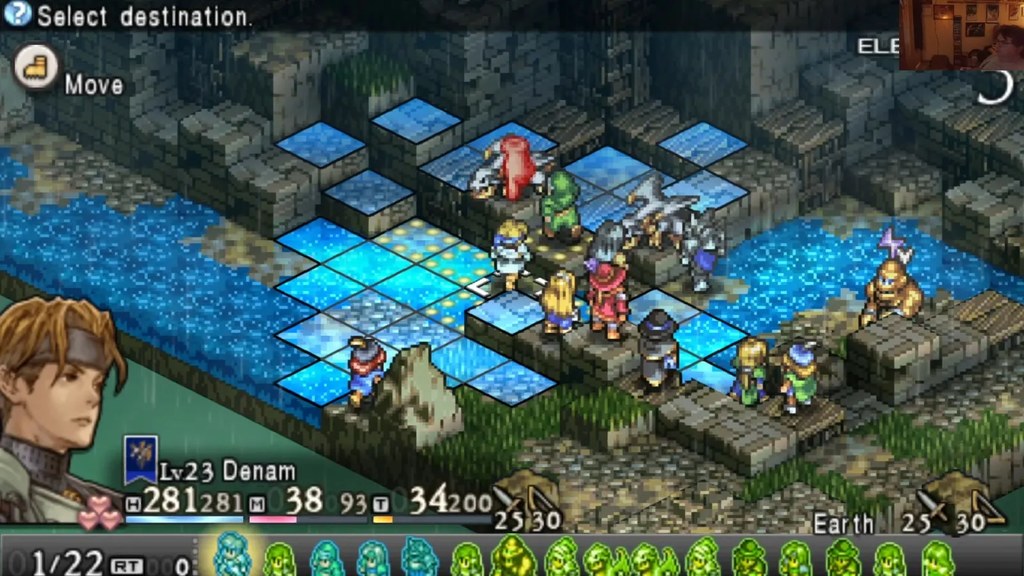
Map design is the remake’s quiet triumph. Each story battle is a built place — a bridge town, a flooded ruin, a castle wall under rain — with chokepoints, high ground and side objectives that reward reading terrain before deploying. Enemy compositions are authored, not generated: a necromancer behind a wall of zombies plays differently from a dragoon screen in open field, and the game expects you to scout, using the Warren Report and the battle preview like the commander it insists you are. Losing a map in Tactics Ogre is information; the Chariot exists so you can afford to use it.
Permadeath, softened, stakes intact
Fallen units leave the field as guests of a three-count system: rescue them, or lose them — unless you spend one of the limited revival blessings, or accept the game’s grimmer bargains. Story characters who die stay dead in the narrative even when mechanics resurrect the soldier, a compromise that keeps consequence and playability in the same room. It is a more grown-up negotiation with difficulty than either the SNES original’s iron or modern tactics’ casual modes, and it suits a game whose theme is the cost of every order you give.

The standard, still
Reborn’s 2022 remaster modernised the interface and rebalanced the classes for a new audience, and it is a fine edition — but the PSP remake remains the connoisseur’s cut: class-level progression, the full Chariot and World systems in their original form, and Smith’s script entire. That a handheld game from 2010 can hold that status is the review in miniature. Tactics Ogre on PSP is not the portable version of a classic. It is the classic.
Crafting and the alchemist’s patience
The crafting system — hundreds of recipes, books bought and earned, materials harvested from the game’s bestiary — is the remake’s most divisive addition: a deep, slow workshop for the player who wants Valeria’s finest blades to carry their own signature, and a menu labyrinth for everyone else. The defence is that it is optional in the way Tactics Ogre understands optional: the war can be won without it, and cannot be mastered without it. The alchemist’s patience is a build, and this game respects builds above all virtues.
A closing note on how to begin: play blind, choose as Denam would rather than as a guide advises, and let the World Tarot wait for the credits — the game’s morality only means anything if your first war is really yours. Save the completionism for the second campaign, when Valeria opens like a second book inside the first. Tactics Ogre asks more of its player than any other PSP game and returns more, which is why, a decade and a half on, its name still ends arguments about the greatest tactical RPG ever made. March carefully. History is watching, and it keeps receipts.
Verdict
The tactical RPG perfected: the deepest, darkest, most replayable strategy game on the PSP, and the standard against which the genre is still measured. Let us cling together, indeed.