At a glance: Tempo · 32X · Red Company / Sega, 1995 · 2D platformer · Score: 7.0/10
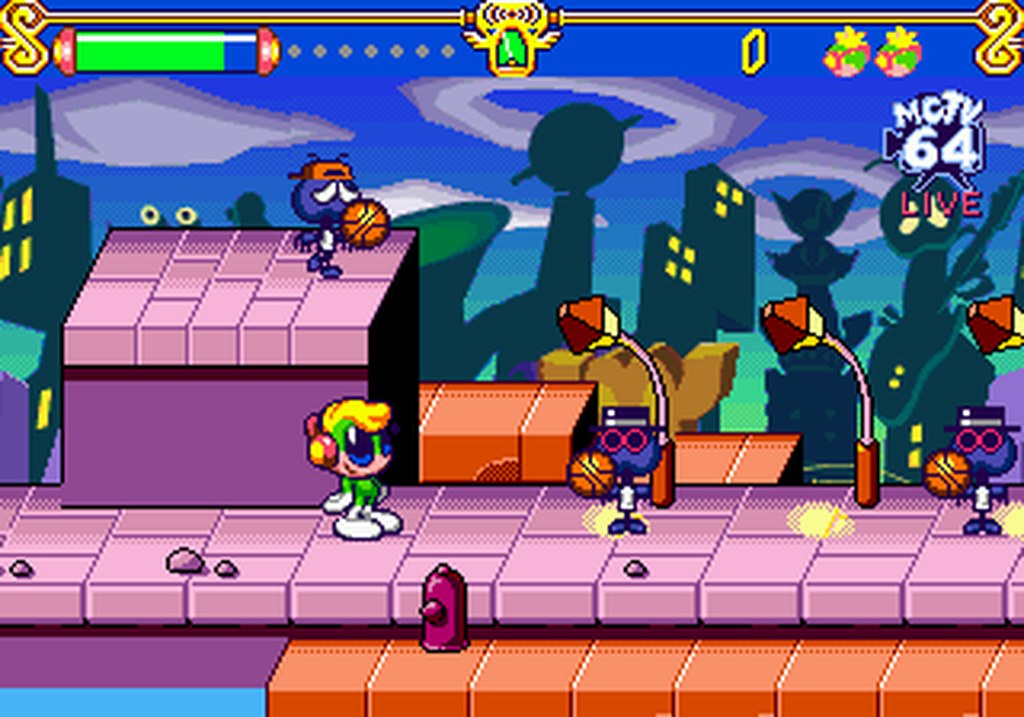
Tempo is a platformer that behaves like a variety show having a sugar rush. Tempo the grasshopper and his partner Katy have been pulled into the world of television by the villainous King Dirge, and the rescue plays out across stages themed as TV programmes — a western, a horror show, a sports broadcast — each rendered in a cartoon style so saturated it seems to vibrate. Red Company, of Bonk fame, developed it; Sega published it as a 32X showcase for 2D. It is, frame for frame, one of the most exuberant-looking games on the system, and one of the most argued-about to actually play.
Tempo fights with music and feet. His attacks are kicks, stomps and musical-note projectiles; his movement is built around rhythm-flavoured flourishes, dance animations, and a satisfying spring in every jump. The stages are hunts as much as journeys — musical notes and hidden items are stashed everywhere, bonus games interrupt the platforming (including a dance mini-game that feels a decade ahead of the rhythm genre), and the whole package keeps changing the subject in the best variety-show tradition.
Invention everywhere, mercy nowhere
The problem, and it is the problem every Tempo review since 1995 has circled, is the tuning. Enemy placement is mischievous to the point of malice, precision jumps land you in ambushes, and the difficulty curve does not so much rise as teleport. The game’s systems — health, lives, continues — are old-school strict, and stages long enough that a late death costs real minutes. None of this is incompetence; it is a philosophy, the hard-edged arcade philosophy Red brought from the PC Engine, but it sits strangely against presentation this friendly. Tempo looks like a cartoon for everyone and plays like an examination for veterans.
What carries players through is the sheer density of ideas. Every stage introduces machinery the last one lacked — moving sets, gimmick platforms, enemies with genuine comic timing — and the boss encounters, staged as showdowns inside their TV genres, are inventive set-pieces. The soundtrack deserves its own paragraph in any honest review: funky, sample-rich, properly musical in a way that justifies the hero’s theme, and a standing exhibit in what the 32X’s sound hardware could add to the Mega Drive’s FM voice.
Tempo looks like a cartoon for everyone and plays like an examination for veterans — and the invention never lets up long enough to mind.
Compared to its stablemate Chaotix, Tempo is the more conventional platformer and the harder sell: where Chaotix experimented with movement itself, Tempo experiments with everything around the movement. Its colour work is the 32X palette pushed as hard as Kolibri’s, in a completely different register — flat cartoon saturation instead of painted lushness — and side by side the two games make the add-on’s 2D case more eloquently than any sales pitch did.
The 32X version, specifically
Tempo never left the 32X in its era (a tamer Game Gear cousin, Tempo Jr., is a different and lesser thing), and the sequels it deserved died with the hardware. Judged here, it is precisely the kind of game the add-on needed more of: an original, a showcase, a personality. Its toughness is a real barrier, honestly recorded; its artistry is the reason to climb it.

Verdict: a dazzling, difficult, idea-drunk platformer — the 32X’s cartoon masterpiece and its most demanding one. Bring patience; it brings everything else.
Time has sorted the 32X library into the famous, the infamous and the forgotten, and Tempo rewards being met on its own terms rather than through any of those reputations. Played today — on a serviced stack, through a clean video path, with the six-button pad the era intended — it is a reminder that the mushroom’s forty games were never its problem. The problem was the calendar they were born into, and calendars cannot be replayed. Games can.
There is also the matter of what Tempo says about its machine. The 32X was sold as a bridge to the 32-bit future and remembered as a dead end, but its best cartridges argue a subtler case: that for eighteen months it was simply a good games platform with a small, strange, high-quality library, judged at the speed of a market panic rather than at the pace games deserve. Revisiting it now, without the panic, is the closest thing the platform will ever get to a fair trial — and on the evidence of this cartridge, the defence rests well.
For collectors, Tempo sits in the honest middle of the 32X market: neither the loose-change common nor the four-figure grail, but a cartridge that rewards the hunt and justifies its shelf space every time the stack is powered up. In a library this small, every game is a significant fraction of the whole. This one earns its fraction.
What lingers after the credits is how completely Tempo belongs to its moment — and how well that moment has kept. The early polygon years are often treated as an embarrassing adolescence for the medium, all jagged edges and experimentation. The best 32X games suggest otherwise: the experiments were the point, the edges were the aesthetic, and a generation of designers was learning 3D in public, at full speed, on hardware like this. Tempo is one of their better lessons.
Time has sorted the 32X library into the famous, the infamous and the forgotten, and Tempo rewards being met on its own terms rather than through any of those reputations. Played today — on a serviced stack, through a clean video path, with the six-button pad the era intended — it is a reminder that the mushroom’s forty games were never its problem. The problem was the calendar they were born into, and calendars cannot be replayed. Games can.
There is also the matter of what Tempo says about its machine. The 32X was sold as a bridge to the 32-bit future and remembered as a dead end, but its best cartridges argue a subtler case: that for eighteen months it was simply a good games platform with a small, strange, high-quality library, judged at the speed of a market panic rather than at the pace games deserve. Revisiting it now, without the panic, is the closest thing the platform will ever get to a fair trial — and on the evidence of this cartridge, the defence rests well.