At a glance: The Orange Box · Xbox 360 · Valve / Electronic Arts, 2007 · Shooter compilation · Score: 9.5/10
Reviewing The Orange Box feels faintly absurd, like reviewing a record shop. The box contains: Half-Life 2, already one of the greatest shooters ever made; its two episodic sequels, one of them brand new; Team Fortress 2, a complete reinvention of online multiplayer; and Portal, a three-hour experiment that became a cultural phenomenon. Five games — or three masterpieces, a landmark and a phenomenon, depending how you count — sold for the price of one, in a year when most compilations were shovelware. It is not just the best value proposition the Xbox 360 ever offered. It may be the best any console ever has.
Half-Life 2 and the episodes
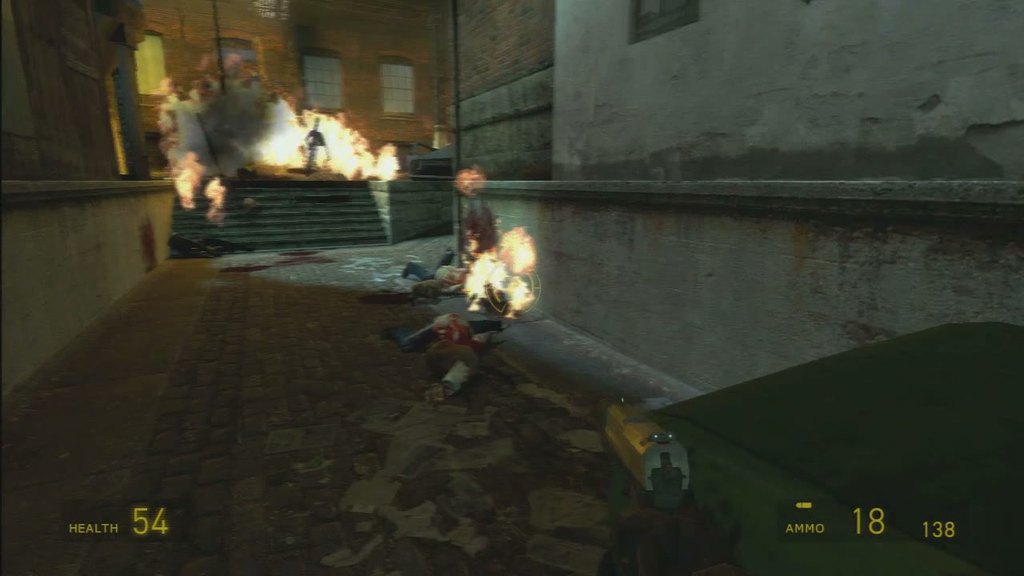
Start with the anchor. Half-Life 2’s arrival on the 360 — after an earlier, compromised port to the original Xbox — finally did City 17 justice on a console: Gordon Freeman’s journey from occupied city to the Citadel runs at a mostly steady clip, and even now the game’s strengths are unmistakable. The gravity gun remains the most influential weapon in shooters, turning physics into a vocabulary; the pacing, alternating combat, vehicles, horror (We Don’t Go to Ravenholm) and quiet character work with Alyx Vance, is a masterclass no FPS since has consistently matched.

Episode One continues directly — an escape from a dying City 17 that deepens Alyx into gaming’s best companion character — and Episode Two, the disc’s new headline act, is arguably the finest single chunk of Half-Life ever made: forest warfare against Hunters, a desperate last stand at White Forest, a car, a gnome-related achievement of legend, and an ending that left a generation of players staring at their screens in 2007 and, for thirteen years, waiting. As a console package, the three together are a twenty-hour campaign with no weak act.
Portal: the three hours that ate the world
And yet the box’s smallest game stole its legacy. Portal is a first-person puzzle game in which Chell, a test subject in the Aperture Science facility, acquires a gun that places two linked portals on flat surfaces, and uses them to solve physics puzzles under the narration of GLaDOS, a passive-aggressive AI whose writing — by turns soothing, funny and genuinely sinister — won every award available to it. Momentum through portals, turrets with children’s voices, a weighted companion cube the internet adopted as a pet, and a closing song that became a generational anthem: Portal was perfect at three hours, revolutionary in design, and unlike anything before it. The 360 version is the original article, complete and uncompromised.

Team Fortress 2, and the fine print
Team Fortress 2 completes the set: nine classes, an art style stolen from J.C. Leyendecker illustrations, and objective modes built for teamwork, all of it colourful and characterful in a way online shooters simply were not in 2007. The honest caveat, from today’s vantage point: the 360 version is a preserved launch-day build — six maps, no unlockable weapons, no hats, none of the decade of updates the PC version enjoyed — played on servers that have long since emptied. As a living game it is a museum piece. As a historical document of how TF2 began, it is fascinating, and its local bones are all Valve-quality.

The other fine print of the era: the port was handled with EA’s involvement while Valve focused on PC, load times are period-typical, and Half-Life 2’s frame rate can dip in the vehicle sections. None of it changes the shape of the thing. No other single disc on the system gives a new owner this much greatness to work through.
The extras nobody mentions
Two smaller features round out the package and deserve their due. Valve’s developer commentary mode — floating nodes throughout the Half-Life episodes and Portal that play short, specific insights from the designers as you stand in the exact room being discussed — was a revelation in 2007 and remains the gold standard for the form: game design taught inside the game, by its makers, at the scene of the crime. And the achievements, a young system when the box shipped, were unusually thoughtful here, from the famous garden-gnome escort through Episode Two to Portal’s transmission-hunting radio puzzles — challenges that taught you the games’ hidden depths rather than merely counting your kills.
There is an elegiac note to add for the 360 edition specifically. Valve’s console ambitions cooled quickly after 2007; the box never received the PC version’s years of Team Fortress 2 updates, and its Half-Life chapters are the story as it stood when the wait for a conclusion began. Buying the Orange Box on 360 today is buying a sealed time capsule of Valve at its absolute peak — the last moment when five of the medium’s defining works could be gathered in one place, at one time, for one price. It cannot happen again. It barely happened then.
How to play the box in 2026
A suggested order for the newcomer, since the box itself won’t give you one: Half-Life 2 first (roughly twelve hours, and the foundation of everything), then Episode One and Two in sequence with no gaps — they are chapters, not sequels. Portal next, in one sitting if you can; it plays like a sorbet and a revelation at once. Team Fortress 2 last and lightest: an evening touring its maps and classes as a museum of where class shooters came from. Take the commentary playthroughs as a second lap for whichever piece you loved most, because Valve’s nodes are content, not garnish.
The 360 edition holds one more advantage over every other way to own these games: it is whole. No launchers, no updates, no storefront between you and five classics — the disc spins, the menu offers its five doors, and gaming’s most generous package is simply there. In an industry that now rents its history back to players one subscription at a time, there is something almost defiant about The Orange Box’s completeness. It sits on the shelf like a promise the business used to make.
The verdict
Five games, three of them all-timers, one of them a phenomenon — The Orange Box is not a compilation. It is a canon, in a box, for the price of a game.
If you are building a 360 collection from zero, this is the second disc to buy after Halo 3 — and on a value-for-greatness basis it might be the first. The cake was a lie. The deal was real.
The score reflects the package, not an average: three masterpieces, one landmark multiplayer debut and one phenomenon, minus a half-point for the 360 edition’s frozen-in-2007 Team Fortress 2 and the era’s load times. No comparable disc exists for any other console of its generation — most cannot field a candidate. If this site’s shelves ran to a single “start here” sticker for the entire 360 catalogue, The Orange Box would be holding it, with Halo 3 looking over its shoulder. That is the company it keeps, and the company it deserves.
Buy it before you buy a second controller. Some purchases furnish a console; this one founds a library.
Score: 9.5/10