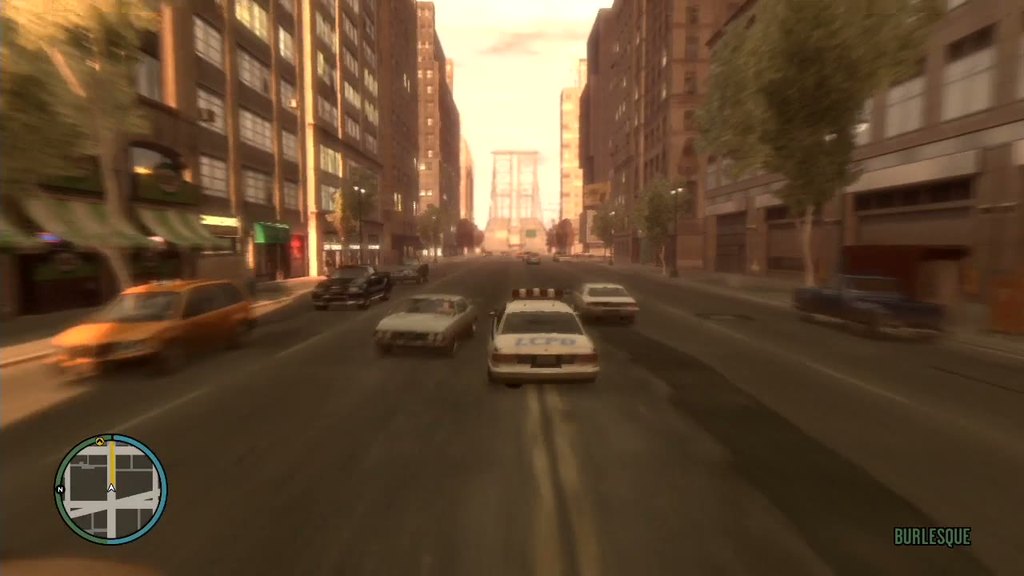
At a glance: Grand Theft Auto IV · Xbox 360 · Rockstar North / Rockstar Games, 2008 · Open-world action · Score: 9.5/10
“What does the American dream mean today?” asked the immigrant on the boat. Grand Theft Auto IV was Rockstar’s answer, and it landed like a thunderclap: the biggest entertainment launch the world had ever seen, and a deliberate reinvention of the series that had defined a decade. Gone was the cartoon sprawl of San Andreas. In its place: one dense, grey, heart-breakingly detailed Liberty City, a physics engine that made every collision a story, and Niko Bellic — a war criminal looking for peace in a country that only has work for his worst skills. It is the most debated GTA ever made, and the debate is the tribute: no game of its era aimed higher.
Niko and the dream
Niko arrives in Liberty City chasing two things: the cousin Roman’s invented fortune of mansions and women, and the man who betrayed his army unit fifteen years ago. What he finds is a failing taxi depot in Broker, a queue of employers who each pull him deeper into the underworld, and a slow moral corrosion the writing never lets him — or you — dodge. GTA IV is, beneath the satire, a tragedy about a man discovering that his talent for violence is the only American skill he has. The supporting cast is Rockstar’s strongest: Roman, whose optimism survives everything; Brucie, the insecure alpha clown; Little Jacob; Packie McReary and his doomed family; and a late-game choice between revenge and deal that lands like a gut punch either way.
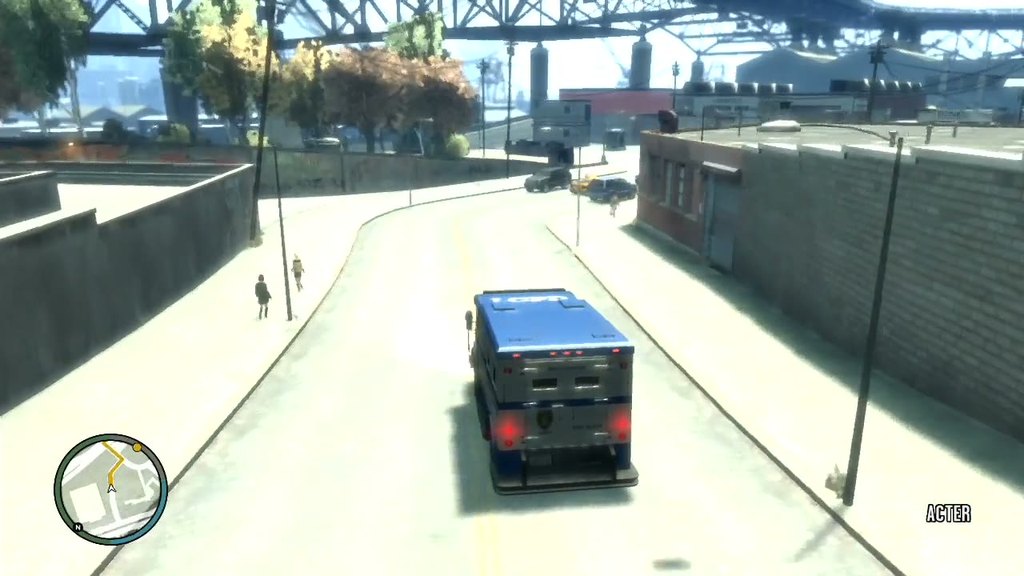
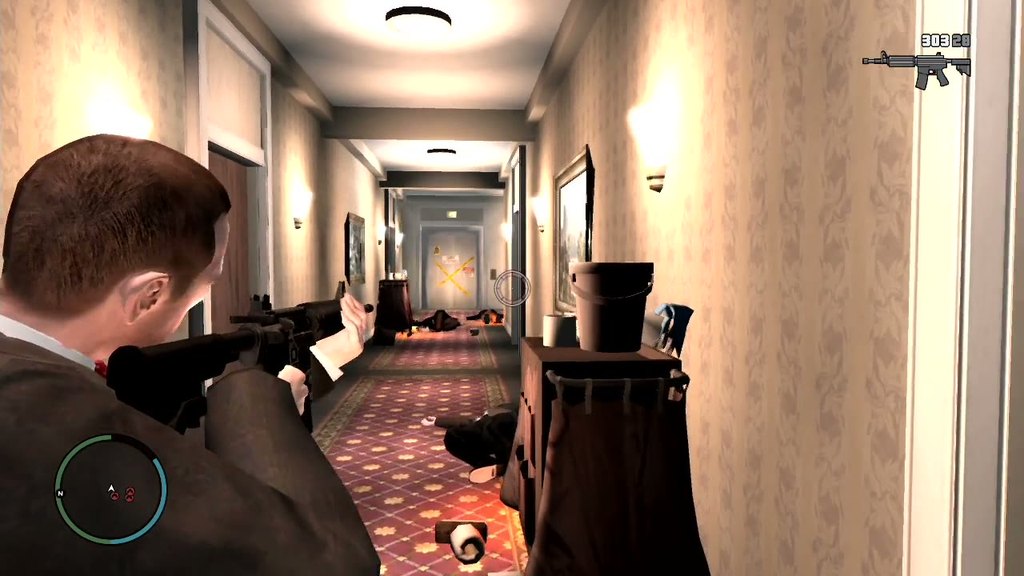
The city itself is the co-star. This Liberty City — Broker’s Eastern European enclaves, Algonquin’s skyscraper canyons, Bohan, Dukes, Alderney’s industrial fringe — trades landmass for density and lived-in detail: steam, litter, neon, a working internet in every café, television channels, comedy clubs, a dating system, and the greatest talk-radio writing in the medium’s history. The Euphoria physics mean citizens stumble, cling to car doors and dive from gunfire as individuals; the cover-based gunplay, new to the series, gives shootouts a weight the PS2 games never had.
Driving the argument
The famous friction is the driving: heavy, boaty, brake-hungry cars that demand you learn them. In 2008 half the audience called it broken and half called it the point — vehicles with mass, suspension and consequence, in a city small enough to cross in minutes but textured enough to reward the crossing. Time has sided largely with the defenders: no open-world driving model since has dared to be this physical. The mission design matures with the story, from simple pickups to the generation’s benchmark set piece, Three Leaf Clover — a bank heist and subway escape that remains a masterclass in escalating mission craft.
What aged least well is also plain: the friend system, in which Roman and company telephone constantly to demand bowling, was an obligation engine bolted onto a tragedy, and checkpoint-free long missions could turn failure into a long drive of penance. These are real taxes on the experience, and they are why the “best GTA” argument never settles. But the taxes buy something: a commitment to tone — melancholy, grounded, adult — that the series had never attempted before and has never repeated since.
The episodes and the living city
The 360 was GTA IV’s lead platform and its exclusive home, at launch, for the two great expansions: The Lost and Damned, a biker opera that darkens every corner of the base story, and The Ballad of Gay Tony, which restores the series’ neon joy in a tale of nightclubs and diamonds. Woven together, the three stories form a single interlocking novel of the city — still the gold standard for how to expand an open world. Multiplayer, a new frontier for the series in 2008, added free mode — an entire city as a lobby, an idea whose descendants now dominate the industry.

Satire with a straight face
The comedy, when it comes, is all in the margins — and the margins are enormous. GTA IV’s radio dial is the series at its sharpest: talk stations charting the city’s paranoid politics, the Republican Space Rangers cartoon, Integrity 2.0’s Lazlow broadcasting his own midlife collapse live. Its in-game internet, complete with parody news, dating sites and spam, was a small miracle of 2008 world-building. Its television channels contain full programmes. The satire’s target had shifted, too: where the PS2 games mocked America’s past, IV mocks its present — the security state, the credit bubble, celebrity rehab, immigrant dreams sold as timeshares — and dates, in the process, into a perfect time capsule of the year it shipped. The jokes are period pieces now, and they have aged into documents.
That tonal control is why the game’s admirers defend it so fiercely against the “less fun” charge. GTA IV is fun in the register it chose: the pleasure of weight, of consequence, of a city that feels occupied rather than rendered. Its bowling is bad and its helicopters are worse and its heart is the largest the series has ever had. The argument matters because the game matters: this was the moment the medium’s biggest franchise tried to grow up in public, and the 360 — lead platform, episodes and all — is where it did it.
The frame the argument hangs in
Perspective helps the score make sense. GTA IV is not being measured here against its own sequels’ abundance but against the ambitions of open-world games in its moment, and on that scale nothing else is close: a city simulated to the level of individual pedestrians’ behaviour, a physics engine that made chaos emergent rather than scripted, and a story that treated its criminal lead as a person rather than a power fantasy. Its flaws — the phone-call friendships, the checkpointing, the dour palette — are the tax on all three achievements, paid visibly. Plenty of games since have been smoother. Very few have been this considered, this literary, or this brave about what a blockbuster is allowed to feel like. That is why its score here stands with the generation’s very best, and why Liberty City, grey as it is, earns a permanent place on this shelf.
The verdict
The series’ most serious, most literary and most physically convincing chapter — the American dream, audited in Liberty City.
Grand Theft Auto IV is not the most fun-per-minute GTA; it is the most meaningful one, and on the console it was built for it remains a staggering achievement of world-building, writing and physics-driven play. Cousin, it is time to revisit. Liberty City is still there, still grey, still great.
Finally, a practical word: play the 360 original if you can, episodes included, before any later port or remaster colours your expectations — the weight, the gloom and the physics are the artwork, and they live here in their intended proportions. Give the driving an hour to teach your hands. Let the city be grey. Somewhere around the first ride over the Algonquin bridge at night, radio murmuring, Niko’s story stops being a game you are evaluating and becomes a place you are living in. Very few open worlds have ever pulled that trick. None has pulled it with this much to say.
Score: 9.5/10