
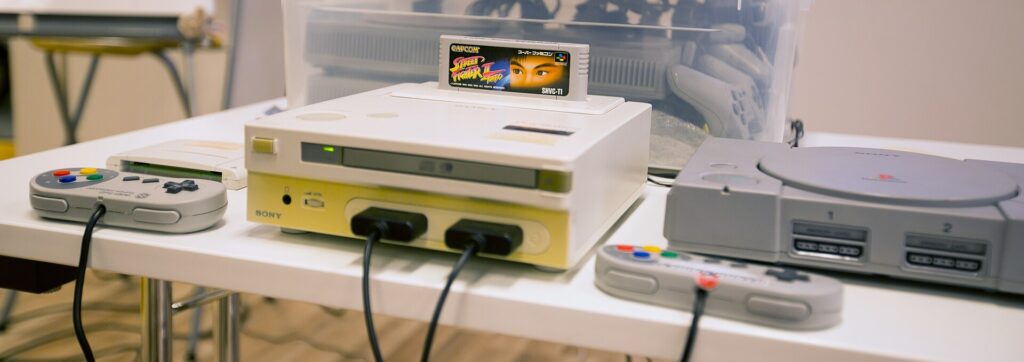
Every games format that reaches shops leaves behind a library. The Super Disc — the CD-ROM format at the heart of the cancelled Nintendo and Sony partnership — never reached shops, and for over two decades its library consisted of rumours. There were stories of test discs and development software, but no playable Super Disc game had ever surfaced in public. Then, in March 2016, the format got its first released game. It was not a lost Nintendo production or a forgotten Sony experiment. It was a tiny freeware puzzler called Magic Floor, ported by the one man who had just taught the world’s emulators how the machine worked.
A note on scope before we begin: this article is about the homebrew milestone itself — the first software written by an outsider for the Super Disc format. The rediscovery of the prototype hardware, and the separate story of its dumped boot ROM, are covered elsewhere in this series; here, the game is the story.
The Man Who Read The Machine
Martin Korth is better known to emulator users as nocash, the author of the no$ family of emulators and debuggers — no$gba for the Game Boy Advance and Nintendo DS, and no$sns for the Super Nintendo. Korth’s tools are beloved by homebrew developers precisely because he documents everything: his technical write-ups on the hardware he emulates are famously exhaustive, assembled from datasheets, patents, testing and sheer bloody-minded reverse engineering.
When the system software of the SFX-100 — Sony’s model number for the Play Station prototype — became available to researchers in early 2016, Korth did to it what he does to every machine that crosses his bench. He took it apart on paper. Within weeks he had published complete specifications for the SNES-CD hardware: its input and output, its memory layout, the behaviour of its BIOS, and the structure a Super Disc would need to follow. Work that Nintendo and Sony’s engineers had done in secret in the early 1990s was, for the first time, written down where anyone could read it.
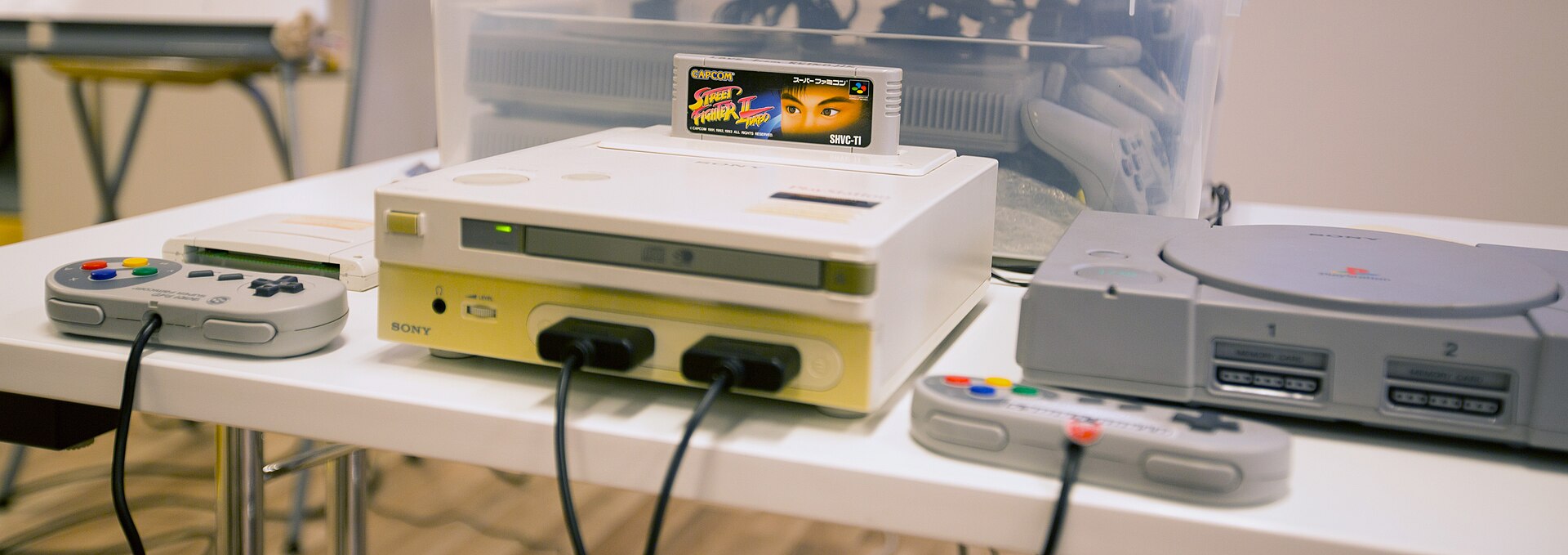
The surviving SFX-100 prototype: a Super Nintendo and a CD-ROM drive in one shell, built for a format that never launched. Photo: Wikimedia Commons.
An Emulator Learns A Dead Format
Documentation alone does not make software. The next step landed on 21 March 2016, when Korth released no$sns version 1.6 with SNES-CD support built in. The emulator could simulate a disc being inserted and ejected, read disc images in the formats Korth’s research had defined, and handle the machine’s built-in memory management — a feature the original reports compared, reasonably, to a PlayStation memory card, since the prototype was designed to keep save data without a cartridge in sight.
Tucked into that changelog, between fixes for sound mixing and notes on flash cartridges, sat the line that made history: the release included a SNES-CD version of Magic Floor, described by Korth himself, with characteristic understatement, as the first ever SNES-CD game released. Ever.
So What Is Magic Floor?
Nothing about Magic Floor was new except its destination. Korth had written the game years earlier as a freeware sample — a demonstration program for his A22i assembler and the no$gba debugger, dating back to a 2002 Game Boy Advance version. It is a small puzzle game in which you play a boulder that has discovered a hidden underground hall beneath its magic cellar, where the floor itself is bewitched and behaves in funny ways. Versions had already wandered across an eccentric list of platforms, from the GBA to the Satellaview broadcast system and Nintendo’s Super System arcade hardware.
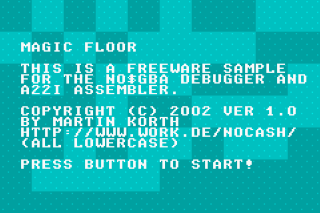
The title screen of the original 2002 Game Boy Advance version of Magic Floor — the little freeware sample that Korth would carry across to the Super Disc in 2016. Image: GameBrew.
That modesty was the point. Porting an existing, well-understood program was the fastest way to prove the whole chain worked: that the dumped BIOS was genuine, that the documented disc format was correct, and that code written by an outsider could boot on a machine that had spent 25 years as a museum piece. Magic Floor on Super Disc was a proof of concept wearing a puzzle game’s clothes.
One correction to the record, because the original coverage of this story — including the headline this article replaces — blurred it: in mid-March 2016 the game had been announced and its disc version prepared, but the updated emulator needed to run it had not yet been released, so for a brief window the first SNES-CD game was released yet unplayable, waiting on no$sns 1.6 to catch up on 21 March. “Has been released” was doing some heavy lifting. The milestone is real, but it arrived in two steps, a week apart.
Why A Boulder Mattered
It is worth pausing on the strangeness of the situation. The Super Disc was a commercial format backed by two of the largest electronics companies on Earth. It had been unveiled at the Consumer Electronics Show in 1991, written into contracts, and killed by one of the most famous double-crosses in industry history. Hundreds of prototype consoles were built. And the format’s entire public software library, a quarter of a century later, began with one programmer’s decade-old freeware demo about a boulder.
That is also why the release mattered beyond its size. Homebrew development depends on documentation, and documentation about the SFX-100 had been locked inside a cancelled corporate project. Korth’s specs, his emulator support and his little port formed a complete, public toolchain where none had existed. Anyone who wanted to write the second SNES-CD game — or the tenth — now had a floor to stand on. Magic Floor, appropriately enough.
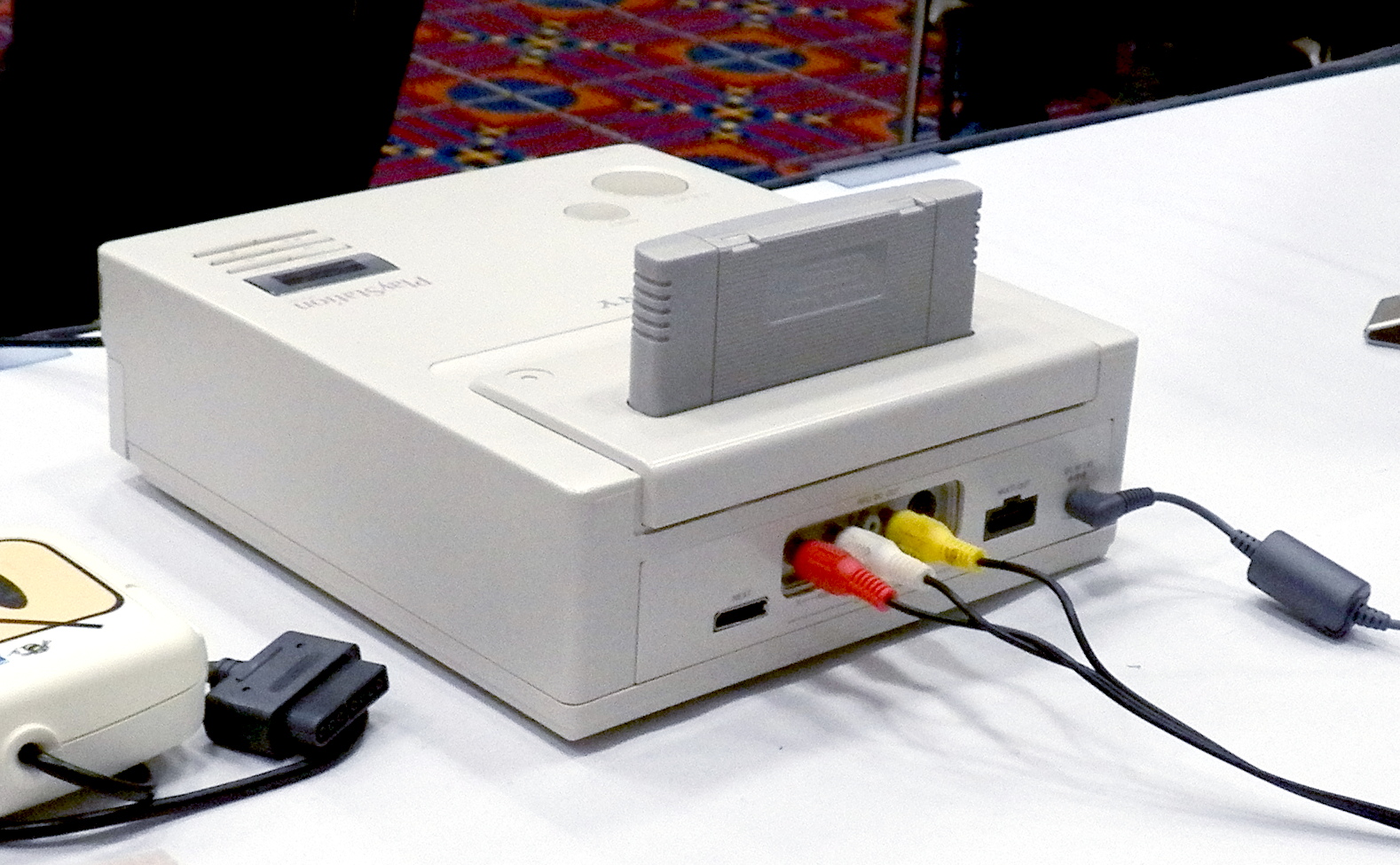
The back of the prototype, photographed at the Portland Retro Gaming Expo in 2018: cartridge slot on top, CD drive below, and a generation of what-ifs in between. Photo: Wikimedia Commons.
Hindsight: The Boss Arrives, And The Real Machine Answers
Hindsight: the second SNES-CD game was not far behind, and it is the one most retrospectives call the first — wrongly, but understandably. In July 2016, German programmers Dieter Lazer and Chrono Moogle released Super Boss Gaiden, a full, purpose-built action platformer whose joke premise — a Sony president rampaging through headquarters after learning the prototype has escaped into the wild — made it the format’s first original game, as distinct from Magic Floor‘s earlier port. If you have seen one of them described as “the first Nintendo PlayStation game,” you now know why both claims circulate: March had the first release, July had the first game written from scratch for the machine.
Hindsight, continued: in 2017 the story completed a strange loop when the surviving prototype was repaired on The Ben Heck Show and its long-dead CD drive finally spun up. The disc it booted was Magic Floor — and the game glitched on real hardware, revealing that the emulators had made assumptions the actual SFX-100 did not share. The proof of concept had one last proof to offer: emulation of the format was still, itself, a work in progress. The prototype console was later sold at auction in 2020 for $360,000. Magic Floor remains what it always was — a few dozen kilobytes of freeware. It is also, permanently, entry number one in the Super Disc catalogue.