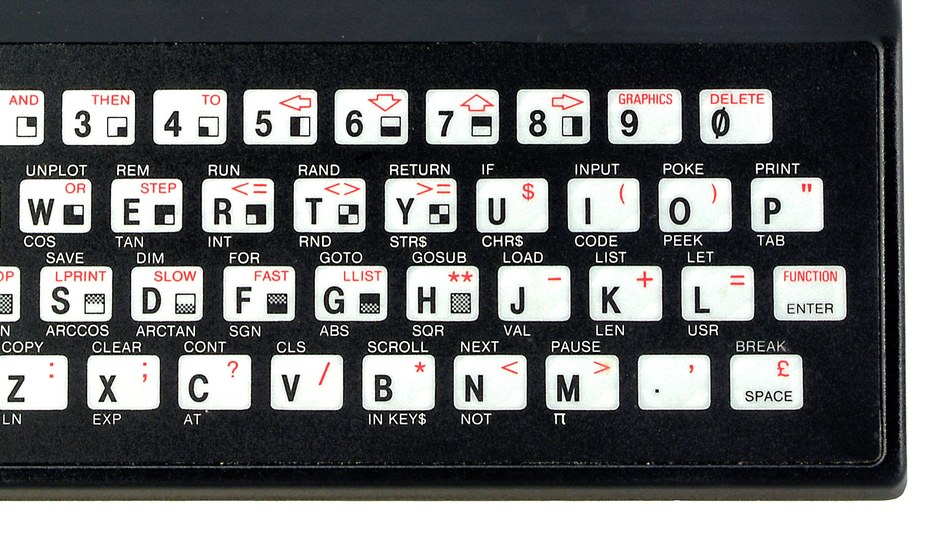
In July 1982, America got its first computer under $100 — and it was British. The Timex Sinclair 1000, the T/S 1000, was the Sinclair ZX81 reborn for the New World: the same black wedge, the same membrane keyboard, the same four-chip minimalism, adapted by the Timex Corporation of Waterbury, Connecticut, for American televisions and American shops. At $99.95 it was advertised, accurately, as the first home computer under a hundred dollars, and it sold through channels no computer had used before — Timex’s own dealer network, department stores, drug stores — to buyers no computer had reached before. Half a million Americans bought one in 1982 by the commonly cited count; early 1983 trade claims ran to 600,000 in the United States. For eighteen months, the cheapest computer in America was a Sinclair wearing a watch company’s name.
The marriage made industrial sense, because Timex was already in the family. The ZX81s themselves were manufactured by Timex at its Dundee plant in Scotland — the British run of the machine rolled off a watchmaker’s lines — and Sinclair had sold the ZX81 in the US under licence from late 1981. When the joint venture’s own model came, announced on 20 April 1982 and shipped that July, the changes were few, practical and telling. An NTSC modulator replaced the British PAL unit, so the wedge could talk to American televisions. Extra shielding answered the FCC’s strict rules on radio emissions. And — the headline specification — the onboard RAM doubled, from 1K to 2K. In a machine this minimal, doubling the memory was a genuine upgrade, the difference between the display file eating the computer and a small program surviving alongside it; Timex marketed the machine as a complete, ready-to-go system for $99.95, with the 16K RAM pack at around $50 and the little thermal printer at $100 in the launch literature.

The $100 barrier
Price barriers are psychological before they are financial, and $100 was the American one. The advertisement ran in Popular Science in August 1982 under a headline that needed no other copy: “Now: World’s First $100 Personal Computer.” Connected to your television, Timex promised, it was a complete system — compute numbers, display text, draw pictures, write your own programs in its built-in BASIC. The pitch was aimed not at hobbyists, who already had their TRS-80s and Apple IIs, but at the vast American public who had never owned a computer because computers cost as much as cars. The T/S 1000’s proposition was that a computer could cost as much as a watch — Timex’s own product — and be bought the same way, in the same shops, on the same shopping trips.
It worked, briefly and enormously. The T/S 1000 dominated the American market it had created: by one careful count, 500,000 units in 1982 alone. And the software crossed the Atlantic in both directions — Psion’s Flight Simulation was marketed in the US as The Flight Simulator for the machine; Mazogs travelled under licence to Softsync; the ZX81’s British catalogue became, in Timex packaging, America’s first software library for the under-$100 class. Historians of the period are right to treat the launch as a landmark in affordable computing: before the T/S 1000, cheap computing was a British eccentricity. After it, it was an American market expectation.
A watch company from Connecticut took a £49.95 Cambridge wedge, doubled its memory, taught it American television, and broke the $100 barrier. For one bright year, the future was a Timex.
The doorstop winter
The fall was as fast as the rise, and it is part of the record. The machine’s limits — 2K, a membrane keyboard, no colour or sound — met American expectations the advertising itself had raised, and the returns mounted; the T/S 1000 acquired the era’s cruelest nickname, the “doorstop,” for the fate of so many units. Sales fell from their 1982 flood to a fraction of it in 1983; the price was cut, and cut again, with Kmart clearing machines at $29.97; the T/S 1500 — 16K built in, a Spectrum-style case and real keys — tried to answer the complaints and could not reverse the story. In the first weeks of 1984, Timex withdrew from the American home computer market entirely, eighteen months after entering it, and took the cheapest machine in America with it.

The British perspective reframes the obituary. The ZX81 at home was not a doorstop but a dawn — because Britain’s buyers met it as a programmable machine sold by a computer company, while America’s met it as a $100 appliance sold by a watch company, and the two experiences diverged exactly where the marketing did. The T/S 1000 taught hundreds of thousands of Americans to program — for every discarded unit there was a teenager who learned BASIC on one, the “my first computer” of a generation of US programmers — and it forced the price war that made every subsequent American home computer cheaper. The Commodore 64’s march downmarket, the whole brutal economics of 1983, runs partly through Waterbury.
The sequels that could not save it
Timex did not surrender the idea at the first reverse. The T/S 1500 answered the 1000’s critics point by point — 16K of memory built in as standard, a silver case in the Spectrum’s manner, a keyboard a touch typist could survive — and the T/S 2068, arriving in 1983, was a genuine colour computer in the Spectrum’s family, cartridge port and all. Neither reversed the story. The 1500 inherited a market that had already learned to expect more for its hundred dollars, and the 2068 met the full force of the American price war it had helped to start. When Timex withdrew in the first weeks of 1984, the joint venture closed with it, and the American Sinclair story became a might-have-been told in eighteen months of extraordinary sales. The machines themselves lingered — in thrift shops, in classrooms, in the cupboards of the half-million households of 1982 — quietly teaching BASIC for years after the company that sold them had gone back to watches. Product lines die on schedule. Installed bases take longer, and the T/S 1000’s installed base was, for a machine sold as an appliance, remarkably unwilling to stop computing.
Two nations, one wedge
The T/S 1000 remains the most interesting member of the ZX81 family precisely because it is identical and different at once: same chips, same keyboard, same 3.25 MHz heartbeat under the FCC shielding, but sold as a different promise in a different retail world. The ZX81 said: here is a computer, learn it. The T/S 1000 said: here is a computer, it costs less than $100. Both statements were true. Both built the future. Only one of them got called a doorstop, and history has been quietly revising that verdict ever since — the little Timex is now a museum piece, a collector’s staple, and the answer to a quiz question no American computer fan misses: what was the first computer under $100? A Sinclair. Of course a Sinclair.