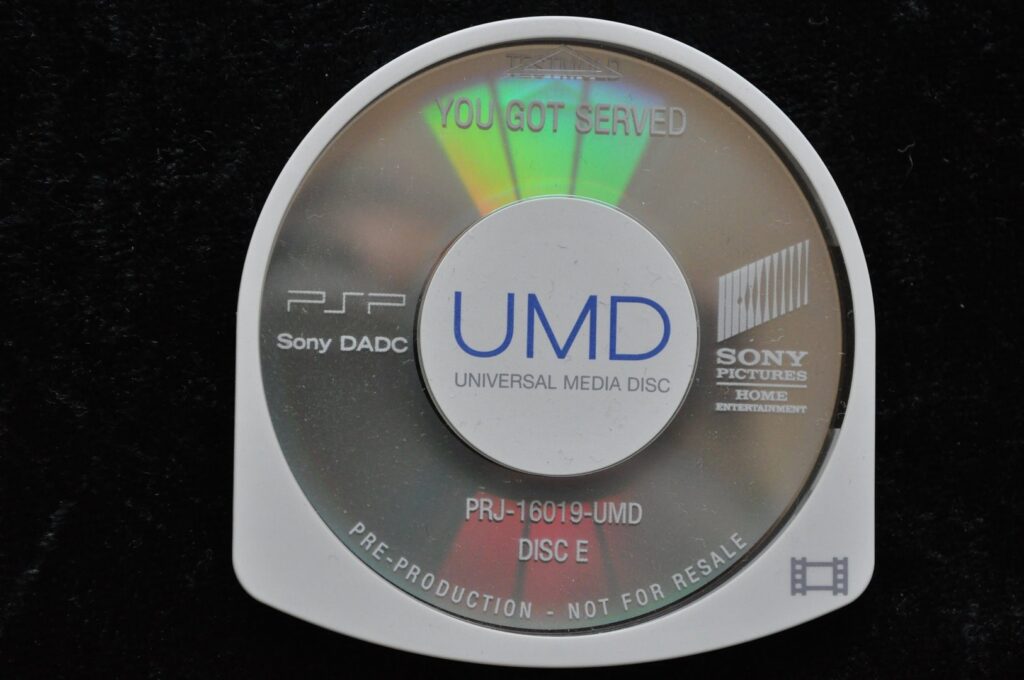
At a glance: Feature · The Universal Media Disc · Sony, 2004–2014 · The format that tried to be everything
Pick up a Universal Media Disc and you are holding an argument. The argument, made by Sony at the height of its powers, ran like this: the future of portable media would still be a disc — smaller, cleverer, locked inside a protective caddy, carrying games and Hollywood films on the same 60 millimetres of optical plastic — and Sony would own it the way it had owned the Compact Disc’s co-patent and nearly owned everything since. The UMD was the PSP’s defining technology and its defining wager. It lost. But for about three years, in the middle of the 2000s, it looked very much like it might win, and the story of why it didn’t is the story of the modern media age arriving early.
The engineering first, because the engineering was genuinely fine. A UMD stores up to 1.8 gigabytes on a dual-layer disc a little over half the diameter of a CD, read by a blue-violet-adjacent laser system miniaturised into the PSP’s slim body. The disc never touches the world: it lives permanently in a hinged caddy with a shutter, a format-level acknowledgement that portable media gets dropped, scratched and carried in school bags. Region coding, copy protection and a proprietary specification kept the format a Sony fiefdom — no blank UMDs, no third-party burners, no pressing plants outside Sony’s control. As a games format, that was a feature. As a would-be world standard, it was the original sin.
The Walkman pitch and the movie miracle
Sony did not sell the UMD as a games disc. It sold the PSP as, in Ken Kutaragi’s famous phrase, the Walkman of the twenty-first century — a convergence device — and UMD Video was the proof. From 2005, the major studios lined up: Sony Pictures, Warner, Disney, Paramount, Lionsgate. Films that had taken years to reach home video economics arrived on UMD within eighteen months of the format’s birth, and for a while they sold startlingly well. Retailers built UMD movie sections. A generation remembers buying a film they could only watch on one screen they owned, on a train, and feeling like the future had been personally delivered.
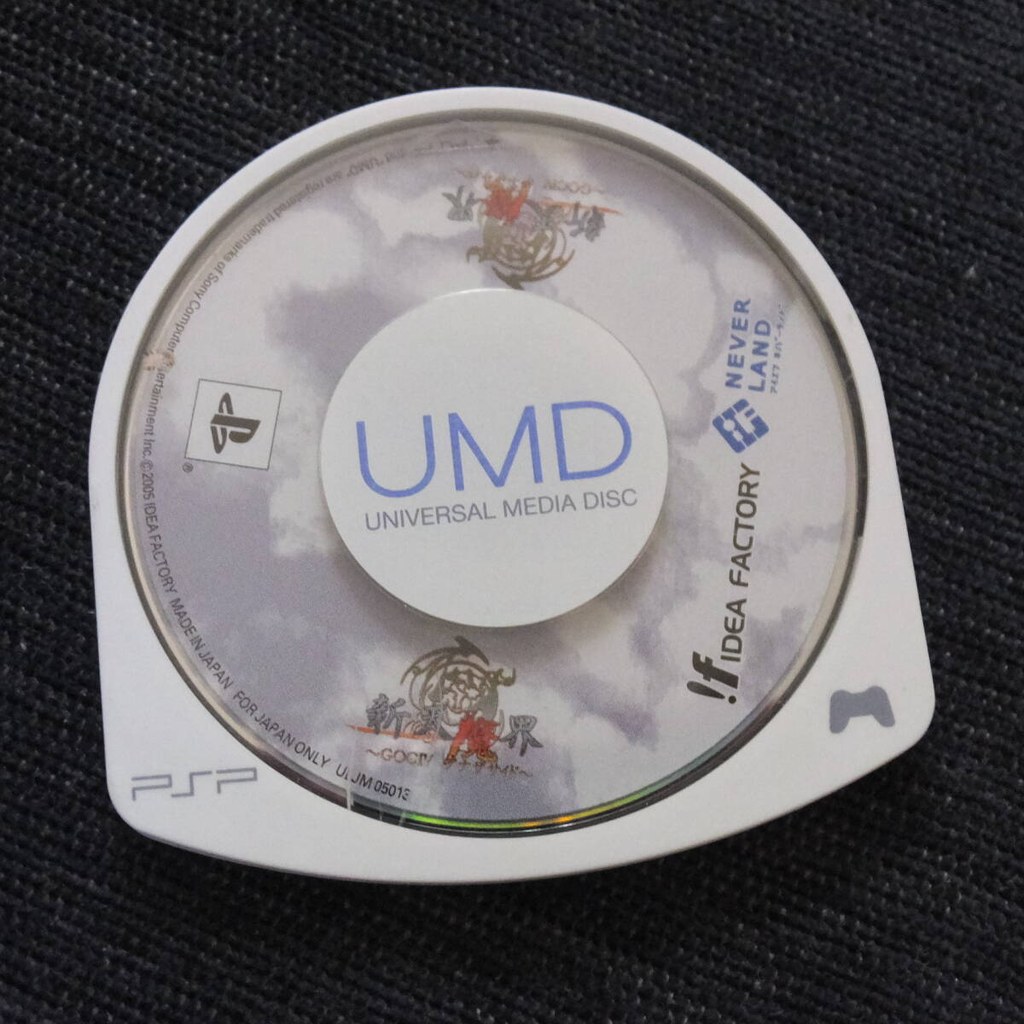
The miracle contained its own ending. UMD movies typically cost as much as — often more than — the same film on DVD, a disc that played on the television, the laptop and the car player the family already owned. The PSP’s screen was gorgeous and small; the proposition asked consumers to buy their film libraries a second time, in a format that worked in exactly one place. Studios noticed the arithmetic before Sony did. In 2006, within months of each other, Warner and Paramount cut their UMD slates, retailers began clearing shelf space, and the trade press wrote the format’s obituary while the PSP itself was still young.
The costs the games paid
Games, the format’s surviving half, paid the UMD’s taxes for a decade. Optical loading meant load times — some early PSP games became bywords for them, with wrestling titles and open-world ports testing players’ faith between matches and missions. The drive drank battery and made noise; the PSP’s famous whir is a UMD seeking. Developers engineered around it with data installs, streaming tricks and level design shaped by seek times, and the very best PSP games are partly triumphs over their own medium. When Sony’s own studios began treating the disc as an obstacle course, the format’s defenders grew quiet.
The deeper problem was philosophical. The UMD bet that physical media’s reign would continue long enough for a new proprietary format to establish itself — in the exact years when the iPod had already taught the world to carry media as files, broadband was arriving in homes, and the iPhone was about to teach it to carry media as streams. Sony, the company of the Walkman, understood portable media better than anyone alive. It simply believed its understanding entitled it to one more format. The market, rudely, had moved on to formats nobody owned.
The afterlife of a little disc
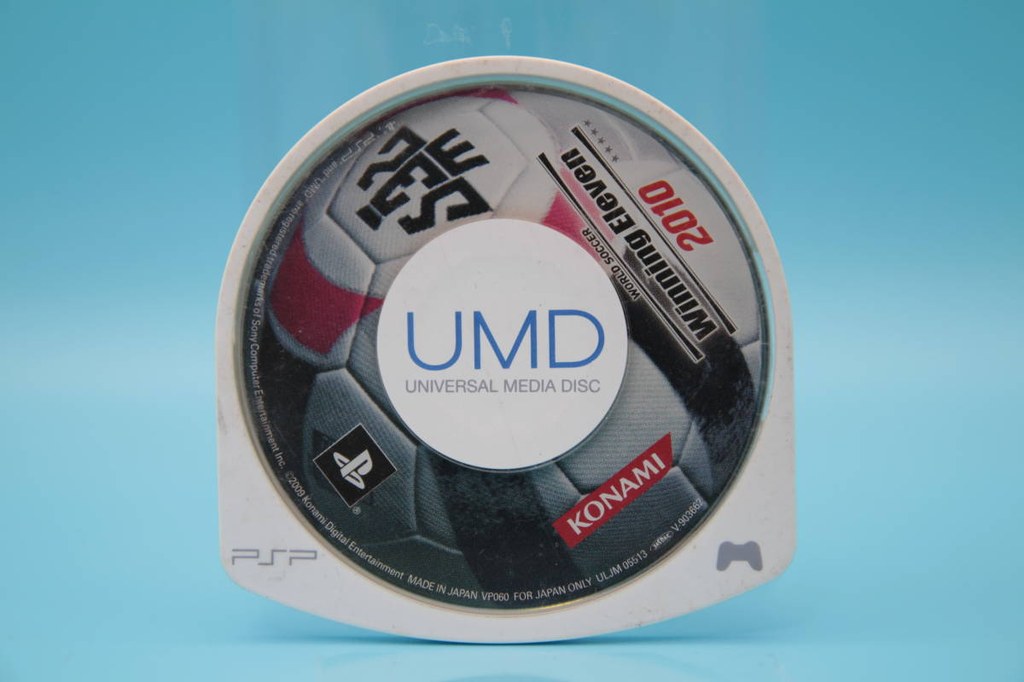
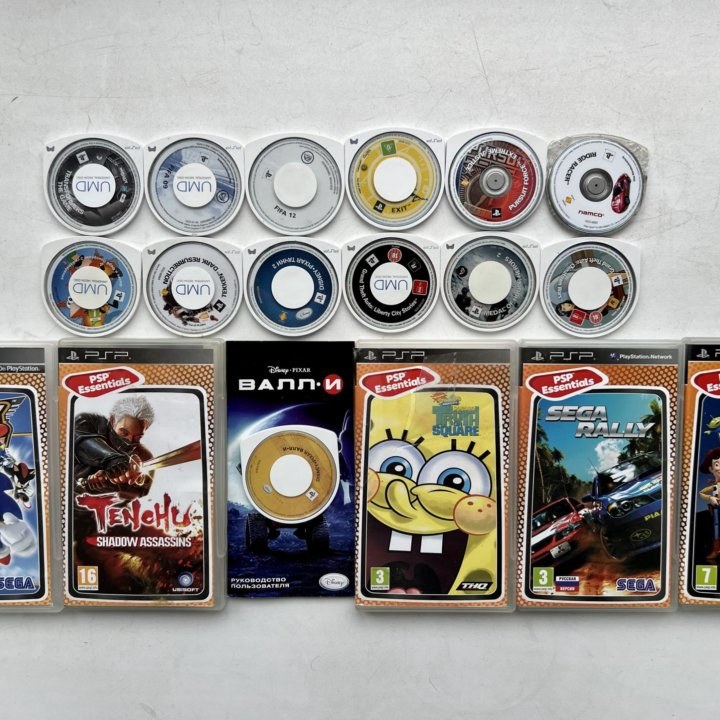
And yet. The UMD’s failure was a failure of ambition’s scale, not of execution, and its afterlife has been kind. The PSP sold over eighty million units; its games library, all of it on this odd little disc, is one of the great handheld catalogues. Collectors now prize the format’s completeness — every PSP game in the same white-spined uniform — and the caddy that journalists mocked turns out to be why twenty-year-old UMDs still play while their DVD contemporaries rot. The bet against the future lost. The artefact the bet produced is a small masterpiece of industrial design that outlived its own obituary.
Verdict in plastic
Remember the UMD the way you would remember Concorde: a beautiful, expensive, technically daring answer to a question the world stopped asking, from the last moment when a single company could plausibly try to own the future of media outright. The little disc deserved a longer decade. It got a fascinating one.
Region locks and grey imports
The UMD’s region coding, inherited from DVD’s playbook, created a grey economy of its own: PSP hardware was effectively region-free for games, but UMD movies enforced their regions, so a traveller’s film bought at an airport might refuse to play on the PSP in their bag. The asymmetry delighted importers of Japanese games — the PSP became the era’s great import machine partly because its games ignored the map — while quietly teaching film buyers that the little disc’s rules served its owner, not its audience. Formats teach consumers what to expect from ownership. The UMD’s lessons were not the ones Sony intended.
The sound of a format
Ask a PSP owner to remember the UMD and many will make the noise first: the clunk-whir of the tray, the seek chatter under a loading screen, the specific silence when a game finally streamed. Every format has a soundscape — vinyl’s crackle, the VHS clunk, the Dreamcast’s famous grind — and the UMD’s was intimate, mechanical, close to the ear. It is a reminder that media history is sensory as well as commercial. The little disc lost the market. In the memory of everyone who carried one, it kept the room.
What the PSP proved despite its disc
The final irony belongs to the games. The PSP library’s greatness — the subject of the twenty articles beside this one — was achieved on the UMD, through its load times and seek speeds, by developers who treated the format as one more design constraint to be beaten beautifully. Formats fail; libraries endure. When the last UMD drive falls silent, the games will be running somewhere — on emulators, on re-releases, on hardware Sony has not imagined yet — which is the fate the little disc always wanted for its contents, if not for itself.
The movie section’s last stand
There is a photograph every PSP retrospective eventually prints: a mid-2000s electronics store’s UMD movie wall, hundreds of white spines, a whole cinema in miniature. What the photograph cannot show is how normal it felt — how completely the format had inserted itself into retail’s furniture before it vanished. Technologies do not usually die from that height that fast. The UMD’s fall is studied now precisely because its rise was real: this was not a format nobody wanted, but one everybody wanted briefly, at the wrong price, in the wrong decade.
So file the UMD where it belongs: not with the punchline formats, the MiniDiscs-in-waiting of lazy listicles, but with the great transitional technologies — the machines and media that carried an industry across a river it could not swim, and were left on the far bank. The PSP crossed on it. Eighty million crossings is not a failure of transport. It is a bridge that did its work and was, as bridges are, mistaken for the destination only by the people who sold the tickets.