At a glance: Feature · PSP Go (PSP-N1000) · Sony, 2009 · The download-only experiment
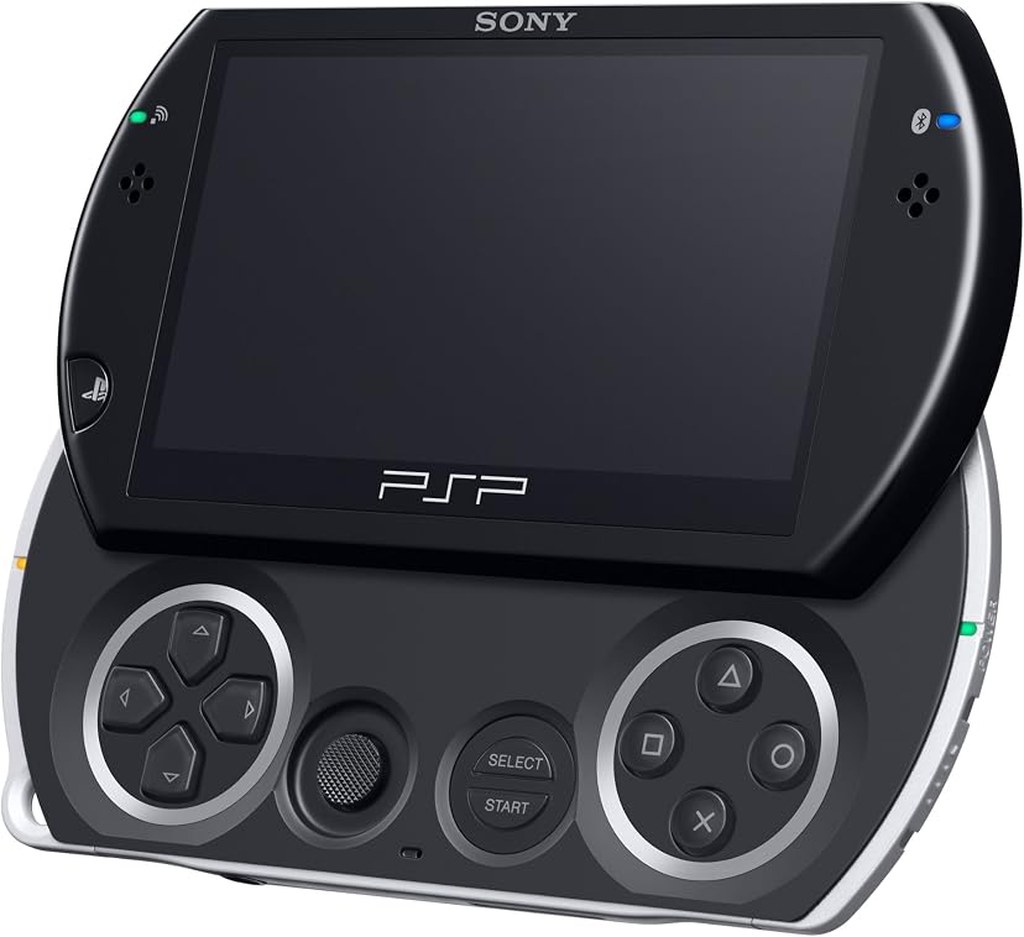
The PSP Go is the most interesting failure Sony ever put on a shelf. Launched in October 2009 at $249 — eighty dollars more than the PSP-3000 sitting beside it, which played the same games and also played the discs its owners already had — it removed the UMD drive entirely, betting the PSP’s second act on downloads, a 16GB internal memory and a sliding-screen design of real beauty. It was discontinued in most of the world within eighteen months. It was also, in almost every particular, a preview of the games industry’s next fifteen years, delivered four years before the industry was ready to applaud.
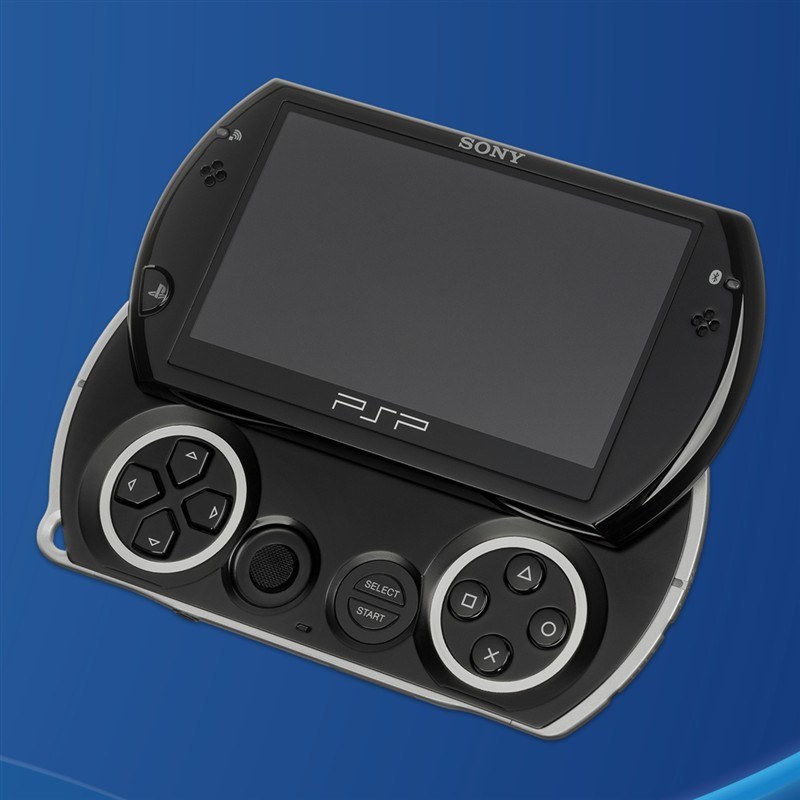
Start with the object, because the object was right. The Go is small — startlingly small, 43 percent lighter than the original PSP, its 3.8-inch screen sliding up over controls with a mechanism that still feels expensive. Closed, it is a media pebble; open, a proper games machine with the PSP’s full face-button layout compressed into a tighter, cleverer arrangement. Designers of the era’s phones were converging on the same slab; Sony’s games division got there with a hinge, a D-pad and no apologies. As industrial design, the Go belongs in the PSP family’s hall of fame, and collectors who handle one today tend to say so within a sentence.
The store that wasn’t ready
The Go’s problem was never the hardware. It was the ecosystem it depended on. Buying a game meant the PlayStation Store — in 2009 a slow, sparsely stocked shop where a meaningful share of the PSP’s back catalogue simply was not available for download, and where prices for digital games routinely matched or exceeded the discounted UMDs in physical stores. There was no way to convert the discs you owned. Sony trialled a UMD conversion programme in Japan and quietly let the idea die elsewhere, leaving the Go’s most natural customers — existing PSP owners with libraries — facing the prospect of rebuying their own games at full price for the privilege of a smaller machine.

Retail delivered the verdict before consumers could. Shops that made their margin on software had no enthusiasm for a console whose games they would never sell, and shelf space — the era’s true kingmaker — went to the PSP-3000 and the DS. Sony’s own marketing seemed half-convinced: the Go launched beside, not instead of, its disc-playing sibling, and when the price dropped and the bundles improved, the message was already written. The experiment was not refuted. It was abandoned mid-sentence, by almost everyone, for reasons that had almost nothing to do with whether it was a good idea.
Four years early, in every detail
Now list what the Go proposed, and date the industry’s adoption of each. Download-only console: the Xbox One’s original pitch, 2013; the all-digital PS5 and Series S, 2020. A handheld as media hub, with video and music woven through the games: the modern default. Bluetooth controllers paired to a handheld docked to a television — the Go did this with a cradle and a DualShock 3, years before the Switch made the pattern the industry’s centre of gravity. Pause-and-resume a game state exactly where you left it, another Go feature, is now so standard it has no name. The machine reads today like a design document for the following decade, annotated by a market that charged it full price for arriving early.
The human cost of early is worth recording too. Go owners were, briefly, the industry’s test subjects: when Sony’s PlayStation Network suffered its great 2011 outage, a download-only console was a paperweight for weeks, a lesson in digital ownership the whole medium needed and the Go’s owners paid to teach. When the PSP’s storefronts finally closed years later, the Go’s library survived on its internal memory and the goodwill of re-download servers — a reminder that the experiment’s terms are still being negotiated every time a store shutters today.
The verdict of the second-hand market
History’s punchline arrived via the collectors. The Go, unloved at $249 in 2009, became one of the most sought-after PSP models on the second-hand market — prized for its screen, its size, its Bluetooth, and, in a twist its designers earned, its second career as a beloved emulation handheld once its protections fell. The market eventually paid a premium for exactly the machine it had refused at launch, minus the ecosystem that failed it. Being early and being wrong feel identical at the time. The PSP Go is how you tell them apart afterwards: check whether the future eventually showed up wearing its ideas. It did.
The accessories that told the story
The Go’s accessory line is a museum of its ambitions: a cradle that turned it into a tiny console, component cables for the television, a camera inherited from the PSP’s own add-on line, cases designed like fashion objects. Sony’s hardware teams believed in the machine and accessorised it like a flagship. Belief was never the missing ingredient — the missing ingredients were a price the market would accept, a store the market could browse happily, and a conversion offer for the libraries its best customers already owned. The Go is a case study in how many things must be right at once, and how being right about the future is only one of them.
The PSP that collectors rebuilt
The Go’s second life completed the argument its launch could not. Freed from dependence on a store and a disc drive, prized for its Bluetooth and its pocketable slide, it became the connoisseur’s way to carry the PSP library — a machine whose value rose as its original ecosystem fell away, because what remained was the design. Few consumer electronics earn that inversion. The Go did, in public, within a decade, which in technology is close to an apology delivered on schedule.

A note on the controls
Honesty about the object requires one reservation the collectors will confirm: the Go’s compressed controls — a smaller D-pad, a nub set close to the screen’s slide, start and select shrunk to suggestions — are a compromise for larger hands and longer sessions, and its single proprietary port was Sony being Sony at exactly the wrong moment. The future the Go predicted standardised its connectors and its store. The machine itself kept a few of its era’s bad habits, which is perhaps the most human thing about it: even prophets accessorise badly sometimes.
The 16GB question
Even the Go’s headline specification was a prophecy with a flaw in it: 16 gigabytes, generous in 2009, was sized for a library the store did not yet stock at prices owners would pay — and the Memory Stick Micro slot beside it used yet another proprietary Sony format, smaller and pricier than the standard sticks PSP owners already had. The future the Go imagined was capacious and standardised. The Go itself, faithful to its parentage, was neither. Prophets rarely get the details right; the honest ones, like this machine, get the direction.
The PSP Go sold poorly, reviewed politely and disappeared quickly — and predicted the next fifteen years of its industry more accurately than the machines that beat it. That combination makes it the PSP family’s most instructive member: proof that in technology, the verdict of the launch window and the verdict of history are different courts, and only one of them reads the future correctly. The little slider was right. It was simply, expensively, undeniably early — and there are worse things for a beautiful machine to be.