At a glance: Valkyria Chronicles II · PSP · Sega, 2010 · Strategy RPG · Score: 8.5/10
Shrinking Valkyria Chronicles for the PSP should not have worked. The PS3 original was famous for scale — its watercolour CANVAS engine painting battlefields you crossed in third person, squad tactics married to real-time movement. Sega’s answer was not denial but redesign: smaller maps, a schoolyard frame, the same heart. Valkyria Chronicles II is the rare demake-by-sequel that understands its source completely, trading spectacle for intimacy and ending up, in some players’ estimations, the most replayable entry in the series.
Two years after the Second Europan War, Gallia slides towards civil war: the Gallian Revolutionary Army, preaching ethnic purity after the Darcsen revelations of the first game, rises against the throne. The story’s centre is not an army but a classroom — Class G of Lanseal Royal Military Academy, a dumping ground of misfits led by Avan Hardins, a cheerful baker’s son investigating his brother’s death. The school frame divides opinion; this review sides with it. The academy gives the war a home front, the missions a cadence of terms and exams, and the cast — thirty-odd students with interlocking personal missions — a reason to be teenagers in a war story that knows what it costs them.
BLiTZ, pocket edition
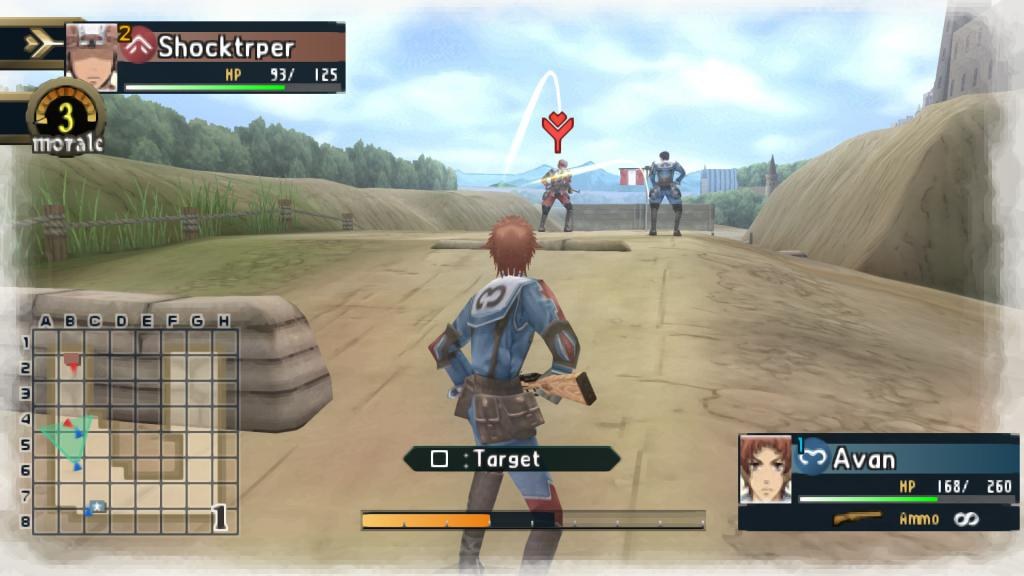
The battle system survives intact in spirit: command points spent from a top-down map, then the camera drops behind a single soldier for real-time movement and one decisive action, enemy fire ticking down your health as you run. The PSP edition’s smaller, segmented maps — linked by camps you capture to change your deployment — suit portable sessions and encourage aggressive, multi-front play. Classes branch and specialise: shocktroopers become flamethrower commandos, engineers grow into medics and mechanics, and the fencer — a cadet with a sword the size of a door fighting tanks — is the series’ most joyful invention.

Between battles, Lanseal’s academy loop is pure portable design: short events advance character stories, credits and materials from missions feed weapon development down branching trees, and orders, potentials and personal flaws give every student a mechanical personality. A cadet who fights better near flowers, another who wilts under fire — the first game’s trait system returns in force, and squad-building becomes an act of matchmaking weaknesses against missions. Co-operative and versus multiplayer, ad-hoc for up to four, extends the academy rivalry with friends.
Watercolour, widescreen
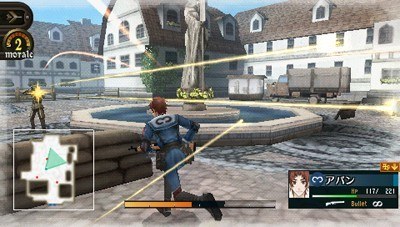
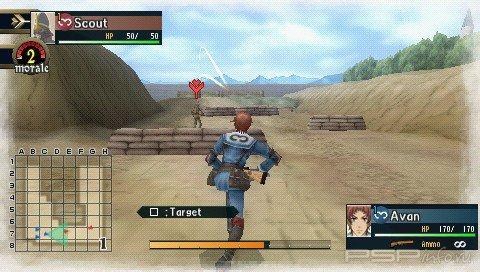
The CANVAS look translates gracefully: the pencil-shaded, storybook filter sits over smaller scenes without losing its identity, and the PSP’s screen makes the game read like an illustrated novel you direct. Performance holds through the busiest firefights, load times between areas are the only regular tax, and the soundtrack — Hitoshi Sakimoto again, in his element — gives school bells and artillery the same melodic seriousness. The English voice cast plays Avan’s optimism straight, which the script needs: sincerity is this game’s armour against its own melodrama.
The compromises are written on the box’s premise: maps repeat across the hundred-plus missions more than the PS3 game’s did, the story’s villains are sketched thinner than its heroes, and the absence of the first game’s sweeping single battlefields is felt by returning players. A third game, Japan-only on PSP, refined the formula further and makes II’s Western exclusivity a historical pity rather than a flaw. Judged on its own shelf, II is complete, generous and quietly brave about its themes.
Potentials: soldiers as people
The trait system is where II’s heart beats loudest. Every cadet carries potentials — personal mechanics born of biography: a farm girl steadied by open fields, a Darcsen engineer who fights harder when doubted, a snob whose aim improves at altitude and whose attitude improves nowhere. Personal missions unpack these traits into story, so building a squad becomes an act of casting: you learn thirty teenagers’ damage and arrange for the war to meet their best selves. Strategy games rarely make the personnel file the best writing in the game. This one does.
The tank is a character too
Class G’s light tank — customisable across turret, armour and absurdity — deserves its billing as the squad’s thirty-first member. Tank builds become strategic identity: the APC that ferries cadets between the segmented maps’ camps, the gun platform that anchors a defence, the flamethrower experiment nobody admits to authoring. In a game about a school’s misfits, the hand-me-down tank they share is the perfect emblem — underfunded, over-loved, and considerably more dangerous than the enemy’s intelligence suggested.
Grading the academy frame
Time has been kind to the school setting that some 2010 reviewers resisted. Lanseal’s terms give the civil war a rhythm no map screen could — classes between battles, festivals before offensives, graduations the plot weaponises — and the frame lets the game argue its thesis quietly: that a country which sends its classrooms to war has already lost something the fighting cannot restore. The final act earns its darkness precisely because the game let its cast be young first. Misfits, all. Heroes, most. Students, always.
The portable trilogy’s middle child
II sits between a PS3 classic and a Japan-only sequel that many importers call the series’ peak, and it carries the awkward honour of being the West’s only portable Valkyria. Judged as the ambassador it had to be, it is superb: complete in itself, generous in systems, and faithful to a formula that should not have fit in a pocket at all. The CANVAS engine’s sketchbook lines on the PSP screen remain a small miracle of art direction surviving compression. Enlist at Lanseal. Class G has a desk free.
Downloadable missions and the cameo economy
Sega supported II with the era’s full playbook: downloadable missions doled out over months, password-unlocked extras, and cameo cadets drawn from Sega’s wider family for players who knew where to look. The support kept Lanseal’s noticeboard fresh long after the credits and gave the academy the feeling of a school with an alumni network. It is easily forgotten now that distribution has moved on — which is a shame, because II’s post-launch life was a model of how to keep a portable game a going concern.
Materials, credits and the upgrade tree’s pull
The development economy is II’s quiet addiction: every mission pays in certificates and scrap that branch the weapon trees — a rifle line that trades accuracy for anti-armour bite, armour that favours mobility over the Darcsen-hating enemy’s preferred targets. Because missions are short and the trees are visible, the game generates the portable player’s favourite sentence: one more mission and I can afford it. A hundred missions later, the sentence is still true. Sega’s designers understood the handheld session the way the academy understands its cadets: completely.
A closing word for series veterans deciding whether the small war is worth their time: yes — for the fencer alone, for the personal missions, for a Gallia seen from its classrooms rather than its command tents. And for newcomers, II is a legitimate front door to the series, friendlier in scale and no smaller in heart. The academy bell is ringing over Lanseal. Class G is present, accounted for, and considerably better armed than the timetable suggests.
Verdict
A model PSP sequel: smaller where the hardware demands, bigger where the design allows, and faithful to a beloved original’s soul. Class G, dismissed. With honours.