
At a glance: Venture · ColecoVision · Coleco/Exidy, 1982 · Dungeon action · Score: 8.0/10
Long before dungeon crawling had a name, Venture was doing it with a grin. Exidy’s 1981 arcade game stars Winky — a round, smiling, bow-armed hero whose entire personality is cheerful greed — raiding a multi-room dungeon complex for treasure while monsters guard every hoard. The structure will feel startlingly modern to anyone raised on later action adventures: a map screen of chambers, each chamber a self-contained combat puzzle, clear them all and descend to a harder floor. Coleco chose it for the ColecoVision’s launch window, and the conversion is so faithful that it preserves both the game’s charm and its one notorious act of cruelty.
The cruelty is the Hallmonster. Linger too long inside a treasure room and a green, invulnerable Hallmonster materialises and hunts you down. It cannot be shot. It can only be fled, abandoning the room — and the treasure resets. It is one of the earliest and purest hurry-up mechanics in games, and it gives Venture its tempo: enter, assess, loot fast, get out.
Two screens, one loop
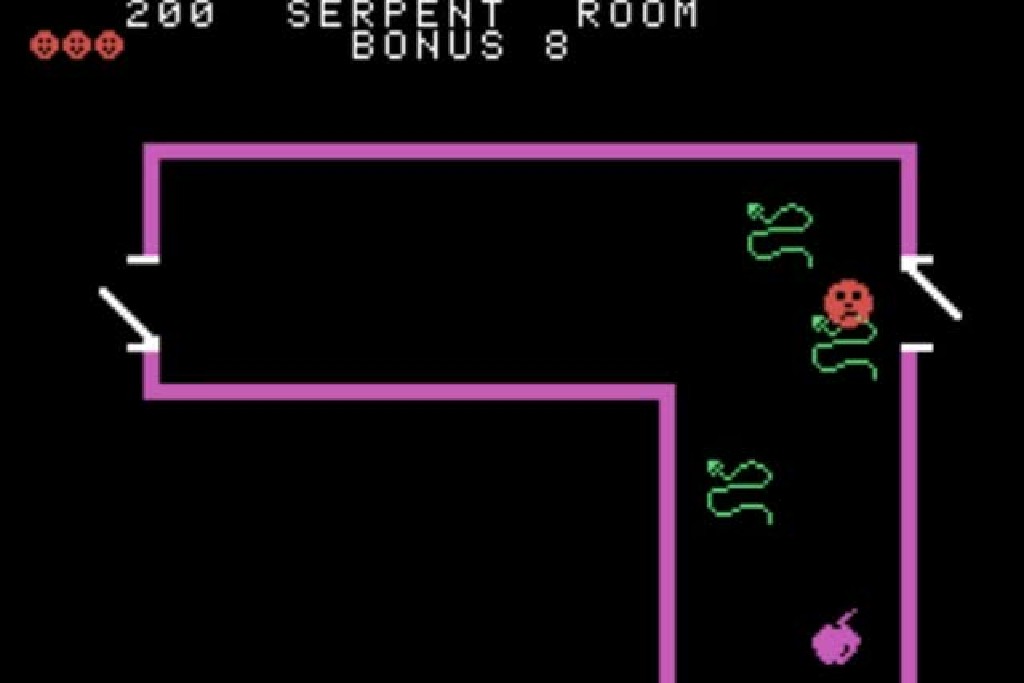
Venture alternates between two scales. On the map view, Winky is a small face moving between chamber doors while monsters drift in the corridors. Choose a room and the view zooms in: now Winky is large, the treasure sits somewhere in the chamber, and its guardians — snakes, skeletons, goblins, demons and more across the floors — converge from every side. Shoot them with the bow (your arrows fly in eight directions and keep travelling until they hit something), grab the treasure, and escape before the Hallmonster’s patience ends. The zoom between scales was a genuine arcade flourish in 1981, and the ColecoVision reproduces it cleanly.
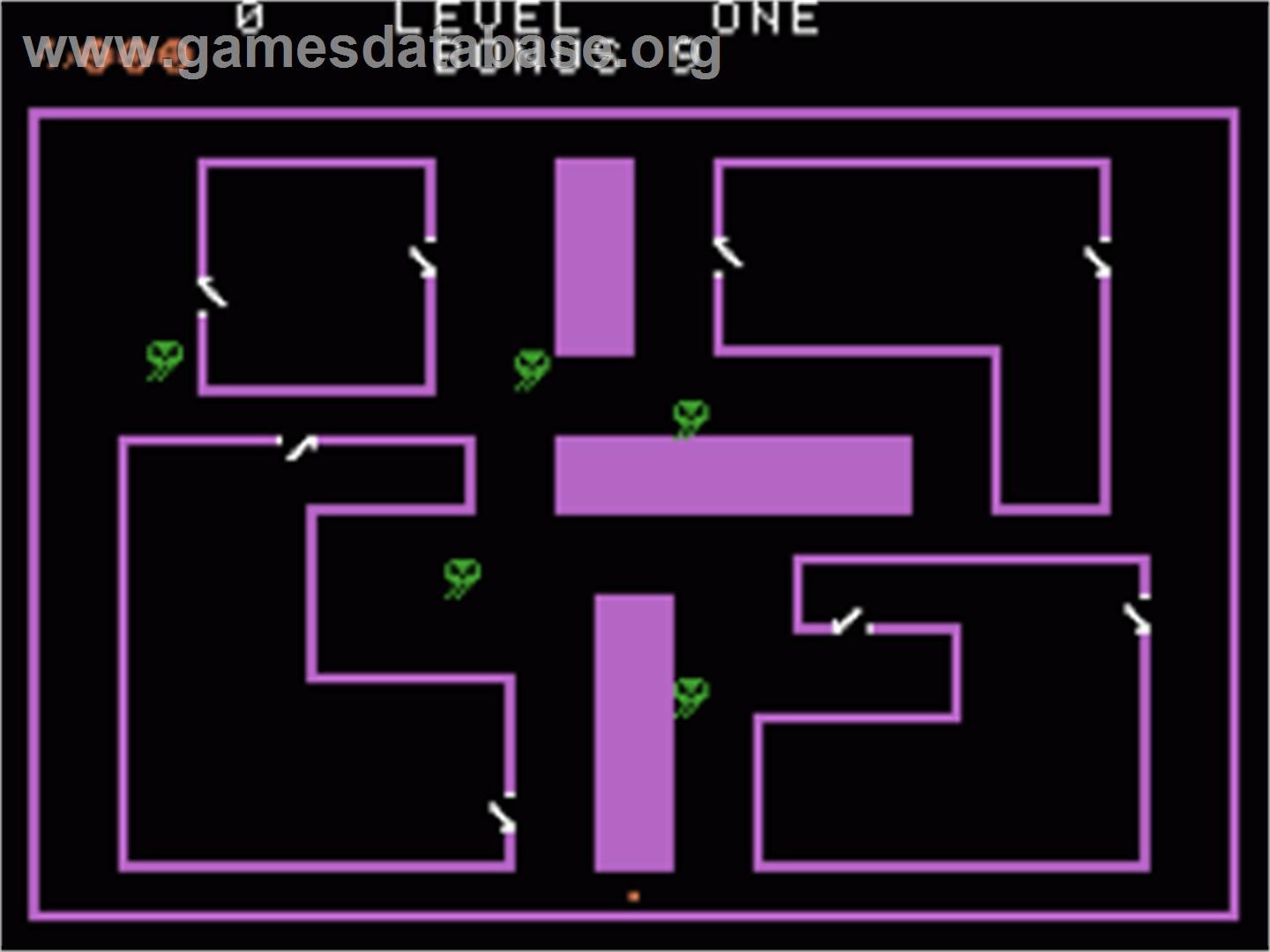
The room design is the game. Each chamber is a little arena with its own geometry and guardian mix: some are open shooting galleries, others are cramped warrens where an arrow down a corridor is the only safe plan. Monsters speed up floor by floor, and later chambers layer hazards so that the route to the treasure and the route back out are different problems. The score system rewards completed rooms and full-floor clearances, and the risk calculus — one more room at low health, or bank the floor? — is recognisably the ancestor of a thousand roguelite decisions.
Simple looks, sharp teeth
Nobody will mistake Venture for the ColecoVision’s graphical showcase; it was never that even in arcades. The sprites are bold and readable rather than detailed, the chambers are spare, and Winky’s fixed grin is doing most of the character work. What the conversion nails is clarity: you always know what is hunting you, where the doors are, and how long you have — the last conveyed by the game’s rising tension rather than a timer bar. Sound is sparse arcade punctuation, though the little fanfares for treasure claimed give each room a satisfying full stop.
The ColecoVision stick handles the eight-way movement and shooting adequately; the design wisely uses one control scheme for both, so there is no twin-stick problem to solve. Diagonal shots take practice, particularly when retreating, and the honest advice is to shoot the corridor you are about to flee down before you turn. Deaths, when they come, usually come from greed — the extra second spent lining up a shot as the room’s guardians close the net. The Hallmonster merely signs the paperwork.
Ahead of its time, at home
Venture’s home history is a study in conversion quality: the game appeared on several systems, and the ColecoVision version is generally regarded as the one that kept the arcade game’s structure and pace whole. That matters, because the structure is the legacy. Room-based looting, escalating floors, an invulnerable pursuer punishing delay — play a modern dungeon crawler and you are playing Venture’s descendants. On this console it also filled a role nothing else did: the launch library had platformers, shooters and maze games, but only Venture offered exploration, however miniature.
Floor by floor: what changes as you descend
Venture’s escalating floors reward a word of guidance. The early chambers teach the three core skills in isolation: shooting on the move, shooting on the retreat, and leaving — the discipline of abandoning a room whose treasure is not worth its guardians, which the scoring system quietly respects because a completed floor pays better than a heroic death. As the floors stack, the game layers its ideas: faster guardians, rooms whose geometry funnels you through kill zones, treasures placed to bait you into the room’s worst corner. The Hallmonster’s timing becomes the real difficulty dial — on deep floors the margin between entering, looting and leaving is a handful of seconds, and the players who thrive are the ones who plan the exit before the entrance. Two-player alternating play, a standard generosity of the era, turns all of this into a spectator sport: Venture is an unusually watchable game, because every room is a small heist with a visible plan and a visible moment where the plan goes wrong.
A genre in embryo
It is worth pausing on how much of the future is packed into this modest cartridge. The overworld-and-rooms structure, the escalating descent, the loot as score and as temptation, the pursuer who punishes dithering — these are the bones of games that would not be codified for years, running here on a launch-window cartridge that most buyers picked up as a curiosity. The ColecoVision version matters to that story because it is the version that preserved the design intact for the home audience: same rooms, same tempo, same smiling hero. Play it after the system’s arcade blockbusters and it feels like a dispatch from a different, more experimental industry — one that was also, in 1982, entirely real.
For collectors and first-time raiders
Venture’s cartridge is a common and inexpensive resident of the system’s bargain bins, which may be the best value-for-depth ratio in the entire library: few cartridges anywhere pack a genre’s whole blueprint into so little plastic. If you are choosing between the system’s versions of a Saturday afternoon, know that Venture also scales gracefully as a social game — its rooms are short, its failures are funny, and its heists are legible to a watching room in a way that denser games are not. New raiders should adopt one habit from the start: say the exit plan out loud before entering a room. It sounds theatrical until the Hallmonster appears mid-loot and the plan, spoken and remembered, carries Winky out by a corridor you would otherwise have forgotten. The grin, by then, will be mutual.
One more modern note: Venture’s influence is easiest to see with fresh eyes after playing almost any contemporary indie dungeon game, at which point the cartridge stops reading as a quaint early effort and starts reading as a design document the whole genre quietly signed. That afterlife costs the player nothing and adds a genuine historical pleasure to every room — you are not just looting a dungeon, you are watching an idea being invented in real time.
The verdict
Venture is modest in spectacle and rich in design: a tight, tense looting loop that predates its genre and still plays crisply today. The ColecoVision version is the faithful one, Hallmonster and all — and any player who enjoys watching a plan fall apart under time pressure will feel right at home.
Score: 8.0/10 — A smiling ancestor of the dungeon crawler, converted whole.