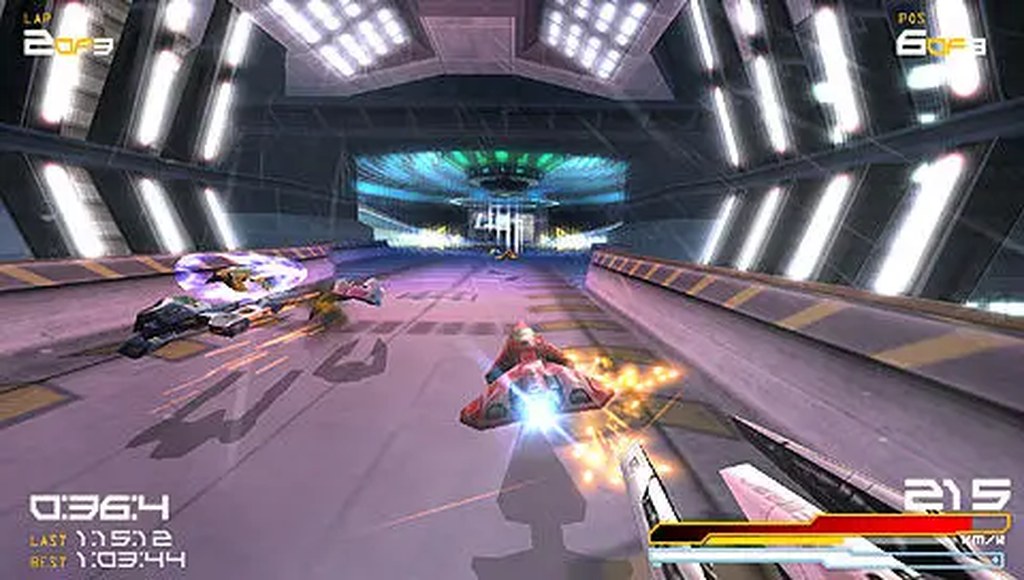
At a glance: Wipeout Pure · PSP · Studio Liverpool, 2005 · Anti-gravity racer · Score: 9.0/10
Wipeout needed saving in 2005, and it knew it. The series that had defined the original PlayStation’s cool had stumbled through the PS2’s Fusion — a game that mistook the formula’s elegance for something to be buried under weapons and gimmicks. Wipeout Pure, a PSP launch title from Studio Liverpool, performed the neatest trick in the series’ history: it went back to what worked, rebuilt it with modern craft, and shipped on a handheld as a statement of intent. The future of the franchise, it turned out, fit in your hands at 60 frames a second.
The structure is the classic one, polished. Eight teams — Feisar, AG Systems, Auricom, Qirex and friends, each with a ship balanced across speed, handling, shield and thrust — race twelve main tracks across leagues of rising speed classes, from the stately Vector to the face-melting Phantom. Time trials, zone mode, tournaments and single races fill the card, and the whole package is wrapped in a graphic identity by The Designers Republic’s successors that still looks like tomorrow’s idea of yesterday’s future.
Speed you steer with your shoulders
Pure’s handling is the series refined to a point: weighty without being stubborn, the ships drifting on a cushion of air that you trim constantly with the airbrakes — twin shoulder buttons that are not a brake so much as a second steering system. Mastering Pure means learning to brake-steer through hairpins while your thumb stays buried in the thrust, threading weapon pads and speed pads that share the same ribbon of track. The AI races hard but fairly, weapons disrupt rather than decide, and the barrel roll — flick the stick or D-pad mid-air to trade shield energy for boost — adds the risk economy every great Wipeout needs.

Zone mode deserves its own sentence in the history books: one ship, no opponents, an ever-accelerating lap count on a stripped, colour-shifting circuit until you kiss a wall once too often. It is Wipeout distilled to meditation and panic in equal measure, the mode Pure’s players cite first, and the direct ancestor of the Zone events that became the franchise’s signature thereafter.
The downloadable future, arriving early
Pure’s second revolution was invisible on the disc — because it was not on the disc. Studio Liverpool supported the game with free downloadable packs for months after launch: new tracks, new ships, new skins, delivered over the PSP’s Wi-Fi in an era when console DLC barely existed. The Gamma and Delta packs effectively expanded the game by half again, a generosity modern live-service games could study. In 2005, on a handheld, this was science fiction practised as customer service.
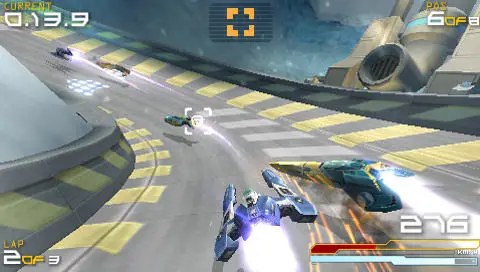
The presentation remains startling. Pure’s tracks — the harbour arcs of Vineta K, the vertical drop of Exostra Run, Sol 2’s sky-lane among the clouds — run with a smoothness and draw distance that launch-window software had no right to, and the licensed electronic soundtrack, from Aphex Twin to Photek, is sequenced like a DJ set that knows where the corners are. Cold Storage’s Tim Wright returning to contribute closes the circle with the PS1 originals.
Launch window, all-time great
Criticism, honestly filed: the single-player campaign can be gold-medalled by the persistent within a few weeks, the weapon balance occasionally turns a Phantom race into a lottery, and the PSP’s analogue nub is a tool you tolerate for steering rather than love. None of it survives contact with the whole. Wipeout Pure is simultaneously a restoration, a reboot and a tech demo that out-races games released years later on stronger hardware — the rare launch title that was also the system’s calling card for its entire life.
A design language you can hear
Pure’s menus, liveries and typography descend from The Designers Republic’s work on the PS1 games, filtered through Studio Liverpool’s own art team into something cleaner and colder. It matters more than graphic design usually does in a review, because Wipeout’s identity was always half racing game, half design object — the copy on a Feisar billboard is written with the same care as the corner that follows it. On the PSP’s screen, at launch, Pure looked less like a game than a product film for a future you could steer.
Multiplayer and the ad-hoc paddock
Eight-player ad-hoc racing was Pure’s party trick, and it transformed the game’s afterlife: this was the title PSP owners used to justify the machine’s Wi-Fi switch. Races hold up because the netcode-era sins — rubber-banding, weapon spam — are restrained by the game’s own balance, and ship choice becomes social: the AG Systems loyalist, the Qirex bully, the friend who only ever picks Piranha when it unlocks. Infrastructure online play existed in an era-typical, account-bound form; the local wireless is the version history remembers, and it remembers it fondly.

The class ceiling
Phantom class is where Pure stops being a racing game and becomes a reflex examination: speeds at which the track must be known rather than read, airbrakes feathered in single frames, barrel rolls chained off every crest. The game’s league structure earns its top end honestly, unlocking speed in steps that feel like promotions. Players who bounce off Phantom have still had a full career in the lower classes; players who conquer it join the small, smug priesthood who consider Pure’s sequel, Pulse, a refinement rather than a replacement.
Lineage and legacy
Pure rebooted Wipeout so successfully that its template — classic handling, league structure, zone mode, heavy post-launch support — governed Pulse, HD and the Omega Collection after it. Coming from Fusion, that was a rescue; coming from launch-day PSP, it was a miracle of timing. Studio Liverpool closed in 2012, and Pure stands among its finest memorials: the game that remembered what the future was supposed to feel like, at 60 frames per second, in the palm of your hand.
The packs, itemised in memory
Veterans still recite the download schedule like a festival line-up: Gamma’s Tigron and Van-Uber ships, Delta’s tracks, the Omega pack’s fan-designed liveries chosen by competition. Each drop was an event in the PSP’s first online community, proof that a handheld game’s launch could be a beginning rather than a shipment. Modern players inherit all of it folded into later editions and fan archives — but the ritual of checking for a new pack, memory stick ready, is a piece of 2005 that belongs to this game alone.
The shipwright’s argument
Pure’s eight teams are an argument about what speed costs, conducted in handling models: Feisar’s forgiveness, Auricom’s balance, Qirex’s armoured momentum, Piranha’s unlockable extremism. Learning a team is learning a philosophy of the corner — brake late and heavy, or carry speed and pray — and the game’s time-trial culture turned those philosophies into leaderboards of belief. Few racing games make the vehicle select screen a genuine decision. Pure’s remains one, twenty years on, because every ship is a fast answer to a different question.
Come for the racing, stay for the download packs, and remember the context: Pure launched beside handheld games that were proud to be shrunk console ports, and it refused the premise entirely. It was not a smaller Wipeout. It was the next Wipeout, which happened to be pocket-sized, and the series lived in its slipstream for a decade. If this review has a single sentence worth underlining, it is that one. The future started here, at Vector class, with the airbrakes warm.
Verdict
Essential: the best handheld Wipeout, a top-three series entry, and the game that proved launch software could be a classic rather than a demo reel with a price tag.