
At a glance: Lumines · PSP · Q Entertainment, 2004 (JP) / 2005 (West) · Puzzle · Score: 9.0/10
Every great handheld needs a puzzle game that justifies the hardware in ninety seconds, and the PSP got one of the best ever made. Lumines, designed by Tetsuya Mizuguchi’s Q Entertainment as the sister project to Rez’s synaesthetic experiments, was a launch title in Japan and the West alike — and for many early owners, marooned between UMD movies and shrunken console ports, it was simply the game the machine lived on. Twenty years on, its core loop has not aged a day, because it was never really about blocks. It is about playing music with your hands.
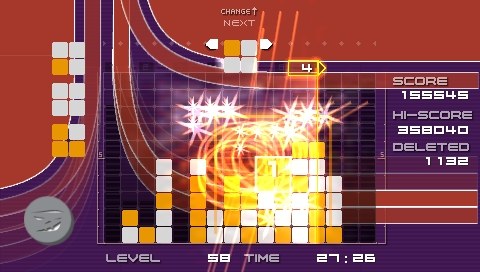
The rules fit on an index card. Squares of four blocks, in two colours, fall into a sixteen-by-ten well. Rotate them, drop them, and build solid 2×2 squares of a single colour. A timeline — a vertical bar synced to the soundtrack’s tempo — sweeps the well from left to right, and only when it passes does a completed square clear, scoring more the more you stack into a single sweep. That delay is the whole genius: Lumines is a puzzle game played in musical time, where greed must be choreographed to a beat.
The timeline changes everything
Where Tetris rewards reflex and tidiness, Lumines rewards composition. You learn to build across the sweep — setting up chains on the right while the bar clears the left, holding a near-finished pattern hostage until the downbeat, surfing the tempo of each skin. Skins are the game’s songs made visible: each stage brings a new track, new block colours, new sound effects triggered by your own moves, so rotating and dropping becomes percussion. A good run does not just look skilful. It sounds like you are playing in the band, because you are.

The campaign of skins runs from the trance pulse of Shinin’ through to the harder, darker late stages, with licensed tracks in the Western release and a difficulty curve that teaches by tempo: slow songs give you time to think and rope to hang yourself with; fast ones turn the well into a fire you manage rather than a picture you paint. Puzzle mode sets one-hundred specific construction problems, Mission mode teaches techniques under pressure, and the versus CPU mode adds attack dynamics that the game’s later sequels would expand for multiplayer.
A launch title with a long shadow
It is difficult to overstate how fresh this felt on a widescreen handheld in 2005. While rivals sold the PSP as a shrunken PlayStation, Lumines argued it could be something else: a pocket instrument, closer to an iPod with a puzzle attached — fitting for a machine Sony marketed as the Walkman of its age. The game became the PSP’s Tetris moment, the evergreen you never deleted, and its formula proved so durable that Lumines Remastered, two decades later, could change almost nothing and still feel contemporary.
Measured criticism exists and mostly misses the point. The single-player campaign is finite, the versus AI cheats its comebacks in ways that can grate, and two colours is two colours — players raised on match-three maximalism may find the palette austere until the first time a six-square chain clears exactly on the chorus. Chain blocks and shuffle mechanics in later entries are absent here. This is the purest version of the idea, not the fullest, and purists will tell you that is precisely the recommendation.

Still glowing
Presentation remains impeccable: the widescreen well, the reactive backgrounds, sound design where every input is an instrument. On the PSP’s screen, with headphones, at night, Lumines is a small light show you conduct — the launch line-up’s most confident piece of design and Q Entertainment’s mission statement in a single cartridge-sized disc. Later versions add HD rumble-trance and bigger libraries, and they are all welcome. The original’s portability is not nostalgia. It is the format the game was dreaming in.
Mizuguchi’s synaesthesia project
Lumines cannot be separated from its creator’s obsession. Tetsuya Mizuguchi founded Q Entertainment to explore synaesthesia — sound you can see, images you can hear — after Rez made the idea famous on Dreamcast and PS2. Lumines moves the experiment from the rail shooter’s spectacle to the puzzle game’s intimacy: your inputs are the instruments, the timeline is the conductor, and the skins composed with musician Mondo Grosso’s Shinichi Osawa in the Japanese edition set the emotional weather. Every design choice serves the fusion; nothing in Lumines is merely decoration, because decoration you play is the entire thesis.
The art of the single sweep
Depth hides in the clearing rule. Because squares only vanish when the timeline passes, expert play becomes a negotiation with time: building half-squares in the bar’s wake, gambling that you can complete them before the next pass, and learning each skin’s tempo the way a drummer learns a song. Chain blocks — special pieces that drag same-colour neighbours down with them — allow the screen-clearing cascades that separate a tidy player from a scorer, and the high-score tables measure runs in the millions. It is a system with a low front door and no visible ceiling, which is the definition of a great puzzle game.
Modes beyond the marathon
Around the core sit the era’s expected furnishings, all executed properly: a time-attack for the two-minute gods, a puzzle mode of one hundred construction challenges that doubles as the game’s secret tutorial in advanced patterns, missions that demand specific clears under specific constraints, and a versus mode against AI personalities whose attack patterns drop garbage timed to their own musical bars. The Western release also carries licensed tracks that date it charmingly to 2005. Nothing here is filler; each mode teaches a different relationship with the timeline, and mastery is cumulative.
Why the original still matters
Lumines has been remastered, sequelled and re-skinned for two decades, and the PSP original retains two advantages its descendants cannot copy. The first is context: at launch it proved the PSP could host design-led, original games rather than ports alone, a proof the machine’s library kept cashing. The second is feel — the D-pad’s clean four-way input and the widescreen well at native resolution give the game a directness that analogue sticks and phone touchscreens dilute. Tetris belongs to the Game Boy in the public memory whatever later versions achieve. Lumines, in the same way, belongs first to the PSP.
Time attack and the two-minute gods
Buried in the mode list is the game’s purest competitive form: the time trials, where a fixed span — sixty seconds, three minutes, ten — turns Lumines from a marathon of survival into a sprint of construction. Scores in the short trials are decided by single sweeps; the community that formed around them treated the two-minute trial the way fighting-game players treat a first-to-ten. It is the mode that best survives a modern attention span, and the one this reviewer still loads when a train journey needs a summit to climb.
One more consideration, from a reviewer who has bought this game on four platforms: the PSP edition’s d-pad is the definitive controller for it, and its native resolution makes the well’s geometry pixel-honest in a way upscales politely blur. Keep a copy on the memory stick beside the epics and the racers. Lumines is the game the PSP itself would choose as its screensaver, its ringtone and its eulogy — a small, perfect loop of light and sound that a launch-day machine carried into the world and never put down.
Verdict
One of the great puzzle games, full stop — a rhythm instrument disguised as a block-dropper, and the first essential PSP purchase. The timeline is still sweeping. Fall in.