
The Legend of Zelda: The Minish Cap, released in 2004 (2005 in North America), is the Zelda most often described with the same two words: charming and overlooked. Developed by Capcom’s Flagship studio — the team behind the Oracle games — it is a top-down Zelda of immaculate craft built around one lovely idea: a talking cap named Ezlo who can shrink Link to the size of a thumb, turning Hyrule’s puddles into lakes, its bookshelves into cliff faces and its ordinary dungeons into two worlds at once. If the bigger Zeldas are symphonies, The Minish Cap is a perfect miniature — which is exactly what it intends to be.

Small hero, double-sized world
The story is classic Zelda with a storybook twist: the sorcerer Vaati (in his human form, at his most theatrical) shatters the Picori Blade, turns Princess Zelda to stone and unleashes monsters on Hyrule during its centenary festival. Link’s quest to reforge the blade takes him to the Minish — the tiny Picori folk who live unseen alongside Hyrule, mending shoes, hiding rupees in the grass and speaking a language only children can hear. Ezlo, a Minish sage transformed into a bird-faced cap, rides on Link’s head as guide, grump and shrinking device in one. The partnership gives the game its voice: Ezlo is funny, vain, occasionally genuinely moving, and the late-game truths about him and Vaati give the fairy tale real bones.
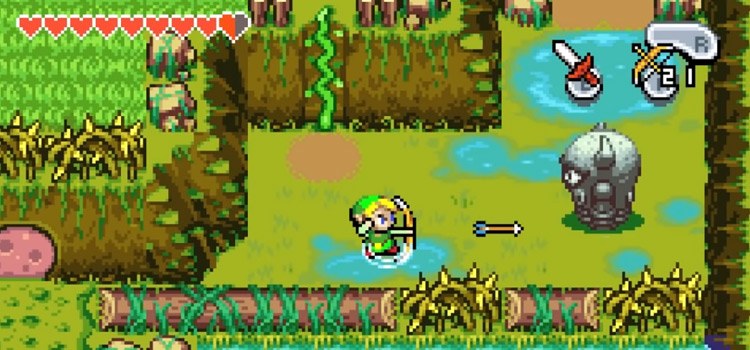
Mechanically, shrinking is far more than a gimmick. At Minish size, the overworld itself becomes a second map: cracks in walls become doorways, lily pads become boats, a single raindrop is a lethal hazard, and Minish villages hide inside barrels, mushrooms and the roofs of human houses. Dungeons exploit both scales — the barrel-filled Deepwood Shrine, the mine-cart madness of the Cave of Flames, a library dungeon where you adventure across the tops of bookshelves and then down among the books. The item set mixes classics with clever newcomers: the Gust Jar (a vacuum that solves half the game’s puzzles and all of its dignity), the Mole Mitts for digging, the Cane of Pacci for flipping anything flippable, and Roc’s Cape for gliding. The sword techniques, learned from a brotherhood of blade masters hidden around Hyrule, deepen the simple combat into something with genuine flourish, including the Great Spin and the joyful roll attack.
The Kinstone question
A review must be honest about Kinstones. Scattered everywhere, these medallion halves can be fused with the matching halves carried by dozens of Hyrule’s citizens, unlocking secrets, passages and treasures across the map. At best, the system makes the whole population feel involved in your adventure and rewards curiosity and conversation. At worst — and veterans will nod — a handful of fusions gate things you want behind random chance and long walks, and completionists face a long tail of fusions after the story ends. It is the game’s one divisive system, charming in spirit, occasionally wearing in practice. The figurine collection side-quest, fed by shells earned in a chance-based gacha, is harder to defend and easily the weakest thing in an otherwise disciplined design; mercifully, it is entirely optional.

A storybook you can play
What nobody disputes is how Minish Cap looks and sounds. This is among the most beautiful games on the GBA — saturated storybook colour, expressive sprite animation (Link’s cap has more personality than most protagonists), weather, festivals, and a Hyrule Town that feels genuinely lived in, with citizens on schedules and interiors full of jokes. The soundtrack reworks series themes with warmth and gives each area a memorable identity. Six dungeons is on the shorter side for the series, and experienced players will finish in a comfortable weekend — but every hour is dense, polished and generous, and the boss fights (a giant Chuchu fought at Minish scale is an all-time great concept) punch far above the game’s size.
The Four Sword connection and the game’s quiet lore
Zelda historians prize Minish Cap for a reason beyond its charm: it is an origin story. Its villain, Vaati, debuted in the Four Swords games; its plot explains the making of the Four Sword itself, the blade that splits its wielder into four — placing Minish Cap near the very start of the series’ (famously tangled) chronology, as an early chapter in Hyrule’s history. The Picori’s gift of the hero’s cap and blade reframes the green outfit itself as an inheritance. None of this homework is required — the game plays as a self-contained fairy tale — but for series devotees it is the rare entry that adds mythology with a light touch, and its final act quietly sets up games made years before it. Flagship also threaded the world with the kinds of details Zelda does best: a café where gossip advances quests, a schoolyard of children who know more than the adults, a lonely ghost needing help moving on, and a Hyrule Town that changes as the festival’s damage is repaired and its people prepare for the next centenary.
A practical word on length and difficulty, since both attract comment: Minish Cap is among the gentler Zeldas, and a seasoned player will not be stuck often — its puzzles favour observation over torment, and its combat errs kind. Read that as design intent, not deficiency. This is the Zelda to hand a newcomer, a child, or a tired adult who wants Hyrule at its warmest — and its brevity (six dungeons, a focused map) means its best ideas never outstay their welcome. The Oracle games were bigger; A Link to the Past is grander. Minish Cap is the one that feels hand-stitched.
The dungeons deserve one more paragraph of praise, because their design language is so confident. Deepwood Shrine teaches scale with a barrel you roll from inside and a boss — a giant ChuChu — that is only giant because you are small. The Cave of Flames turns mine carts into a routing puzzle. The Fortress of Winds layers the Roc’s Cape into vertical archaeology, the Temple of Droplets shrinks you for an entire ice-and-water dungeon built around lilypads and frozen switches, and the Palace of Winds takes the adventure into the sky for the series’ best handheld dungeon climax, cape and all. Each is compact, readable and built around one idea explored thoroughly — the same discipline as the overworld, and the reason the game’s modest dungeon count never feels like a shortfall while you are inside them. Add the Dark Hyrule Castle finale, which stitches the whole map’s lessons into one last ascent, and Minish Cap’s structure is complete: small, yes, but finished in a way bigger games envy.
Collectors and the merely curious should know the cartridge holds up unusually well as an object of play today: its save system is painless, its sessions divide cleanly at dungeon doors, and its difficulty curve makes it the rare Zelda that can be finished in a week of evenings without a guide — except, perhaps, for one or two Kinstone fusions and the last figurines, which remain, as established, the game’s small toll on the completionist spirit. Pay it or skip it; the other ninety-eight percent of Minish Cap is as close to flawless as handheld Zelda gets. It is the entry this reviewer hands to sceptics who think top-down Zelda is a nostalgia act. One hour in Ezlo’s company usually ends the argument.
Verdict
The Legend of Zelda: The Minish Cap is a small masterpiece about being small: a beautifully crafted, funny, heartfelt Zelda whose shrinking mechanic doubles its world and whose charm has only grown as bigger, louder entries have come and gone. Newcomers get one of the friendliest entries in the series; veterans get one of its most inventive. Do not let its modest stature fool you.
Score: 9.0/10