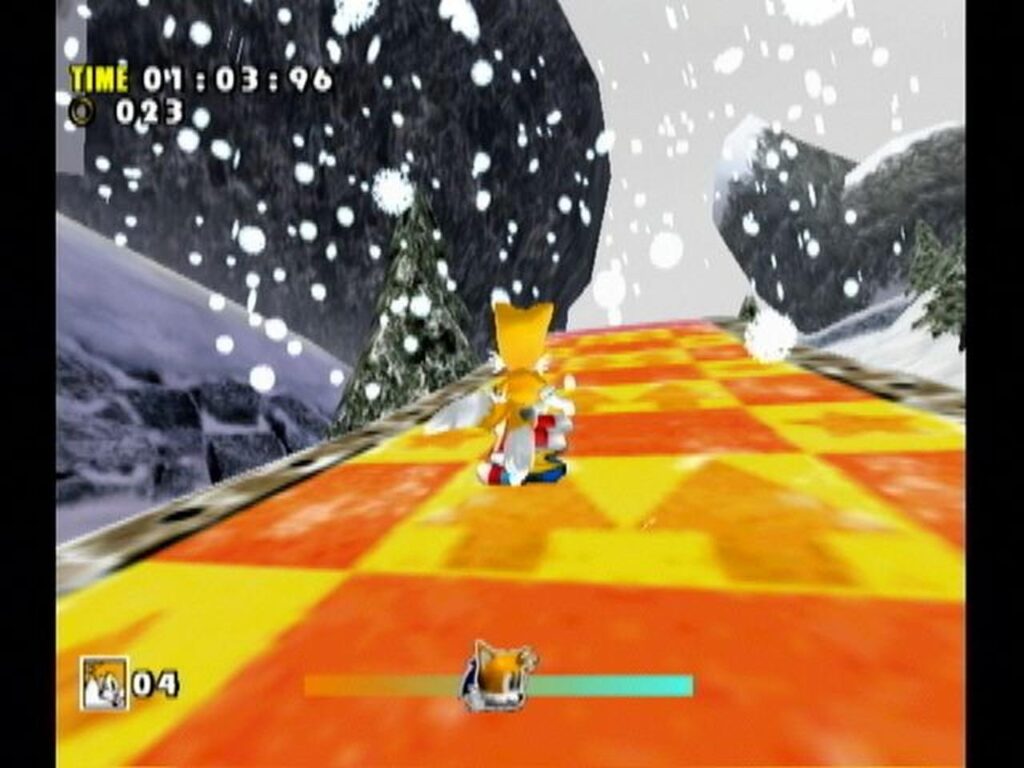
At a glance: Sega Dreamcast · Developer: Sonic Team · Released: 1998 (Japan), 1999 (worldwide) · Six playable characters · Genre: 3D platformer / action-adventure · Screenshots show the Director’s Cut port
Every console launch has a game that carries the whole machine’s promise on its back, and for the Dreamcast that game was Sonic Adventure. Sonic Team’s brief was unenviable: reinvent a mascot built for raw 2D speed inside a genre, the 3D platformer, that was barely three years old, and do it loudly enough to relaunch Sega itself. What they shipped in December 1998 in Japan, and alongside the Dreamcast’s famous 9/9/99 western launch, a date Sega marketed like a moon landing and the industry has never quite forgotten, is one of the most fascinating flawed games ever made: a title whose best levels still thrill, whose worst levels are infamous, and whose ambition towers over its execution in ways that remain weirdly lovable.
Six Stories, One Station Square
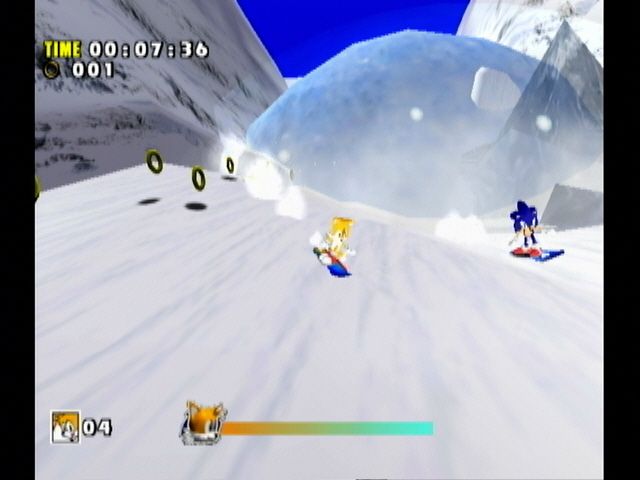
The structure was radical for the series. Six interlocking campaigns, Sonic, Tails, Knuckles, Amy, the debuting E-102 Gamma, and Big the Cat, retell one story from six angles: an ancient water god named Chaos, imprisoned in the Master Emerald, is freed by Dr Eggman and fed Chaos Emeralds toward a city-drowning final form. Between stages you roam hub worlds, Station Square and the Mystic Ruins, solving light puzzles and talking to citizens whose dialogue has become the stuff of affectionate legend. Sonic’s campaign is the spine, ten stages of pure velocity. Tails races Sonic through remixes of them. Knuckles hunts emerald shards with a radar that later games would make more generous. Amy flees a robot in a slower, tenser register. Gamma’s shooting stages carry a miniature tragedy that still lands. And Big fishes. We will come to Big.
Speed, When It Works
At its best, Sonic Adventure is a rollercoaster with a game attached. Emerald Coast opens with a killer whale smashing a pier apart behind you, a set-piece so confident it became the Dreamcast’s signature screenshot. Speed Highway sends you down the side of a skyscraper. Casinopolis drowns you in pinball and neon. The stages are linear, bumpy and occasionally held together by hope, but the sensation they chase, speed as spectacle, is real, and the grading system dares you to chase it again for a better letter. The soundtrack deserves its own plaque: Crush 40’s “Open Your Heart” fronts a score that swings from guitar rock to lounge jazz to the Station Square theme’s immortal saxophone, and the game is unimaginable without it.
Then there is the Chao Garden, a virtual-pet nursery tucked inside a platformer, raising evolving blobs whose stats you could boost through a VMU mini-game you carried in your pocket. In 1998 this was witchcraft. Players who never cared for emerald shards sank dozens of hours into Chao races, and the feature built a fandom so durable that its absence is still mourned in every subsequent game.

The Cracks
Honesty section. The camera in Sonic Adventure is not a tool but an opponent, swinging wildly in corridors and surrendering entirely in corners. Collision detection is aspirational: loops occasionally eject you into the void, and light-speed dashes along ring trails fail for reasons the game keeps to itself. The English voice acting, recorded with minimal direction, produced a generation of memes, and the lip-sync simply does not occur. Knuckles’ radar only tracking one shard at a time turns his stages into archaeological digs. Amy’s campaign is brief and slight. And Big the Cat’s fishing stages, slow, fiddly, wildly out of place, guard story completion behind the series’ most baffling design decision. Playing today requires meeting the game on its own terms, and its terms include suffering.
Two Launches, One Rush Job
The cracks have an explanation, and it is printed on the calendar. The Dreamcast launched in Japan on 27 November 1998 with a thin line-up, and Sonic Adventure, the flagship, arrived on 23 December, visibly unfinished in places: the Japanese original is the buggiest build of the game, its camera and collision at their rawest. Sonic Team spent the following year revising as they localised, so the western version that launched with the Dreamcast on 9 September 1999 is measurably more stable, and Japan then received the improved build back as Sonic Adventure International. None of this excuses the fishing, but it reframes the flaws: this was a launch-window moonshot shipped against a hardware deadline, built by a team simultaneously inventing a genre grammar and launching a console. The wonder is less that parts of it wobble than that Emerald Coast doesn’t.
It is also worth remembering what surrounded it. Sonic Adventure was among the first console games to push downloadable content, offering small extras through the Dreamcast’s modem, and its internet features and Chao-raising VMU game sketched a connected future the hardware was a generation too early to enjoy. The ambition leaked out of every seam of the package, including the seams that split.
Why It Still Matters
Context is the defence. In 1998, a fully voiced, hub-worlded, six-character action epic with a monster-movie plot was not a normal thing for a platform mascot to attempt; Mario had kept his 3D adventure intimate and wordless, and Sonic Adventure’s sheer narrative and structural sprawl was Sega swinging for a fence nobody had built yet. Its fingerprints are everywhere: the boost-era games inherited its set-piece grammar, its tone, sincere, shonen, faintly unhinged, defined the series for two decades, and Perfect Chaos flooding Station Square remains one of gaming’s great final-act images. The Dreamcast port’s later Director’s Cut smoothed a few edges, but the original’s character is untouched by polish. This is a game with a whale in it.
“Half rollercoaster, half beautiful car crash: Sonic Adventure’s peaks are why the Dreamcast era still glows, and its valleys are why we argue about it forever.”
The Hub World Gamble
One design decision deserves a final word, because the series spent twenty years arguing with it: the Adventure Fields. Sonic Adventure’s hubs were meant to give its world body, a city to live in between the rollercoasters, with citizens, a casino district, a train to the ruins. Modern players often find them empty and slow, and they are, but they were also the game’s thesis in miniature, the claim that Sonic could sustain a place rather than merely a pace. Every open-zone experiment the franchise has attempted since is this idea, still being renegotiated. Station Square, for all its wandering NPCs and awkward geometry, is where 3D Sonic began trying to be a world. The trying counts.
Verdict
Scored as a piece of engineering, Sonic Adventure wobbles. Scored as an experience, accounting for Emerald Coast at full tilt, Gamma’s ending, the Chao Garden’s strange peace and one of the great soundtracks of its generation, it earns its legend. The camera and the fishing have not aged a day in the wrong direction, and neither has the speed. A landmark, an argument and a time capsule in one blue blur, and still, for all its bruises, the most interesting thing Sonic Team ever made. 7.5/10