
At a glance: Advanced Dungeons & Dragons Cartridge · Intellivision · Mattel Electronics, 1982 · Action-adventure · Later retitled Advanced Dungeons & Dragons: Cloudy Mountain · Score: 9.0/10
In 1982, “role-playing game” on a home console meant almost nothing — the genre lived at pencil-and-paper tables and on university mainframes. Then Mattel, holding the Dungeons & Dragons licence, did something audacious: it built an adventure with an overland journey, a mountain range of caves, a quiver of arrows, monsters you can hear before you can see them, and a golden crown at the top of the world waiting to be claimed. Advanced Dungeons & Dragons Cartridge — the game later reissues would subtitle Cloudy Mountain, after its destination — was developed by APh Technological Consulting for Mattel, and it is one of the foundation stones of the console action-adventure. Zelda’s shadow lies long over this genre. This game was casting one four years earlier.
The journey is the game
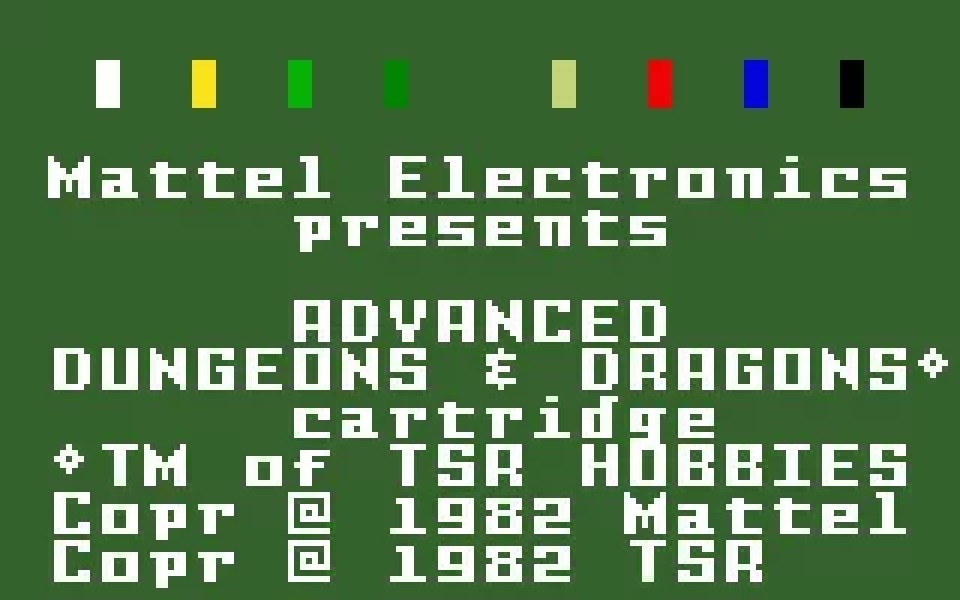
The structure is a small masterpiece of compression. The game opens on an overland map: a wilderness of forests and rivers between you and Cloudy Mountain, whose peak holds the two halves of the Crown of Kings. Scattered across the land are the caves and dungeons — colour-coded by the danger within — that stand between you and the mountain. You travel the overland on foot, choosing your route, and enter the caves to hunt for the equipment the mountain will demand: boats to cross rivers, axes to clear forest, keys to open gates, and above all arrows, because inside the caves the game becomes something else entirely.
Inside, the view drops to a dark labyrinth revealed only around your adventurer — one of the earliest and best uses of limited visibility in a home game. You explore by sound as much as by sight: the system’s audio gives each class of monster a signature — the snore of a sleeping dragon is the most famous sound in the game, a slow rhythmic rumble that means treasure and death are in the next room — and veteran players navigate the dark by ear, counting their arrows, hugging the walls. Combat is real-time bow work: aim with the disc, loose with the button, and mind the quiver, because arrows are ammunition, treasure and lifeline in one. Dead adventurers are gone for that run; the game gives you a party of lives and spends them with genuine reluctance to forgive mistakes. Difficulty settings scale the whole expedition from a brisk hike to one of the sternest challenges on the system.
Sound as a sense

Plenty of Intellivision games use sound well; this one uses it as a primary sense, and in 1982 that was radical. The darkness mechanic could have been a gimmick — instead, the audio design turns it into the game’s signature tension. Dragons snore. Snakes hiss their warning. Demons and blobs have their own voices in the dark. You learn the bestiary by ear because your eyes are rationed, and the moment of stepping into a black corridor with a full quiver and a dragon snoring somewhere off-screen remains, decades later, one of the purest adventure-game sensations of the 8-bit era. The Intellivision’s sound chip was nothing exotic; what APh understood was that atmosphere is an information system, and they built the whole cave game around it.
The overland layer has aged just as gracefully. It is essentially a board of decisions: which caves to raid, in what order, at what risk, with the mountain always visible as the argument for one more delve. The colour-coding of cave entrances by difficulty is a piece of player communication modern games would recognise, and the equipment gating — you cannot simply walk to the crown; the land itself must be unlocked piece by piece — is Metroidvania grammar written years before the term existed. Nobody at APh or Mattel would have used that vocabulary. They were too busy inventing the thing itself.
The licence, used properly

A word about the D&D name, because it is not mere branding. The game does not implement the tabletop rules — no console of the day could have, and its sequel would take a different, more dungeon-crawling approach — but it captures the tabletop’s feeling with unnerving accuracy: preparation, exploration, the terror of the unknown room, treasure guarded by things that snore. TSR’s licence on a Mattel cartridge could easily have been a sticker on a maze game. Instead it became one of the earliest home games that players described, unselfconsciously, as an adventure — and played in sessions measured in evenings rather than credits.
Honesty requires noting the austerity: the graphics are stark — black caves, simple sprites — and the overland map is diagrammatic. Players who need their adventures illustrated will find Treasure of Tarmin’s first-person halls richer. But starkness is this game’s atmosphere, and the imagination it demands is repaid with interest, as anyone who has frozen at the sound of snoring in the dark can testify.
Fieldcraft: surviving your first expedition
New adventurers die in predictable ways, so a few hard-won lessons. Arrows are life: enter no cave without a plan for the quiver, and never spend your last shafts on a monster you could walk around. Sound is scouting — play, if you possibly can, in a quiet room with the volume up, because the difference between a snoring dragon (rich, sleeping, avoidable) and an awake one is the difference between a raid and a rescue that never happens. Use the difficulty ladder as it was intended: the lower settings are not a lesser game but a training wilderness, where the cave colours, equipment logic and overland route-planning can be learned before the mountain starts keeping score. And treat the overland map as the game, not the commute: the order in which you open the land — which rivers get boated, which forests get axed, which cave colours you dare and in what sequence — is the strategy layer on which the crown is actually won or lost. The caves are where expeditions look dramatic. The map is where they are decided.
That two-layer structure is, in the end, the game’s most durable invention: an adventure with a geography, in which preparation is play. Console adventures spent the following decade rediscovering it.
The verdict
Advanced Dungeons & Dragons: Cloudy Mountain is a landmark — a real adventure game, with a journey, a quest structure, resource management and sound-led exploration, on a console from the era of the fixed shooter. It founded a lineage (Tarmin, Tower of Doom and the whole console adventure tradition look back to it) and it remains gripping to play today, because its core sensations — the dark, the quiver, the snore — have never been improved upon, only re-rendered. If the Intellivision library has a Mount Rushmore, this is on it.
Collectors should note the naming quirk for their want-lists: the cartridge was first sold simply as Advanced Dungeons & Dragons Cartridge, and the Cloudy Mountain subtitle belongs to later reissues and modern references — same quest, same crown, same snoring dragons. Whichever label your copy wears, it is the same essential game.
Play it loud, play it patient, and mind the snoring.
Score: 9.0/10