
At a glance: Tower of Doom · Intellivision · INTV Corporation, 1987 (developed by Mattel Electronics) · Roguelike adventure · Score: 9.0/10
Procedurally generated levels. Permadeath stakes. Unidentified items you must experiment with to learn. Character classes, hit points, armour, diplomacy with monsters, traps, treasure and a long descent through a dungeon that is different every time you enter it. In 1987, those were not features a console game was supposed to have — they were the culture of mainframe and home-computer roguelikes, of Rogue itself and its descendants, sealed inside university computer labs and PC floppy disks. Tower of Doom, developed at Mattel and published by INTV in 1987, put them on a seven-year-old games console, on a television, with a keypad controller. It should not exist. It is magnificent.
A roguelike before consoles had the word

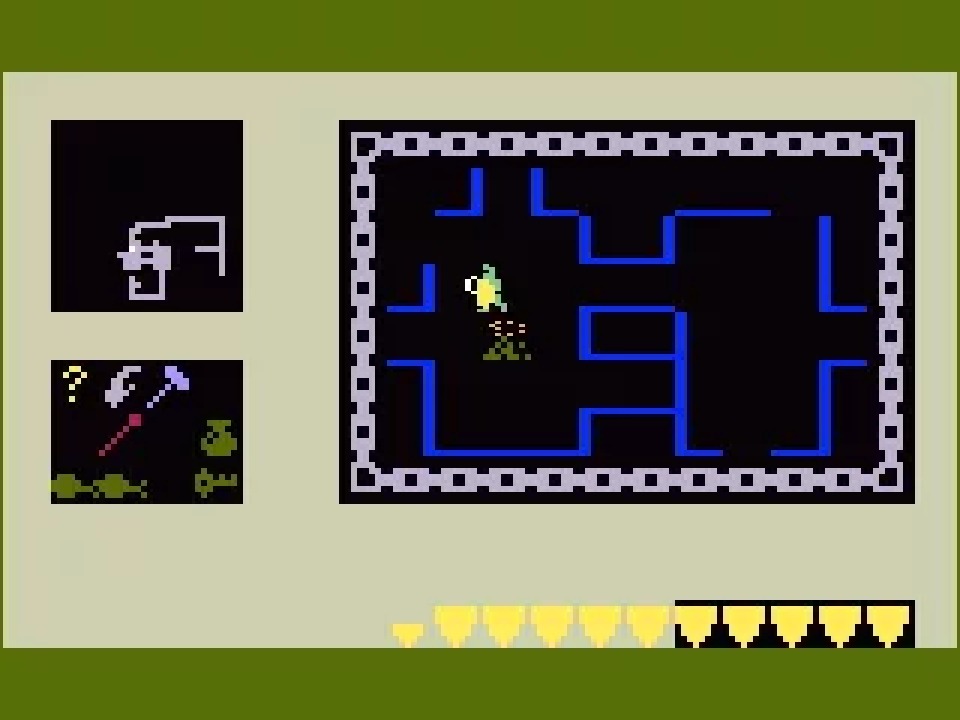
The structure will be familiar to anyone who has played a modern roguelike, and reading the list in 1987 context is the review’s whole argument. You choose your adventurer from a roster of character types with different strengths, and choose your quest — descents of increasing depth, from a six-level novice delve to expeditions of punishing length. The tower’s levels are generated fresh for every game: mazes of rooms and corridors, shown in a split display that gives you both a top-down map view and a side-view close-up when the action demands it. Monsters roam — snakes, warriors, creatures rendered in the system’s chunky style and described by the game with a wit that acknowledges the hardware’s limits. Treasure, weapons, armour, food and magical items are scattered through the dark, and many items are unidentified: the game famously invites you to guess what things are, and a wrong guess can be a poisoned lesson. That is not a quirk. That is Wizardry-and-Rogue design philosophy, intact, on a cartridge.
The statistics screen tells the same story: strength, stamina, diplomacy — diplomacy! — experience and treasure tallies. You can attempt to parley with some monsters rather than fight them, spending a stat most action games have never heard of. Combat itself is a side-view duel of positioning and timing. Traps punish the hurried. Hunger and attrition punish the slow. And when you die, the tower generates a new one, which is the entire point: Tower of Doom understood, earlier than almost any console game, that randomness plus consequence turns a short game into an endless one.
The Mattel adventure lineage, perfected
Tower of Doom did not appear from nowhere. It is the culmination of a thread that runs through the whole Intellivision catalogue: the two Advanced Dungeons & Dragons games (both reviewed elsewhere in this wave) had already brought overland quests and first-person dungeon crawling to the console, and the system’s strategy tradition — Utopia above all — had normalised the idea that an Intellivision game could be a system to learn rather than a pattern to memorise. Tower of Doom is where those threads tie off. The D&D games are adventures with fixed shapes; Tower of Doom is an adventure engine, and the difference is the difference between a novel and a storytelling machine.
It also helps that the game is beautiful by the system’s standards. The title screen — a tower against layered blue mountains — is a small painting. The side-view chambers use the hardware’s colour and background cards with real artistry, monsters are characterful, and the interface, split between map, inventory icons and stats, stays legible under pressure. Sound is sparse and functional, as the genre demands; the game’s atmosphere is generated by uncertainty rather than effects, which is precisely how the computer roguelikes did it too.
Honest caveats

A fair review owes the reader the friction. The keypad-and-disc controls carry a lot of game here, and inventory management by 1987 cartridge standards is an acquired taste — expect to learn with the manual close at hand, and expect early expeditions to end in confusion as often as in combat. The graphics ask the player’s imagination to do genuine work — the game’s own documentation cheerfully admits as much — and players raised on explicit modern roguelikes will find the information design of its era: stats reviewed at particular moments, item knowledge carried in your head. None of this is carelessness; it is the shape of the possible in a cartridge of its time. But Tower of Doom is a connoisseur’s game, and it is better to say so than to pretend otherwise.
It is also, inevitably, a scarce one — a late INTV release with a collector following, sought after precisely because its reputation has grown every decade since. Players meeting it through compilations or emulation are getting the same tower; the generation algorithm does not care what year it is.
How a run actually feels
Abstract praise undersells Tower of Doom, so here is the texture of a typical expedition. You pick a mid-tier adventurer — durable enough to learn with, not so strong the tower gets casual — and take a medium descent. The first levels teach the grammar: a map that fills in as you move, a chamber where something unidentifiable is sleeping, a weapon whose name you’ll have to trust before you know whether trust was wise. By level four the tower is spending your resources in earnest: food matters, the good sword is nicked and tired, and a negotiation with something large has just gone wrong in a corridor you needed. By level seven you are playing the real game — route discipline, retreat lines, triage of potions — and the permadeath stops being a threat and becomes the atmosphere itself, the thing that makes a found treasure feel like wealth and a wrong doorway feel like a story. Modern roguelike players will recognise every one of those beats instantly. The shock is not that the game resembles the present. The shock is the date on the box.
It helps, too, that sessions scale: a short six-level delve is a satisfying half-hour, while the deep expeditions are weekend undertakings. The cartridge respects both kinds of player, which is part of why its reputation compounds — everyone who plays it finds the version of it sized for them.
The verdict
Tower of Doom is one of the most forward-looking games of the entire 8-bit era: a full roguelike — procedural, permadeath-haunted, item-mysterious, diplomacy and all — running on hardware designed in the late 1970s. It crowns the Intellivision’s adventure tradition and it embarrasses most of what consoles attempted in the genre for a decade afterward. If you play one late-era Intellivision game, make it this descent. Bring a notebook. Trust nothing unidentified. The tower is different every time, and it is waiting.
For the collector’s notebook: Tower of Doom’s original release is among the scarcer INTV cartridges, and its price reflects a reputation that has done nothing but climb — this is one of the rare cases where the market and the critics agree completely. A tested loose copy is the player’s buy; the game inside is identical, and the tower, as ever, is generated fresh just for you.
Descend when ready. The tower will generate something worthy of you — it always does, every single time.
Score: 9.0/10