At a glance: Advanced Dungeons & Dragons: Treasure of Tarmin · Intellivision · Mattel Electronics, 1983 · First-person dungeon crawler · Developed by APh Technological Consulting (programmer Tom Loughry) · Score: 9.0/10
First-person perspective. A multi-level dungeon of dozens of floors. Real-time combat against skeletons, giants and worse. Weapons that break, armour that wears, potions and scrolls and treasure in chests, a Minotaur waiting at the bottom with the treasure that gives the game its name. Treasure of Tarmin is a 1983 Intellivision cartridge, and reading that list of features against that date is the whole review in miniature: this is a first-person dungeon crawler of genuine depth, built for a console whose contemporaries were still mastering the two-screen arcade port. Alongside its Cloudy Mountain sibling it forms the most historically important pair of games on the system — and as a game to actually sink an evening into, Tarmin may be the greater of the two.
Down, in first person

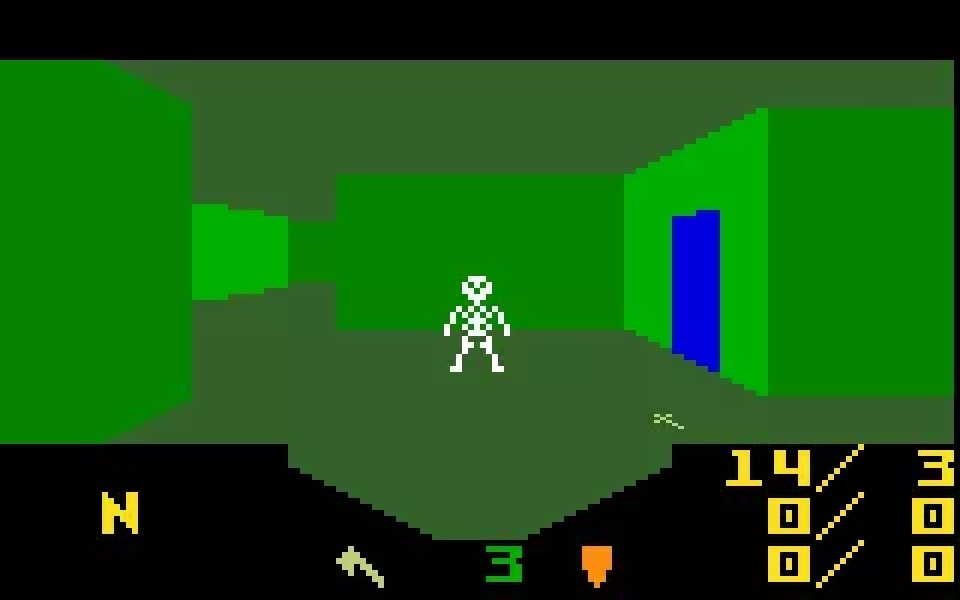
Where Cloudy Mountain was an overland quest, Tarmin is a descent. The game renders its dungeon in first person — blocky, boldly coloured corridor walls that step toward you as you move, in a style closer to a living diagram than an illusion, and all the more readable for it. Each level is a maze of corridors, doors and chambers; stairs lead down; the dungeon runs deep, with the Minotaur and the Treasure of Tarmin waiting at the bottom of a full expedition. Movement is grid-based and turn-flavoured but the combat is real-time and positional: a skeleton steps out of the gloom ahead of you — the screenshot above shows the shock of it — and you are suddenly in a fight measured in your weapon’s condition, your remaining strength, and your nerve.
The systems depth is what astonishes. Your adventurer has distinct spiritual and war-making capacities, improved by the right kinds of combat and use. Weapons and shields come in grades and materials and degrade — a favourite sword is a wasting asset, and carrying a spare is wisdom rather than clutter. Chests hold treasure and supplies and occasionally trouble; potions and books confer real benefits; food and rest management matter on a long descent. Death is permanent for the run, the dungeon is regenerated between expeditions, and the Minotaur is a genuine final exam. This is the design language of Wizardry and the mainframe crawlers, transplanted to a cartridge by APh programmer Tom Loughry — who also carried much of Cloudy Mountain — with a fidelity that still surprises historians of the genre. Console RPG history usually starts its clock years later. Tarmin is the counterexample that starts it in 1983.
The view from inside
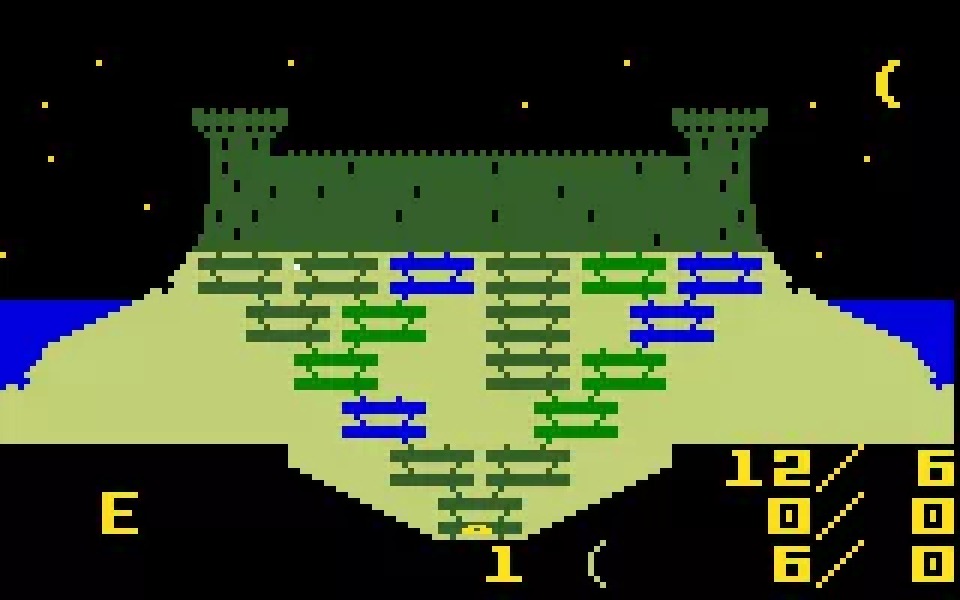
The first-person rendering deserves its own appreciation, because APh made exactly the right compromises. Rather than chasing realism, the corridors are drawn in flat, saturated colour — walls of green and blue receding in clear steps — with a compass heading and a compact status readout that keeps your strength, weapons and depth in view. The result is that movement feels deliberate and navigation is a learnable skill: you build the maze in your head, corridor by corridor, the way the pen-and-paper game taught a generation to do with graph paper. Monsters appear in the corridor view at distance and grow as they close, giving fights a geography — fall back, hold a doorway, spend the good weapon — that pure menu combat never has. For a 1983 television game, the sense of being somewhere is extraordinary, and it is the direct ancestor of every console dungeon crawler that followed.
Sound, as in Cloudy Mountain, is used with intent: the dungeon’s sparse effects make encounters startling, and the quiet between them is the game’s true texture. Tarmin is a solitary, late-night kind of game — a marked contrast with the Intellivision’s social, sporting image, and evidence of how far Mattel and APh were willing to stretch the machine’s identity.
Which D&D game should you play?

The two cartridges are complements, not rivals. Cloudy Mountain is the quest — the journey, the mountain, the bow in the dark. Tarmin is the crawl — deeper systems, longer expeditions, a stricter RPG skeleton. Players who want the purer adventure sensation usually cite Cloudy Mountain; players who want to lose a weekend to character management, equipment economies and a Minotaur tend to cite Tarmin, and both camps are right. What is not in doubt is the pair’s joint significance: in 1982–83, while the rest of the console industry was licensing arcade cabinets, Mattel and APh shipped two distinct, serious, systems-rich role-playing adventures for a home console. The industry would take most of a decade to catch up with that ambition, and the modern dungeon-crawler revival has made Tarmin feel less like an antique than like an early draft of the present.
Caveats are the familiar ones for the era: learn it with the manual, expect the austerity of early first-person graphics, and give expeditions the time they ask for. The dungeon does not do short sessions.
Expedition craft: how to actually descend
Because Tarmin rewards method, a brief field guide for new delvers. Treat your first expeditions as surveys, not attempts: go down a few levels, learn the combat timing against the early creatures, and get out with your notes. Weapons discipline is the game’s first real lesson — a degraded good weapon is a future emergency, so fight trash with trash and save the fine steel for things that can kill you. Chests are information as much as loot; learn what the dungeon tends to stock where, because the generation is patterned enough to reward observation without ever becoming memorisable. Above all, respect the descent’s mathematics: every level down offers better treasure and worse company, and the Minotaur is not a surprise boss but a destination you should arrive at over-prepared, over-supplied and slightly afraid. Players who approach Tarmin with a roguelike’s patience will find it astonishingly modern in its demands. Players who charge will find the dungeon’s opinion of charging, delivered promptly.
That discipline is the deepest compliment to pay the design: a 1983 cartridge that supports play styles — surveyor, hoarder, duellist, gambler — is a game that understood role-playing as something the player does, not something the box claims.
The verdict
Treasure of Tarmin is a landmark dungeon crawler — first-person, systems-deep, genuinely dangerous — hiding inside a licence most publishers would have wasted on a maze game. It is one of the two or three most important RPGs of the entire 8-bit console era and, not incidentally, a gripping game still. Descend carefully. Mind your sword’s condition. The Minotaur has been waiting forty years, and he is patient.
A final note on pairing: Tarmin and its sibling were designed to be owned together, and playing them in sequence — the quest first, the crawl second — is the closest the Intellivision comes to a two-volume novel. Most owners who start with one end with both, plus Tower of Doom waiting beneath them as the saga’s final exam. As a trilogy of ambition, nothing else on a 1979 console touches it.
One last word to the sceptical: find a way to play a single expedition before forming an opinion. Tarmin’s reputation was built by players, not marketers, and an hour in its corridors explains forty years of devotion better than any review can.
Score: 9.0/10