
At a glance: Microsurgeon · Intellivision · Imagic, 1982 · Medical action-simulation · Designed by Rick Levine · Score: 8.5/10
You are a microscopic robot surgeon, injected into a patient whose chart reads like a disaster area: brain tumour, lung infection, gallstones, failing heart, bacteria in the bloodstream and a limited power supply with which to fix as much of it as you can before the patient — or your battery — gives out. Microsurgeon, designed by Rick Levine for Imagic and released in 1982, is not merely the strangest game on the Intellivision. It is one of the strangest and most forward-looking games of the entire early-80s: a resource-management simulation disguised as an arcade journey through a human body, Fantastic Voyage with a triage list, and it plays like nothing else in the catalogue of any console of its day.
Triage: the game

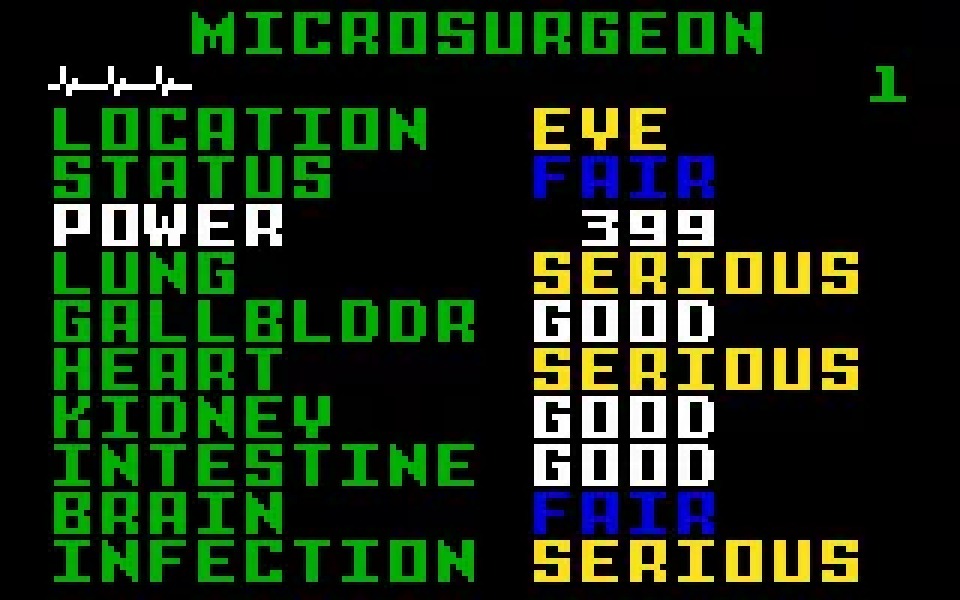
Every game of Microsurgeon begins with a diagnosis, and no two diagnoses are alike. The status chart lists the patient’s organs and systems with conditions ranging from good to serious to critical, and a random assortment of pathologies is generated for each new patient — tumours, viruses, bacteria, cholesterol deposits, tapeworms, failing organs. You cannot fix everything. Your robot probe runs on a finite power supply that drains with movement and treatment, and the patient’s overall condition declines as time passes. So the game, before you have treated a single cell, is already an exercise in prioritisation: which emergencies first, which chronic problems can wait, what will kill the patient soonest, and how do you route the journey through the body to treat the most with the least travel?
That routing is the gameplay. You guide the probe through a stylised circulatory and organ system — a scrolling map of arteries, veins and organs rendered as an abstract landscape of red channels and coloured anatomy — shooting bacteria and viruses, breaking up cholesterol, destroying tumours, and deploying limited aspirin and antibiotics where they’re needed. Movement follows the body’s own plumbing, and navigation is a real skill: the body is a maze with a logic, and learning its geography is as much a part of mastery as aim. All the while, the chart ticks. Organs worsen. The patient’s status slides. Microsurgeon’s famous difficulty is not twitch difficulty; it is the pressure of an entire failing system asking for more surgeon than one small robot can be. It is, in the best sense, a management game wearing an action game’s clothes — closer in spirit to the simulations the Intellivision did so well than to the shooters it superficially resembles.
A designer with a thesis
Rick Levine designed Microsurgeon with an explicit philosophy, discussed in interviews of the era, that games could be about healing rather than killing — and the design bears him out beautifully. Your weapons are treatments. Your enemies are diseases. Your score is a patient’s survival and discharge status: the game ends by telling you how the patient did — from recovery through to the bleakest outcomes — and the grade stings in a way no lost spaceship ever did, because the fiction gives failure a face. In 1982, when the public argument about video games was almost entirely about violence and quarters, Imagic shipped a console game whose entire dramatic engine is care under scarcity. It is one of the earliest and clearest proofs that the medium’s range was always wider than its critics assumed — and it came from a third-party publisher, on a Mattel console, aimed at the same living rooms as everything else.
The presentation matches the concept’s boldness. The body’s interior is drawn as a vivid, almost psychedelic anatomy — pulsing reds, organic yellows, landmark organs you learn to recognise: the heart, the brain, the lungs, the eyes. Each patient visit begins with that superb status chart, which does more narrative work than many games’ entire scripts: LUNG — SERIOUS; HEART — SERIOUS; INFECTION — SERIOUS is a story in six words. Sound is clinical and functional. The probe itself has real character, a tiny determined machine in an enormous organic world.
Playing it now

Modern players should know two things. First, the learning curve is real: the body map, the treatment types and the chart’s language take a session to internalise, and the manual earns its keep. Second, once internalised, the game reveals a strategic depth that has kept it on “most innovative games ever” lists for decades — it was recognised in its own time, too, receiving prominent magazine honours in the early 80s. Sessions are complete stories: intake, triage, the long journey through a stranger’s bloodstream, the verdict. No two patients alike means no memorised solution, ever. In an Intellivision library rich in sports and space, Microsurgeon is the cartridge that most expands what a newcomer believes the system was.
It is also worth saying plainly: this is Imagic at its best. The same publisher’s shooters (Demon Attack, Atlantis) are better known, but Microsurgeon is the company’s most original object — the one that could only have come from a designer with a thesis and a publisher willing to ship it.
Learning the body: a starter’s ward round
For new surgeons, a brief orientation the manual would approve of. Start by reading the chart like a triage nurse: the word SERIOUS is your itinerary, and the patient’s most degraded vital systems outrank every interesting side-quest the body offers. Treat infection early and always — it spreads its damage across the whole chart while you are busy elsewhere. Route your journeys: the body rewards a surgeon who treats in a circuit rather than criss-crossing the map, because travel is power and power is the game’s true currency. And accept, early, the lesson the game most wants to teach: some patients cannot be made whole, and the difference between a good Microsurgeon run and a great one is not perfection — it is the wisdom of the order in which you save things. That is an adult kind of game design moral, and the fact that a 1982 cartridge for a toy computer can deliver it, in play rather than in prose, is the measure of Rick Levine’s achievement.
It also makes Microsurgeon the rare vintage game that improves in discussion. Owners compare patients the way anglers compare weather — the tumour behind the heart, the infection that outran the antibiotics — because the generator deals everyone a different body and the same impossible arithmetic.
The verdict
Microsurgeon is a masterpiece of conceptual design: a triage simulation, an anatomical maze and an argument for games about healing, all in one 1982 cartridge. It is demanding, strange, moving in a way few of its contemporaries attempted, and utterly unique on the Intellivision. If your shelf tells the story of what early games could be, this one is a chapter of its own.
One more distinction, rarely granted to its contemporaries: Microsurgeon is the Intellivision game most often cited by designers rather than only by players. It appears in innovation retrospectives, in histories of serious games, in arguments about what the medium was already capable of before it had the vocabulary to say so. Playing it is therefore a double pleasure — a genuinely absorbing simulation, and a visit to one of the medium’s founding ideas, still warm.
Score: 8.5/10