
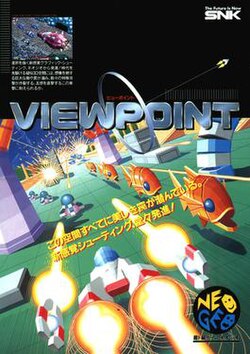
Most cancelled games leave behind a paper trail and nothing to play. A few screenshots in a magazine, a trade-show appearance people half remember, and then silence. Viewpoint 2064 followed that script for a quarter of a century — and then, in November 2025, it broke it. An apparently final, master build of Sammy and Racdym’s cancelled Nintendo 64 shooter surfaced through preservation channels, was documented by the YouTube preservation channel Hard4Games, and was preserved online for anyone to study. A game that missed its release date in 1999, missed another in 2000, and was quietly cancelled in 2001 had, twenty-five years later, effectively been released.
Start with the original: a Neo Geo showpiece
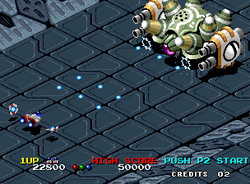
To understand what was lost, start with the game that did come out. Viewpoint, developed by Aicom and published by Sammy in November 1992, was an isometric scrolling shooter for SNK’s Neo Geo hardware — Sammy’s only game for the system, and a genuine showpiece. Where Sega’s Zaxxon had pioneered the diagonal viewpoint a decade earlier, Viewpoint dressed it in detailed, hand-drawn graphics that imitated 3D without any 3D hardware, and paired them with a hip-hop-influenced soundtrack that turned heads as much as the visuals did. It won Electronic Gaming Monthly‘s awards for best graphics and best music of 1992, scored 95 percent in Computer and Video Games and 96 percent in Sinclair User, and was described by GameFan‘s reviewers, in scores of 99.5 and 99 percent, as the best game on the system to that point. Six stages, a chargeable pulse laser, three flavours of bomb — fire wall, nova blast and homing mini-missiles — and a reputation for serious difficulty completed the package. Ports followed to the Genesis, PlayStation, Sharp X68000 and FM Towns, with varying fidelity, but the Neo Geo original remained the reference version.
It also remained, for years, a dead end. Viewpoint was a critical darling on expensive hardware, not a franchise with momentum. A Saturn port was planned and cancelled in the mid-1990s; a Game Boy Color version was mooted and cancelled too. When Sammy returned to the series at the end of the decade, it was not with a port but with the only true sequel the game would ever get — new levels, new mechanics, a new perspective, and a new machine.
2064: the sequel that kept almost happening
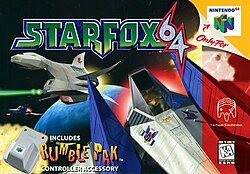
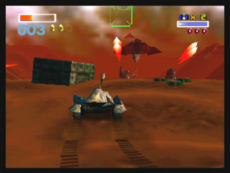
Viewpoint 2064 was developed by Racdym — the studio now known as Racjin, also responsible for the Snowboard Kids games on the same hardware — and published by Sammy for the Nintendo 64. The design traded the original’s isometric angle for polygonal 3D and a behind-the-ship viewpoint, which immediately invited comparison with Nintendo’s Star Fox 64. Contemporary descriptions paint a hybrid: the forward rush and lock-on shooting of a rail shooter, mixed with old-school shoot-’em-up structure, planet and space stages, large boss encounters and branching progression, with the ship travelling into the screen along a fixed path rather than roaming freely.
The game was not a secret or a rumour. It was shown publicly at Nintendo’s Space World event in August 1999 and at the Tokyo Game Show that September, where it was playable. Nintendo’s own Space World guidebook gave it a half-page advertisement and listed it as 100 percent complete, dated for release on 11 November 1999 at ¥7,800. IGN’s N64 team praised its polygonal graphics, lock-on system and boss battles, and reported that Sammy was talking to international publishers about taking it beyond Japan. By any normal measure, this was a finished game weeks from shop shelves.
Then the dates started dissolving. The November 1999 release came and went. Through 2000 the game was delayed repeatedly, then resurfaced one more time: in August 2000, reporting indicated it would appear at that autumn’s Tokyo Game Show with a new release date of 24 November 2000, listed by the show’s organisers, while retailer listings floated a date a week earlier alongside preliminary box art. That date passed as well. By 2001, Viewpoint 2064 had been quietly cancelled. No official reason was ever given. The explanation preservation writers reach for is economic rather than creative: by 2000 the Nintendo 64 market was contracting fast, the GameCube was on the horizon, and manufacturing expensive cartridges for a niche shooter from a small series may simply have stopped making sense. A finished game became a rumour with screenshots.
The long way back: 2015, 2020, 2025
The recovery happened in instalments, which is usually how these stories go. In October 2015, a prototype cartridge of Viewpoint 2064 appeared on eBay and sold for $2,999. The buyer allowed footage to be captured and shared, giving the public its first moving look at the game since the trade shows of 1999. That sighting galvanised preservationists, and in 2020 a build of the game was dumped and preserved by Gaming Alexandria, with Hard4Games among those showcasing it. For the first time, the cancelled sequel was actually playable.
But playable was not the same as finished. The 2020 build carried the marks of an in-development version: problems with collision detection, a user interface that did not match the advertised screenshots, boss fights missing altogether, and a developer debug menu still present. It was a draft of the game, invaluable and incomplete at once — the difference, for historians, between reading an author’s notes and reading the book.
The book arrived in November 2025. An anonymous source provided Hard4Games with a cartridge labelled as a master version — reporting on the dump noted a label reading “MASTER 4/13VER,” dated 13 April 2000 — and the channel documented the build in a video comparing it directly with the 2020 version. The differences were exactly the ones that mattered: the collision problems fixed, the interface matching the game Sammy had advertised, the missing boss content present, the debug scaffolding gone. In other words, this was not another prototype. It appeared to be the game as it would have shipped, preserved a quarter of a century after the shipment was cancelled, and it was released into preservation archives online — coverage at the time also credited the release group 8bitbros and the Hidden Palace preservation project in connection with the dump. The story was reported across the games press within days, including by Time Extension, Eurogamer, GamesRadar and ComicBook, all telling the same story because, unusually for lost-media tales, the evidence was sitting there in playable form.
Why this one matters
It is tempting to file Viewpoint 2064 as a curiosity — a footnote to a footnote, a sequel to a Neo Geo cult favourite on a console not known for shooters. That undersells what its survival demonstrates. The Nintendo 64’s traditional shoot-’em-up library was always thin next to the Saturn’s and PlayStation’s, and Viewpoint 2064 was, on the contemporary evidence, a credible, complete entry in that library that the historical record nearly lost entirely. Its cancellation left no customers, no reviews, no second-hand market — none of the usual traces a released game leaves. Everything now known about it exists because a development cartridge changed hands on an auction site, because a community of preservationists treated that as a beginning rather than a trophy, and because somebody, anonymously, decided the master build belonged in public hands.
There is a comparison the coverage kept making, and it earns its place: Nintendo’s own Star Fox 2, completed for the SNES, cancelled at the last moment, and finally released officially in 2017 inside the SNES Classic Mini. Viewpoint 2064 got no such corporate resurrection and never will — Sammy was absorbed into Sega Sammy in 2004, and Racjin works today as a respected support and co-development studio. Its rescue was entirely unofficial, which is the point. Preservation of this kind is a relay race run by strangers across decades: a collector in 2015, archivists in 2020, an anonymous donor and documenters in 2025. After twenty-five years in the dark, Viewpoint 2064 lives — not as a rumour, not as a debug build, but as the game its makers finished. That is what winning against lost media actually looks like.