
At a glance: American Gladiators · Genesis · developed by Imagitec Design · published by GameTek · 1993 · TV licence event compilation · six events · tournament for up to eight contenders, played in turns on two pads
The television version of American Gladiators understood its own appeal perfectly: ordinary athletes, visibly mortal, hurled themselves at a roster of spray-tanned bodybuilders inside a sequence of playground events scaled up to arena size. GameTek collected the licence and, true to the publisher’s habits, spread versions across every machine that would take one. The Genesis cartridge, built by Imagitec Design and released in February 1993, recreates a single episode or a three-round tournament, quarter-finals through to a final, with as many as eight named contenders sharing two control pads between them. Six events make the running order — Assault, Joust, Atlasphere, The Wall and Powerball building towards The Eliminator — and every one is recognisably the event from the screen. The tragedy is that a show about physical mastery produced a game that fights your hands at every step.
Six Events, Faithfully Rebuilt

Start with what works, because the scaffolding is sound. Assault sends you sprinting between barricades on an overhead field while a Gladiator lobs tennis balls from a raised platform; reach a station, and the view swings behind your contender so you can aim that station’s weapon at a target hanging over the gunner’s head. Joust reduces the pugil-stick duel to a two-dimensional fighter on twin pedestals, health draining with every landed blow. Atlasphere cages two contenders inside rolling steel spheres on a split screen, bumping and barging towards sunken scoring pods while caged Gladiators do the same in defence. The Wall is a split-screen climb, handholds picked out clearly, with a Gladiator starting the ascent behind you once your head start expires. Powerball turns frantic: grab a ball from a bin, carry it through patrolling Gladiators, and deposit it in a guarded cylinder, centre pod worth double. The Eliminator closes the show, an eight-part obstacle course — treadmill, hand bike, balance beam, cargo net, zip wire, hurdles, a sprint and one last Gladiator barring the line — powered by alternate mashing of A and C.
Points accumulate under each event’s own rules, and the structure flatters the licence. Nobody could accuse Imagitec of inventing their own programme: the running order, the scoring quirks, even the absence of contender-versus-Gladiator mercy, all track the broadcast. One event is missing, though, and Sega owners drew the short straw — Human Cannonball appears in the Super NES edition, where Nintendo’s hardware scaling swung the contestant across the arena, and it simply is not in this cartridge. Six events rather than seven, then, and the Genesis shows them well. The music over those events is better than they deserve: Barry Leitch, working with Ian Howe, supplies bright, brassy themes that live entirely inside the television show’s world of spotlights and applause, and the cartridge sounds most alive exactly where it plays worst.
The tournament deserves a word of its own, because it is where the cartridge’s ambitions quietly outgrow its interface. Up to eight contenders can be named and entered — one gender chosen for the whole field — with the computer filling any empty slots in the bracket. Quarter-finals, semi-finals and a final each run the same six events, and matches between computer contenders are never shown; their results simply appear on the ladder, so a tournament with friends becomes a rhythm of your rounds punctuating a slowly resolving fiction. It is a generous structure for a licence cash-in, the kind of thing GameTek’s shotgun development model rarely bothered with, and it gives the game its one genuine claim on a group’s evening: a bracket to fill, names to invent, and a running order everyone at the television already understands from Saturday afternoons. That the events themselves then fumble their controls is the frustration the rest of this review keeps circling.
Where Your Hands Lose

Assault exposes the disease in miniature. Barricade play runs on a liturgy — B to take cover and change the view, drift sideways to the weapon, C to lift it, aim through a little inset window that shows crosshair lines rather than the target itself, B to loose the shot, C again to set the gun down before you may move. While that ceremony unfolds you are rooted to the spot, which makes a mockery of the cover you just took: the cannon tags you mid-ritual, behind the so-called safety of the station, and there is no ducking out of the sequence early. Every weapon on the course demands the same four-step dance, so the event’s tension comes not from the Gladiator’s aim but from whether the pad will finish interpreting your intentions before the next tennis ball arrives.
Joust is worse, because its inputs feel negotiable. Hold B and push a direction for your strikes, push a direction alone for your guards — that is the documented system, and the manual’s table of high strikes, jabs, parries and dodges looks respectable on paper. In the arena the same command produces a swing on one occasion and a thoughtful pause on the next, as if your contender is considering the philosophical implications. Salvation comes from the opposition: the Gladiators’ artificial intelligence is so passive that a single repeated attack, delivered with conviction, tends to empty their health gauge before they organise a reply. You win, regularly, while feeling that neither participant understood the rules. Multiplayer inherits a related frustration — two humans never actually clash. In Joust and Assault you take your turns separately against the machine; in the racing events you compete in parallel on a split screen. The programme’s format explains it, but a mode handing the Gladiators to player two was sitting there unclaimed.
A Good-Looking Show, an Unlistenable One
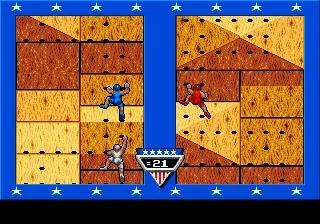
Visually, the conversion earns its keep. Sprites are chunky and legible, the arena sets carry the show’s gaudy patriotic dressing, split-screen events keep both halves readable, and anybody who suffered the NES edition will recognise this as a different class of production entirely. Barry Leitch and Ian Howe are credited with the music, which makes the result sadder: the soundtrack settles into one relentlessly looping theme that accompanies menus, events and results alike, while effects are rationed to a grunt, the cannon’s pop and the referee’s whistle. Turn the volume down and the game loses almost nothing; the broadcast’s bombast never makes it through the cartridge slot.
“A faithful little episode of the show, faithfully ruined by its controls: the events are all here, and your hands will lose most of them.”
The Verdict
There is a version of this cartridge that works — the events are the right ones, the tournament gives a roomful of friends a bracket to argue over, and the presentation flatters the licence. It lives underneath an interface that turns every simple action into a committee decision. Fans of the programme will extract one nostalgic evening from it, especially with company to share the farce, but the television show was about bodies obeying their owners at full stretch, and here is its game asking you to remember a four-button sequence in order to duck.
Verdict: the show in full, sabotaged by its controls — a fan’s one-night rental rather than a keeper — 4.5.
Keep reading: the Genesis system archive