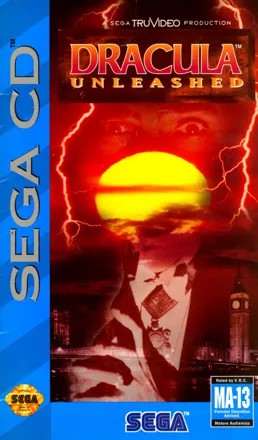
At a glance: Dracula Unleashed · Sega CD · developed by ICOM Simulations · published by Viacom New Media · 1993 · FMV adventure · London, winter 1899, across several in-game days · single player
ICOM Simulations had a house style, and if you played its Sherlock Holmes: Consulting Detective games you already know whether Dracula Unleashed is for you: live actors, filmed scenes, and an interface whose main job is deciding which scene you watch next. This time the dressing is gothic rather than Baker Street. You are Alexander Morris, a Texan in London in the winter of 1899, newly engaged to Annisette Bowen and newly inducted into the exclusive Hades Club — the circle of his late brother Quincey, who a decade earlier helped destroy Count Dracula. Corpses are turning up drained and decapitated, old friends from Stoker’s novel are gathering again, and the Count, it seems, has not stayed destroyed. As interactive movies go it is a decent tale, decently told. As a game, it is one of the most tightly railed adventures ever sold in a box.
London, One Door at a Time
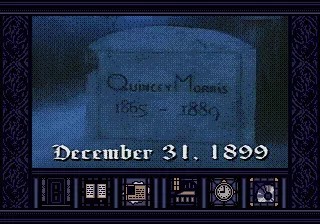
Every visitable address in London is the same arrangement: a still illustration of the building, a waiting carriage, and a door. The carriage returns you to the travel map. The door plays a film clip — roughly half a minute of it — whose contents depend entirely on where the story currently stands. Arrive at the correct place in the correct order and the clip advances the plot and hints at your next destination. Arrive out of sequence and a servant or superintendent appears to explain, politely, that nobody is home. There is no scene to search, no witness to question with lines of your own choosing, no clue to uncover by looking closer. Investigation, in the detective sense, does not occur; what occurs is playback, routed through a row of icons along the bottom of the screen governing your journal, the map, the clock and your belongings.
Two systems dress this up as participation, and both are thinner than they look. The first is time. Travel consumes it, clips consume more of it in great fictional gulps, and dawdling has consequences: be in the wrong district when a scripted appointment arrives, or reach a confrontation without the protective item the story expects, and Alexander dies. Time is therefore less a simulation than a leash, there to stop you brute-forcing the plot by clicking every door in London. The second is the inventory. Items are never found by searching a location; they appear in an “in” tray on the inventory screen after a scene, must be collected before you wander off, and occasionally — only occasionally — change which clip plays if you have armed the right object beforehand. Mostly the inventory is another way to die on a technicality: the scene where the blackjack would have saved you does not pause while you fetch it.
“You do not solve Dracula Unleashed. You attend it, punctually, in the order it prefers, carrying what it told you to carry.”
To be fair to ICOM, the rails were partly the point. The Consulting Detective formula had already proven that a certain audience — part adventure player, part armchair viewer — enjoyed being ushered through a filmed mystery with light duties, and Dracula Unleashed is that formula given a bigger, moodier canvas: a two-disc production (the Sega CD edition spans a pair of CDs), a full supporting cast drawn from the novel, and a plot with genuine sequel logic, since Alexander’s investigation works precisely because he is an outsider inheriting his brother’s unfinished war. A newspaper found early on even tips a wink to the Holmes games, the studio signing its own house style. If you accept the contract — punctuality and attentiveness in exchange for story — the game honours its side of it more faithfully than most FMV productions bothered to.
Camp, Competence and a Pen You Must Click
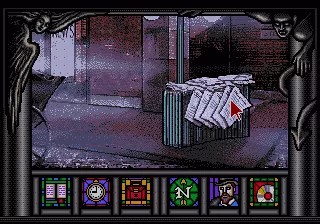
Small absurdities accumulate. Your journal, the game’s memory of everything learned, does not fill itself in: after each important scene you must select the pen icon to have the observation written down, a chore whose only conceivable purpose is checking you were awake. Van Helsing offers a tutorial in an accent that wanders Europe without a passport. Saving, at least, is allowed almost anywhere a film is not running, which in a game this fond of killing you for inefficiency amounts to basic human decency, and backtracking through earlier saves is less a strategy than the intended method.
It is also, for the format, unusually literate about its source. Stoker’s novel is an epistolary patchwork of diaries, letters and newspaper reports, and there is a quiet aptness in a Dracula game built from journals you must remember to write, addresses you must visit in person and newsprint that moves the plot — the Hades Club itself is an invention, but Van Helsing, the Harkers, Dr Seward and Lord Holmwood all behave like people continuing a story rather than mascots rented for a licence. The game trusts that inheritance completely; arguably it trusts it to carry weight the interaction never has to.
And yet the film itself is likeable. The acting is ripe, certainly — this is community-theatre Stoker, not Coppola — but it is committed, the costumes and candlelit sets sell 1899 within the Sega CD’s means, and the video compression behaves better than the format’s reputation, faces and actions staying readable even as fine detail breaks into the familiar mosaic. The plot honours the novel’s machinery without merely repeating it, the returning cast give Alexander’s investigation a sense of inherited dread, and there is an undeniable pleasure in settling in for the next instalment. It plays, deliberately, like a gothic serial: which is fortunate, because a serial is what it is.
Posterity has offered one unexpected kindness: the game was reissued on DVD in 2002, playable on an ordinary DVD player, with the video restored to full-screen clarity and behind-the-scenes material included — an admission, in effect, that the film was always the product and the interface the packaging. On Sega CD the mosaic compression and the icon-wrangling stand between you and that film at every step. Played today, the DVD edition is the comfortable way to attend Alexander’s story; the Sega CD original remains the historically interesting one, murk and all.
The Verdict

Strip the icons away and Dracula Unleashed is a linear novella whose pages turn when you knock on the right door at the right hour holding the right keepsake — more interactive, just, than the book it sequels, and less interactive than almost any adventure game of its year. Follow a walkthrough and you will honestly lose very little; you will gain the story, which is the part worth having, without the deaths for inefficiency. Devoted Dracula enthusiasts and connoisseurs of early FMV will find a single playthrough rewarding. Everyone else should know precisely what is being sold before the carriage leaves: atmosphere and narrative, yes; agency, no — and in 1993, for one ride through fogbound London, that trade tempted more players than history remembers.
Verdict: a well-told gothic tale trapped in one of the era’s most restrictive adventures — 5.0, for Stoker completists.
Keep reading: the Sega CD system archive