
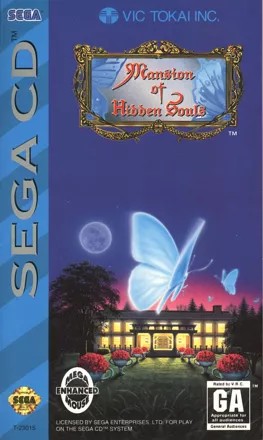
At a glance: Mansion of Hidden Souls · Sega CD · developed by System Sacom · published by Sega (Japan and PAL) and Vic Tokai (North America) · Japan 10 December 1993, North America February 1994 · first-person FMV adventure · roughly forty minutes to four hours · 1 player
The packaging does its best to frighten you. A mansion glows against the night, the title drips with gothic intent, and everything about the presentation suggests a proper haunted-house ordeal in the mould of The 7th Guest. Then the game begins in a sunny meadow, with a boy, his sister and a butterfly — and the butterfly turns out to be the whole point. Mansion of Hidden Souls, known in Japan as Yumemi Yakata no Monogatari and in Europe as Yumemi Mystery Mansion, is a first-person adventure built entirely from pre-rendered video, in which the souls trapped inside a mysterious house have all taken the form of butterflies. It is eerie, pretty and oddly gentle. What it is not, whatever the cover implies, is a horror game — and judging it fairly means accepting that early, then deciding whether the gentler thing it actually is still works.
A Haunting That Starts in a Meadow
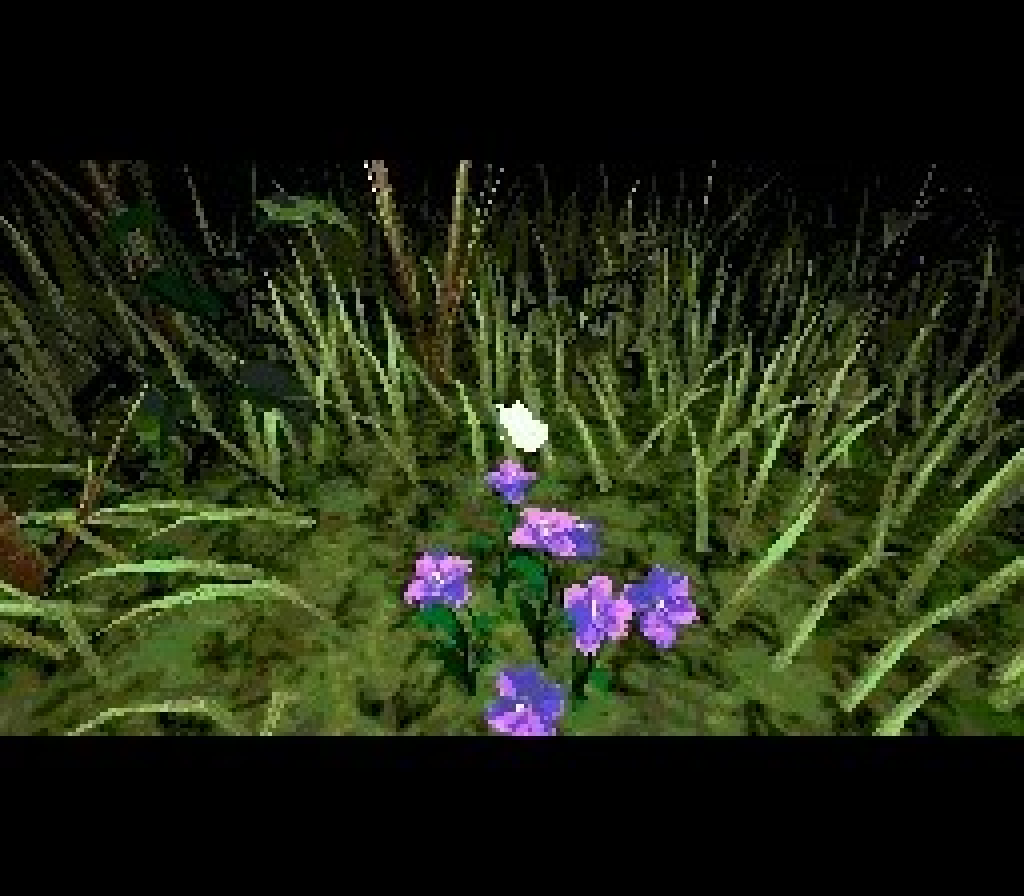
The opening film sets the tone and the limitations in one go. Jonathan and Samantha are out in the grass when she spots the butterfly and chases it, against their grandmother’s warnings about the old place nearby. The adults voicing the children strain visibly for youthful enthusiasm, the camera lurches after her in slow, juddering steps, and by the time Jonathan follows her into the mansion that has appeared where no mansion should be, you understand both the fairy-tale register the story wants and the technical ceiling it is working under. She is gone. He goes in. You take over, in first person, moving between pre-rendered viewpoints with full animated transitions between them — a step beyond the static slideshows of Myst, even if the step is a slow and wobbly one.
Inside, the house opens up gradually. A handful of rooms are available at first; the rest wait behind locked doors, and the keys and useful objects sit inside the rooms you can already reach. Nearly every chamber has its resident butterfly, and talking to them is the game’s real substance. Each soul has a personality, an accent borrowed from somewhere around the world, and a small history: some were lured here, some came looking for exactly this fate, and some speak darkly about a figure called the Hunter, whose collection of pinned specimens hangs in one room as a quiet rebuke to anyone praising the arrangement. The performances are broad and the echo effects laid over some voices make lines genuinely hard to catch, but the cast gives the house a populated, melancholy feel that a emptier game would lack. There is no text to read — everything is spoken — which was a genuine novelty worth crediting in 1993.
One Puzzle at a Time, Whether You Like It or Not
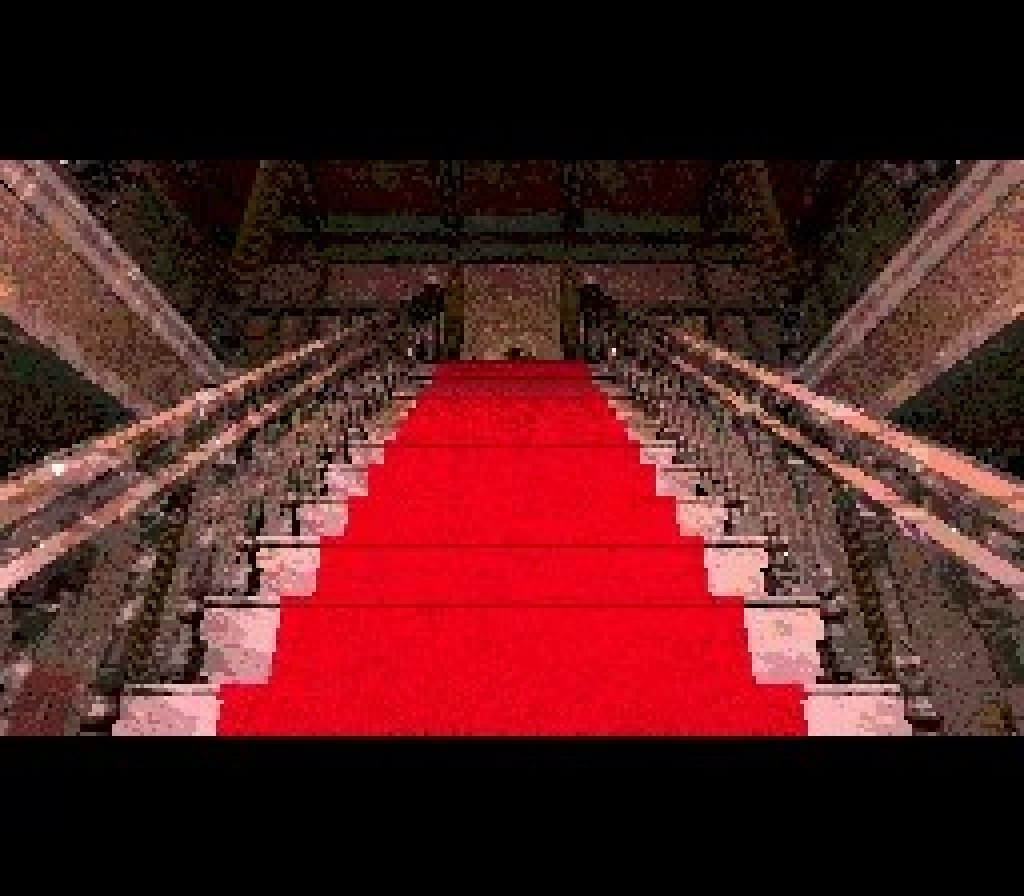
Mechanically, this is about as simple as the genre gets. You move with the pad, press up to look closer at whatever the room offers, press again to use it. Your small inventory is never combined, never puzzled over for long, and a magic picture frame in the house will show you, outright, the next object your attention should turn to. Puzzles arrive strictly one at a time, in a fixed order, and the structure produces the game’s most irritating habit: you can examine a spot, see something promising sitting there, and be unable to touch it until the story has formally unlocked that step. An early key hidden by a dresser makes the point — you can look at the pillow it hides behind long before the game permits you to move it. At moments like that the frame is not helping you play; it is playing, and you are carrying the controller for it.
Seasoned adventurers will stroll through. There are a couple of pattern puzzles and a late stretch against the clock that briefly raises the pulse, but nothing here will hold an experienced player up, and a knowledgeable run can be startlingly brief — the whole thing can be finished in well under an hour, while a first, unhurried exploration might take an evening. Whether that brevity is a flaw depends on what you came for. As a challenge, the game barely registers. As a place to wander through at a child’s pace, with the house slowly turning from wondrous to faintly wrong, it has a mood that very few of its contemporaries managed.
“A haunted house where the ghosts are butterflies, the puzzles solve themselves in single file, and the scariest thing in it is how short it is.”
Pretty, Grainy and Barely Frightening
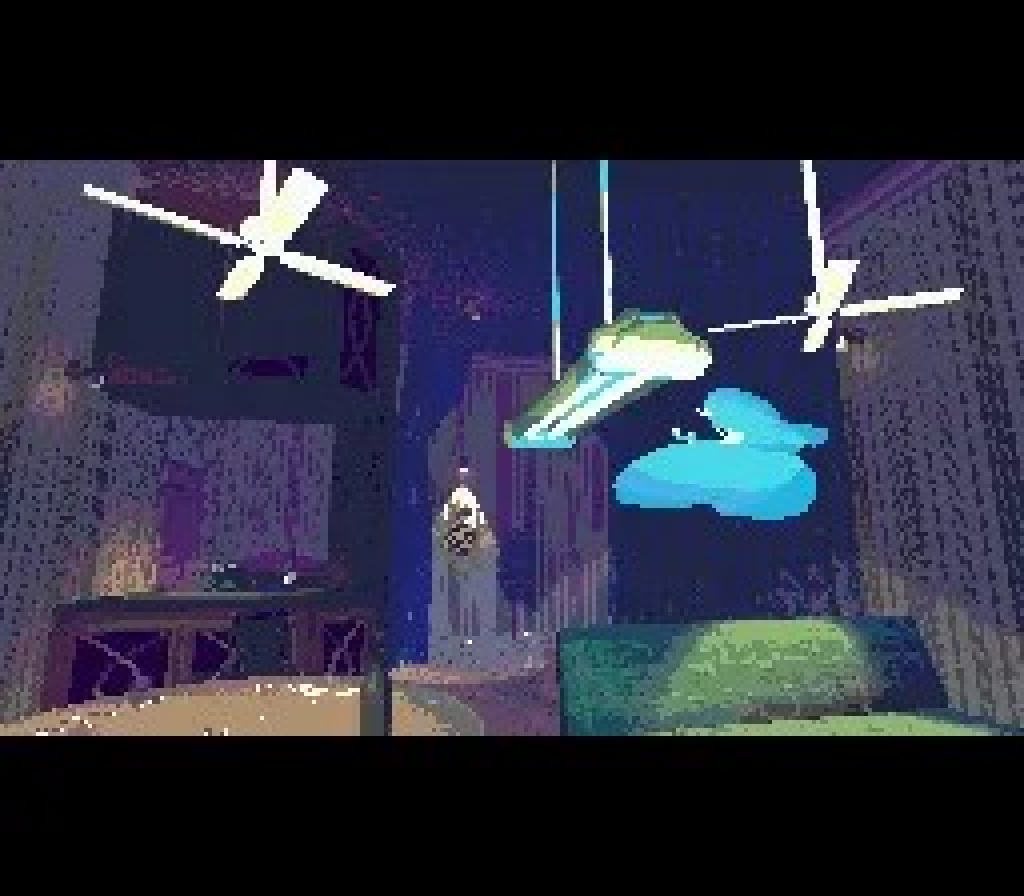
The atmosphere is the achievement, and it survives its technology better than you would expect. Every room has its own dressed, deliberate look, and the early stretch of the game feels like exploring a beautiful doll’s house after hours — calm, curious, faintly unreal. As the story proceeds the same spaces curdle a little; nothing jumps out, nobody screams, but the wrongness accumulates, and the late time limit gives the dream a pulse. It is the atmosphere of a Twilight Zone episode or a children’s ghost story read at bedtime: unsettling in retrospect rather than in the moment. Players who arrive wanting fear will call it boring, and on their terms they are right. Players who can meet it on its own terms get something rarer — a game that is spooky the way a music box is spooky.
The presentation fights that mood at every step, mind you. The pre-rendered scenes were produced on far stronger hardware than the Sega CD, then squeezed through its video compression, and the results are grainy, colour-starved and letterboxed, with objects smearing into blocks of colour while the camera moves and only settling once it stops. Water and stone fare worst; furniture and faces fare better. The music is the other casualty: each room has its own drifting, ethereal theme, but the themes loop after only a couple of seconds, and what begins as ambience becomes an irritant if a puzzle keeps you in one place. Footsteps, small chimes for discoveries and the odd pointed sound effect do the rest of the work, and do it well enough.
The Verdict
Mansion of Hidden Souls survives as a mood piece. Its house is lovely to wander, its butterfly residents give the place a sad, strange population, and its story lands a twist that suits its bedtime-story register perfectly. Against that stand puzzles that barely deserve the name, a structure so linear it sometimes plays itself, a soundtrack of two-second loops, and a running time that can collapse to forty minutes once you know the route. In 1993 its fully voiced, fully rendered world was a glimpse of where games might go; what it actually previewed was how much atmosphere alone can carry, and how quickly it runs out of road.
For the right player — a younger one, a newer one, or anyone who prefers their ghost stories gentle — it remains a pleasant, peculiar evening. Everyone else should know what the box does not tell them: the butterflies are not a metaphor, and the haunting is a lullaby.
Verdict: a beautiful, drowsy little ghost story wearing a horror game’s coat — 6.0, and best met on its own gentle terms.
Keep reading: the Sega CD system archive