
Everybody knows the Amiga’s headline acts. Sensible Soccer, Cannon Fodder, Lemmings and The Secret of Monkey Island get the magazine covers, the anniversary features and the compilation slots, and quite right too. But a library as vast and as gloriously eccentric as the Amiga’s keeps its best surprises in the second drawer down: the games that reviewed well, sold modestly, arrived late in the machine’s life or simply got buried under a pile of bigger names in the same month. Dig through the early Nineties, in particular, and you find a remarkable run of inventive, polished releases from 1993 and 1994 that many owners never played at the time.
These ten are not obscure for the sake of it, and none needs a sympathy vote. There is a puzzle-platformer from the future creators of Battlefield, a Hungarian role-player unlike anything else on the machine, a demoscene platformer made essentially by two people, and a shooter that still looks expensive today. Each one rewards an evening with an emulator or original hardware now. Here is where to start digging.
1. Benefactor (1994)
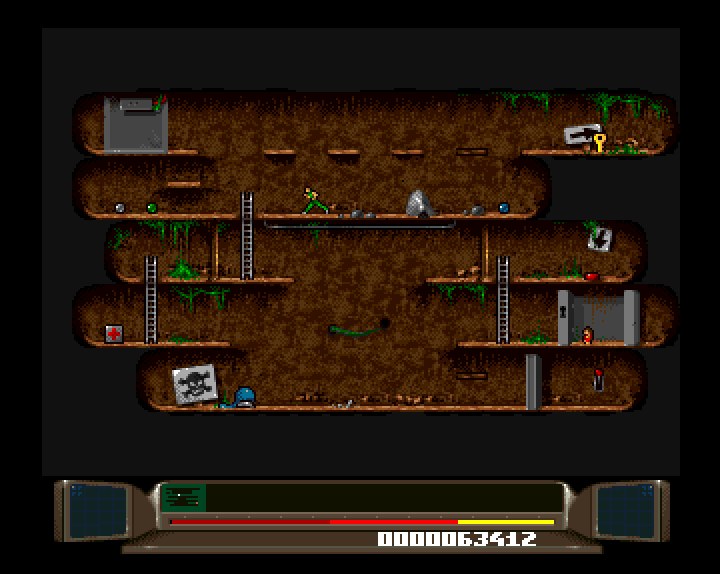
Before Digital Illusions CE became DICE and built Battlefield, the Swedish team made pinball tables and this: a puzzle-platformer of rare charm and quiet brilliance, published by Psygnosis in 1994. You play Ben E. Factor, a retired hero coaxed back into action to rescue the Merry Men, a tribe of cheerful little creatures kidnapped and scattered across sixty levels. Ben runs, jumps, climbs and swims through compact stages, flipping switches, fetching keys and rolling boulders — and then the clever part begins, because the Merry Men you free do not just wave and vanish. They follow instructions, operate machinery, help shift obstacles and sometimes need rescuing all over again when your plan goes wrong.
That makes Benefactor feel like Lemmings reimagined as an action game: half of every level is working out what everybody needs to do, and the other half is doing it yourself under pressure. The sprites are tiny but beautifully animated, the controls are precise, and the difficulty climbs with real fairness. It reached the CD32 as well, yet remains the least talked-about game in DICE’s early catalogue.
2. Perihelion: The Prophecy (1993)

Nothing else on the Amiga looks like Perihelion, and very little plays like it either. Developed by the tiny Hungarian team Morbid Visions and published by Psygnosis in 1993, it is a dark science-fiction role-player built around a prophecy: a mad god, the Unborn, is coming to unmake reality, and your party of six genetically engineered psionics — created for exactly this crisis — is the empire’s answer. The whole game is rendered in a striking palette of burnt orange, black and bone, like exploring a nightmare printed on old parchment, and it gives every corridor and creature a cohesive, oppressive atmosphere that far bigger productions never achieved.
The systems are just as individual. Instead of picking spells from a list, you build psionic powers yourself by stringing together syllables, experimenting to discover what each combination does — a genuinely creative piece of design for 1993. Exploration is first-person, combat is tactical and turn-based, and the story leans into moral murk rather than heroic comfort. Perihelion is demanding, occasionally opaque and utterly singular. If you only try one role-player from this list, make it this one.
3. Wiz ‘n’ Liz (1993)
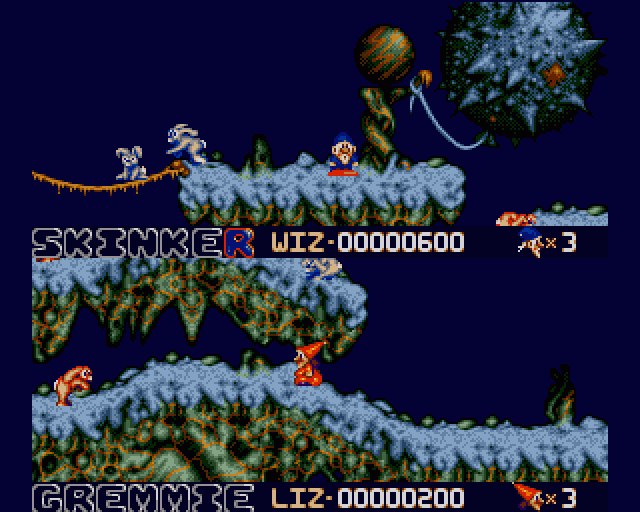
The Frantic Wabbit Wescue, to give it its full title, might be the most joyful game on this list. Designed by Raising Hell Software — the team that became Bizarre Creations — and published by Psygnosis in 1993, with the Amiga version handled by Lunatic Software, it casts you as a wizard or witch on the planet Pum, sprinting non-stop through side-scrolling levels to round up escaped rabbits before the clock runs out. There are no goombas to stamp and no lives lost to pits in the usual way; the enemy here is time itself, plus your own greed for the fruit, stars and letters the wabbits drop as you grab them.
Collect the letters to spell out bonuses, toss gathered fruit into the cauldron back home, and the mixing system rewards experimentation with everything from extra time to silly mini-games. Two players can rescue simultaneously, the pace is relentless, and Matt Furniss’s soundtrack bounces along happily. Wiz ‘n’ Liz sold respectably yet never became the mascot hit it deserved to be. Play it now and its kindness feels radical: a platform game about saving things, at speed, with a smile.
4. Globdule (1993)

Ex Animo Designs’ Globdule, published by Psygnosis in 1993, stars a melancholic pink blob who lives underground and dreams of escape — of becoming, of all things, a toy. It is a wonderfully odd premise, and the game built around it is just as individual. Globdule’s one great trick is adhesion: your gelatinous hero sticks to any surface he touches, which means floors, walls and ceilings are all fair game. Levels become three-dimensional puzzles in a two-dimensional world, as you roll around the underside of platforms, drop onto switches from above and pick routes across rooms that a conventional platform hero would cross in only one direction.
Secret rooms, trap doors and bonus lives hide behind that freedom, and the strange character design — all wobble and oversized eyes — gives the game a personality no focus group would have approved. Reviews were divided, some finding it fiddly, others won over by its invention, and a planned Mega Drive version never appeared, leaving the Amiga as Globdule’s only home. Stick with it, learn to think like a blob, and it quietly becomes one of the most original platformers Psygnosis ever released.
5. Traps ‘n’ Treasures (1994)

A pirate platform adventure with a German accent: Traps ‘n’ Treasures was designed by Roman Werner, working as Nightingale, released in Germany by Starbyte in 1993 and then in English by Krisalis in 1994. You are Captain Jeremy Flynn, shipwrecked and stripped of ship, crew and treasure by the villainous Redbeard, exploring a lush island world of beaches, jungles, caves and temples in search of all three. Where most Amiga platformers of the era were level-to-level affairs, this one opens up into exploration — hunting for keys, maps, weapons and hidden stores, backtracking through connected areas and gradually equipping Flynn for the dangers deeper inland.
What impresses most is the technical craft squeezed from a humble Amiga 500: smooth scrolling, rich colour and large, characterful sprites that would flatter far newer hardware. The island is dense with secrets, the swordplay and platforming are responsive, and the whole production has a hand-finished quality that bigger teams rarely matched. It found warmer reviews in some territories than others, which may explain why so many British owners missed it. They missed a treat: this is the Amiga’s answer to the console adventure-platformer, built by essentially one designer.
6. Brian the Lion (1994)

Reflections made its Amiga name with the moody spectacle of Shadow of the Beast, so nobody expected its fond farewell to the machine to be a funky cartoon lion. Brian the Lion, published by Psygnosis in 1994 for Amiga and CD32, is a mascot platformer built with a console audience in mind: Brian bounds through jungle stages at a smooth fifty frames per second, clawing enemies or bouncing on their heads, across levels stuffed with secrets and short, punchy challenges rather than the sprawling slogs the genre often demanded.
The technical showmanship is pure Reflections. Brian himself has over two hundred frames of animation, the game throws zooming, rotation, sprite scaling and de-resolution effects around like a demo coder showing off, and some stages put a reported 182 colours on screen at once. Fifty original tunes fill out the package. Brian arrived in 1994, the year Commodore collapsed, and was rather lost in the wreckage; Reflections moved on to Destruction Derby and Driver, and this delightful detour became a footnote. As footnotes go, it is a roaring one — colourful, confident and still technically astonishing.
7. Disposable Hero (1993)

If you want to show somebody what an Amiga shooter could do at its peak, load Disposable Hero. Developed by Dutch team Euphoria and published by Gremlin Graphics in 1993, with a CD32 version following in 1994, it is a horizontal shoot-’em-up in the R-Type tradition — biomechanical scenery, hulking mid-bosses, memorised bullet patterns — executed with a level of polish that still looks expensive. The parallax is deep, the sprites are huge and detailed, and a hard-driving electronic soundtrack pushes the whole thing forward like it is late for something.
Its best idea sits between the shooting: a proper power-up economy. Collect energy as you fight, then spend it in the game’s construction system to build and bolt new weapons onto your ship, choosing a loadout that suits the stage ahead. That touch of strategy gives Disposable Hero a replay value most rivals lacked. Be warned, though: it is hard as nails, in the proudest arcade tradition. It is also, quite simply, one of the finest shooters the Amiga ever hosted, and it baffles us that it is not mentioned every time the subject comes up.
8. Yo! Joe! (1993)
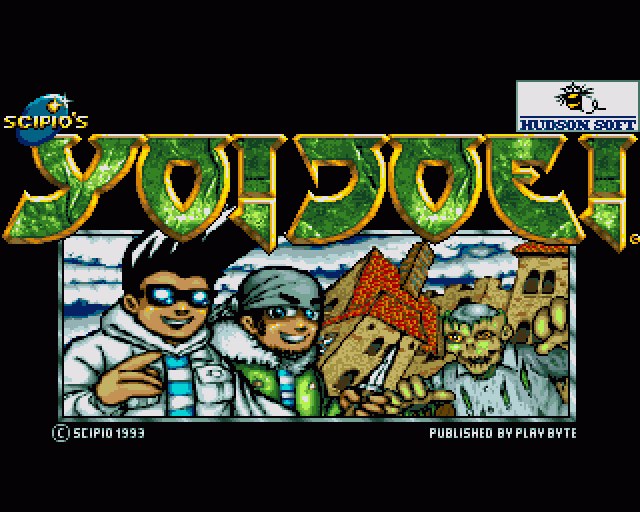
Yo! Joe! Beat the Ghosts, developed by German team Scipio and published by Hudson Soft with Play Byte in 1993, is that rarest of things: an Amiga platformer that feels like it escaped from a coin-op cabinet. It runs at a constant, silky fifty frames per second, throws two heroes — Joe and his friend Nat — into a haunted castle and its grounds, and lets them kick, punch, slide, crawl and swim their way through the undead in single-player or, far better, simultaneous two-player. Weapons including firearms and chains turn up alongside the fisticuffs, the scenery keeps changing — castle, labyrinth, even shooting sections — and a thumping soundtrack of more than forty minutes ties it together.
Contemporary reviewers could not agree about it, with scores ranging from the high sixties to the low nineties, and that split probably cost it the audience it deserved. The low scorers called it straightforward; the high scorers noticed how exceptionally well it moved. Sitting with it now, the high scorers were right about what lasts: controls this crisp and animation this fluid do not date. Grab a friend, because co-operative Amiga platforming rarely got better than this.
9. Naughty Ones (1994)

Naughty Ones is the demoscene walking into commercial games and showing everybody how it is done. It was created for Interactivision in 1994 essentially by two members of Danish demo group Melon Dezign: programmer Jacob Gorm Hansen, known on the scene as Paleface, and artist Henrik Mikkelsen, or Seen. You control John and Jim, a pair of cheerful terrors working through five worlds of linked rooms, each room demanding the same simple, satisfying loop — find the key, unlock the way on, survive everything the room throws at you — before a final showdown with an evil king.
Everything about it is economical and assured. The graphics are clean rather than flashy, the controls answer instantly, power-ups arrive at a fair clip, and two players can misbehave simultaneously, which is plainly the correct way to play it. Amiga magazines noticed the quality even if the wider world did not: Amiga Power scored it at ninety percent, praising exactly the unfussy, gameplay-first design that the scene prized. Naughty Ones never got a sequel or a big reputation, but as a demonstration of what a tiny, talented team could wring from one megabyte of memory, it remains a small masterclass.
10. Marvin’s Marvellous Adventure (1994)

We finish with the most improbable hero on the list: a pizza delivery boy. Marvin’s Marvellous Adventure, developed by German team Infernal Byte Systems and published by 21st Century Entertainment in September 1994, begins with Marvin delivering a pizza to a professor whose latest invention — a brain-scanning device — has attracted the attention of an evil being called Dark-One. A stray ray, a pratfall through a doorway, and Marvin wakes in another dimension with a professor to rescue, a missing piece of machinery to recover and sixty levels standing in his way, spread across six bright worlds.
This is console-style platforming done with real care: small, expressive sprites chosen so the screen can hold plenty of action, fruit and stars to Hoover up, enemies despatched by jumping, kicking or collected weapon power-ups, and smooth scrolling throughout. Production had begun as far back as 1990, paused while the team went to university, and the patience shows. Magazine scores were all over the place, and a CD32 version followed in 1995. At its best — which is most of the time — Marvin is one of the most purely likeable platformers of the Amiga’s final years.
Start Digging
Ten games, ten arguments that the Amiga’s story does not end with its famous names. What unites this list is timing and circumstance: several arrived in 1993 and 1994, as the market shrank and the magazines thinned out, and some of the finest were built by tiny teams in Sweden, Hungary, Germany, Denmark and the Netherlands. The Amiga always was an international, small-studio machine at heart, and its hidden gems prove it better than its hits do.
So pick a starting point. Take Benefactor if you like your platforming with puzzles, Perihelion if you want something genuinely strange, Yo! Joe! or Naughty Ones if you have a second player handy, and Disposable Hero if you think modern shooters have gone soft. Every one of them is waiting exactly where it was left — in the second drawer down, under the famous stuff, still gleaming.