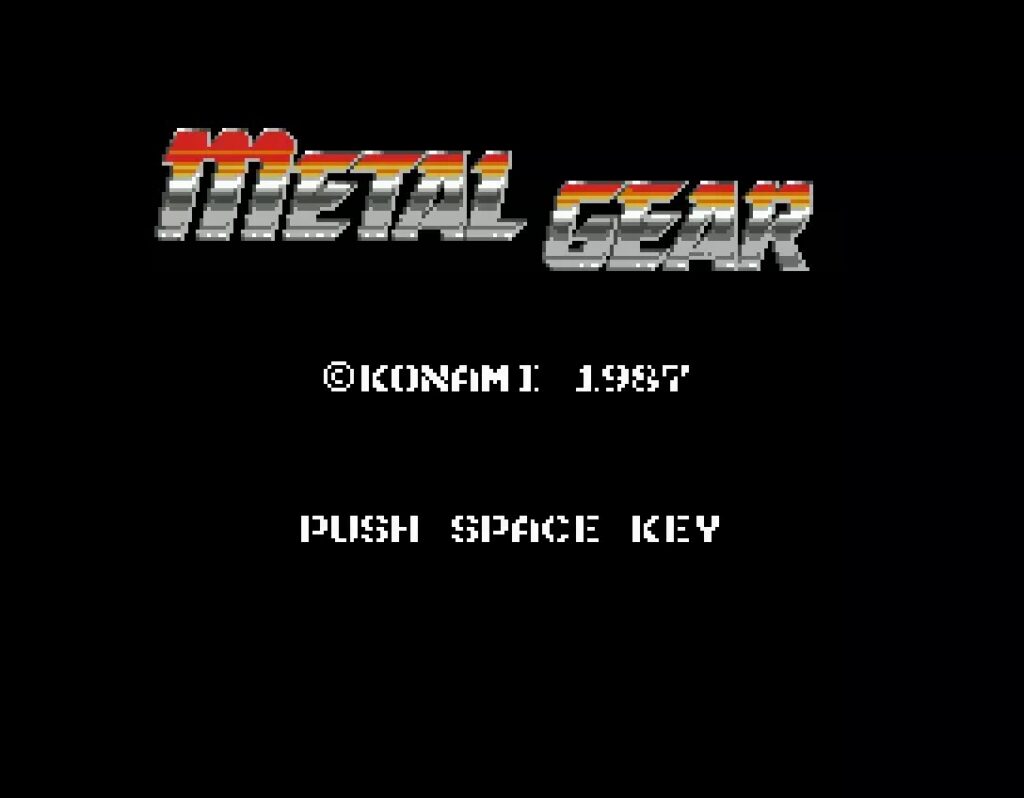
Every legend has a first draft, and Metal Gear’s was written on a home computer most of the West never owned. Released for MSX2 in Japan in July 1987 — months before the compromised NES conversion reached the world — Hideo Kojima’s debut as a designer is not a rough sketch of the stealth genre. It is the stealth genre, arriving essentially complete: infiltrate, observe, evade, improvise. Playing it today is less like archaeology than like meeting a classic on its home turf.
At a glance: Konami, 1987 · MSX2 · Stealth-action · Designer: Hideo Kojima
Outer Heaven, As Intended
You are Solid Snake, rookie operative of FOXHOUND, dropped alone outside the fortified state of Outer Heaven to rescue a captured agent and destroy the walking nuclear tank of the title. The MSX2 original tells that story with an assurance the NES version never managed. The structure is a genuine open infiltration: a sprawling complex of buildings, yards and truck routes that you learn by probing, backtracking and dying informatively. Keycards gate your progress in the series’ signature rhythm, the radio brings Big Boss’s guidance — and, eventually, his suspiciously bad advice — and the whole campaign builds toward revelations the Famicom port mangled or dropped.
Stealth Before It Had a Name
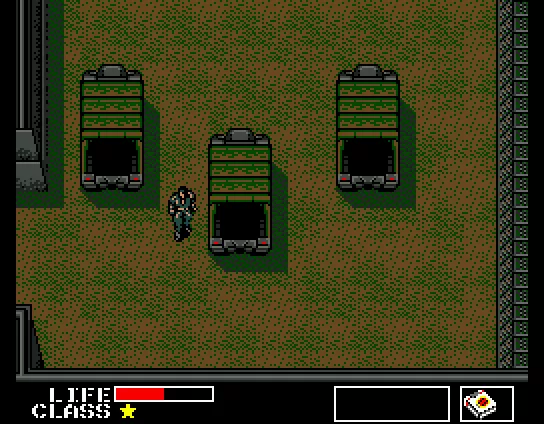
What astonishes, nearly forty years on, is how modern the play feels. Guards have sightlines and patrol logic; being spotted raises an alert that must be waited out or outrun; silenced weapons, disguises, rations and remote misdirection are tools in a kit that rewards patience over firepower. Combat is deliberately awkward — Snake is a spy, not a space marine — so every corridor becomes a small puzzle of timing and nerve. The famous tricks are all present in embryo: the cardboard box, the cigarettes, the trucks you ride between areas. Later games refined the formula with vastly better technology. None of them invented anything this one lacks.

The MSX2 Difference
Because this is the MSX2 version, it also looks and sounds the part. The hardware’s richer palette gives Outer Heaven a grimy military coherence the NES palette never achieved, and the presentation — portraits, radio screens, those earnest function-key tutorials — has a handmade charm that suits the story’s sincerity. Slowdown and the occasional screen-transition hiccup are the honest taxes of 1987 hardware programming; they cost the game little.
The Radio Is the Real Interface
Metal Gear’s boldest idea is its radio. Years before Metal Gear Solid made the codec famous, the MSX2 original built its storytelling around a transceiver: Big Boss talks you through the fortress, resistance leader Schneider feeds you intelligence from inside, Diane and Jennifer round out a support network you never see but come to trust. It is a masterstroke of constrained design — a home computer adventure’s worth of characters and plot, delivered through a text window and portraits, while the action never leaves the field. And it enables the game’s coldest trick. As Snake penetrates deeper, Big Boss’s instructions begin to curdle — a door sealed here, a retreat ordered there, guidance that leads somewhere it shouldn’t. The voice of authority becoming the threat is a twist the medium would spend decades reusing. It starts here, on a radio, in 1987.
What the NES Version Changed
Most of the world met Metal Gear through the NES port, and deserves to know what it missed. The conversion added a jungle preamble the original never had, rearranged the base, infamously never lets you fight the Metal Gear itself — the tank is reduced to a guarded computer room — and wrapped it all in a translation of heroic brokenness. Kojima has never hidden his disappointment with it. The MSX2 game is the director’s cut by default: the infiltration structure intact, the tank awaiting at the end of it, the story’s betrayals in their proper places. Comparing the two side by side is the fastest way to understand how much of this series’ identity was present at its conception — and how casually it was nearly lost in transit.
Playing It Today
The good news is that the MSX2 original is no longer hard to reach. Konami itself has repeatedly reissued it — most notably in the Metal Gear Solid 3: Subsistence package and the HD collections, where the two MSX games sit as the saga’s honored prologue — and the cartridge thrives on real hardware for those who have it. However you arrive, arrive patient. This is a game that expects you to map, to experiment, and to treat every new keycard as a small victory. Give it that patience and it gives you back a landmark: not the seed of a great series, but the thing itself, in full flower, five years before most of its audience knew its name.
Learning the Fortress
A word about how the game teaches, because its pedagogy is half its genius. Metal Gear drops Snake outside Outer Heaven with almost nothing and trusts the player to become a spy by doing a spy’s work: watch a patrol complete its circuit before crossing its yard; learn that a punch is quiet and a gunshot is a dinner bell; discover that the lorry routes stitch the map together and that a cardboard box, properly timed, is the best armor ever issued. Failure is frequent but never muddy — you always know which sightline caught you, which alarm you tripped, which shortcut your new keycard just opened in a corridor you cleared an hour ago. The fortress slowly converts from hostile maze to personal property, and that conversion — from trespasser to ghost — is the game’s true progression system, more satisfying than any statistic. Modern stealth games render this with minimaps and threat indicators. Kojima’s original does it with your memory and your nerve, and the purity of that arrangement has aged magnificently.
The bosses deserve their sentence too: a machinegunner in a corridor that punishes the frontal approach you have been trained out of, a tank, a helicopter fought from cover — set-pieces that test the infiltration toolkit rather than replacing it. And then the final approach, the supercomputer’s guardian, and the escape countdown that would become the series’ signature farewell. Everything the franchise does, it learned to do here, on a Z80, in 1987.
The Verdict on Value
One more consideration for the modern reader weighing an evening with a 1987 computer game: Metal Gear asks for roughly four to six hours and repays them with a density of invention that many forty-hour titles never approach. It is also, not incidentally, the perfect first MSX game — the title that explains the platform’s Japanese heartland, Konami’s golden division, and a designer’s entire career in a single cartridge. The stealth genre has produced bigger spectacles in the decades since. It has never produced a more efficient one, and it began, definitively, here.
Consider it the keystone of this entire MSX shelf: the cartridge that explains why the platform mattered, and what it could do in the hands of a designer with something to prove.
Verdict
The stealth genre’s founding document, in its best 8-bit form — tense, inventive and decades ahead of its own reputation.
If you know Metal Gear only through its console descendants, the MSX2 original is a revelation: not a prototype of a great series, but a great game that started one. Essential.