
At a glance — Developer: Delphine Software · Designer, programmer and artist: Éric Chahi · Publisher: Delphine Software · U.S. Gold (UK) · Released: November 1991 (Amiga and Atari ST) · Platform: Amiga · Genre: Cinematic platformer · Music: Jean-François Freitas
Thirty-five years ago this month, a young French artist-programmer finished a game he had built almost entirely by himself, in flat polygons and near-total silence. Another World did not just push the Amiga — it showed every games machine that followed how to behave like a cinema. Our Atari ST review covers how it plays. This is the other half of the story: the version where it all began, on the machine it was born on, and the one man who designed, coded, drew and rotoscoped it into existence.
The Illustrator Who Wanted His Own Game
Éric Chahi arrived at Delphine Software in 1988 hired for his pencil, not his keyboard. He had been programming since 1983, on the Oric and Amstrad machines of French bedrooms, but Delphine — a Parisian studio spun out of a record label — wanted him as an illustrator on a point-and-click adventure designed by Paul Cuisset: Les Voyageurs du Temps, released in English as Future Wars in 1989. The game was a hit, and its success changed Chahi’s life twice over. The royalties gave him independence, and Delphine gave him something rarer: the chance to develop his own game, in his own words, “without any constraint of any sort or any editorial pressure.”
He had a grievance to work off. Chahi had lobbied to paint the Future Wars cover himself and been refused, and he had watched publishers dress his earlier games in artwork he disliked. Whatever he made next would be his in every particular — code, pictures, and the painting on the box. Offered the choice between illustrating Cuisset’s next game, Operation Stealth, and striking out alone, he chose the empty desk.
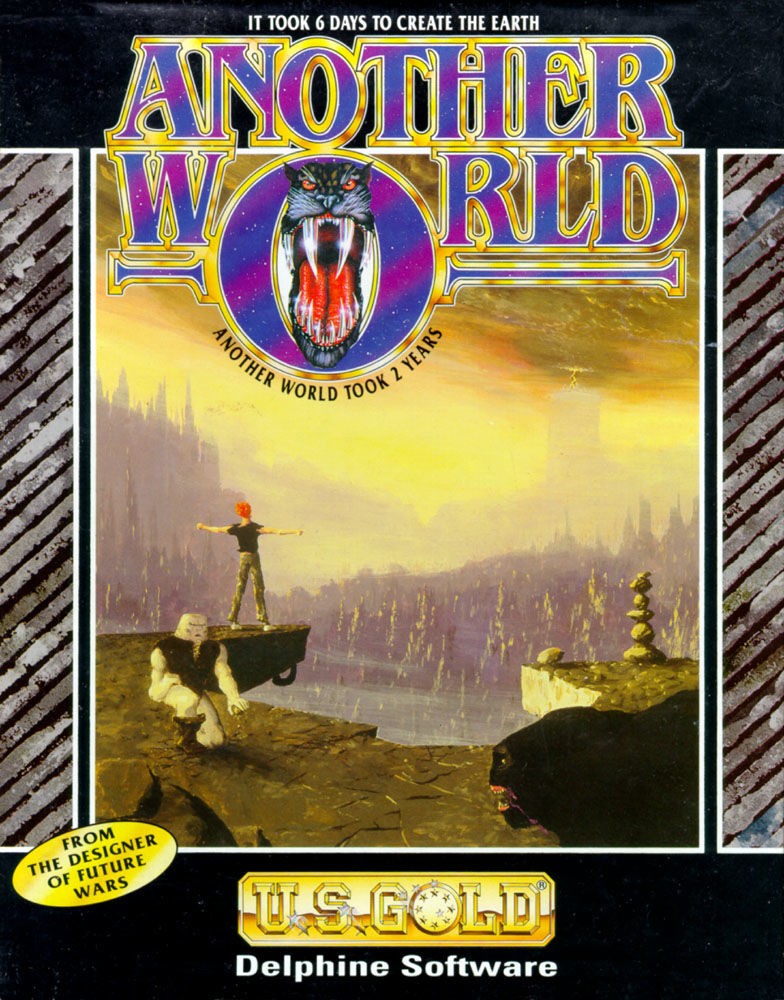
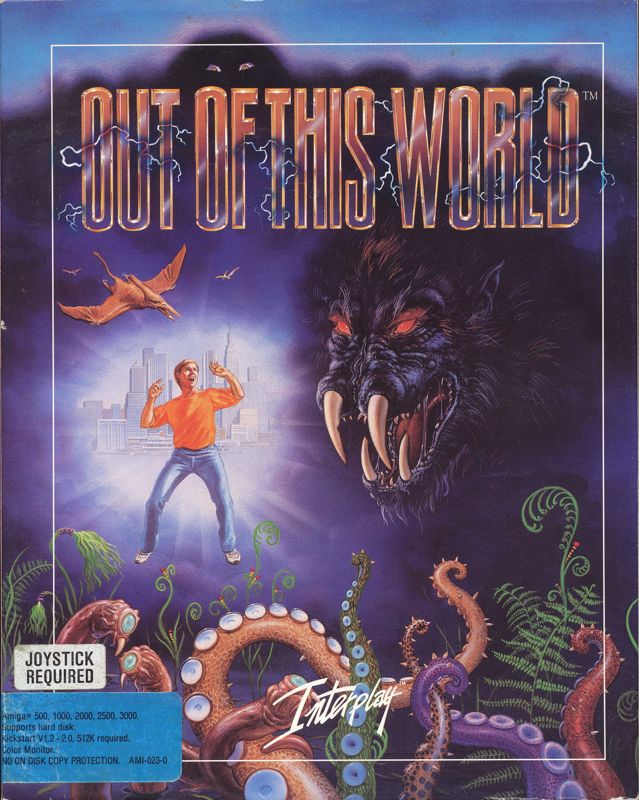
The European box, with Chahi’s own cover painting. In North America the game was sold as Out of This World (Interplay) — that box is this article’s featured image.
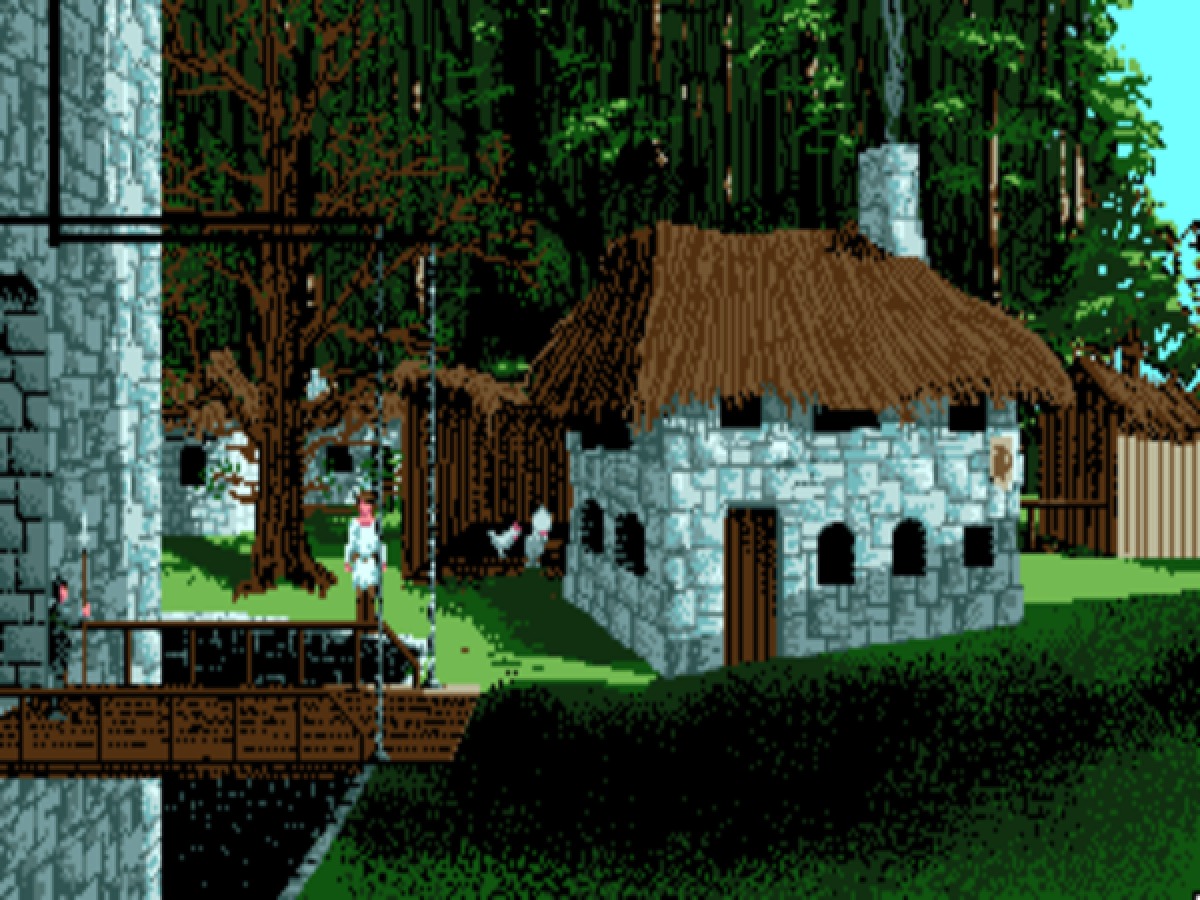
Future Wars (1989): the Delphine adventure Chahi illustrated for Paul Cuisset. Its success bought him two years of freedom. Screenshot via The Digital Antiquarian (Amiga).
Polygons, Not Sprites
The spark was somebody else’s game. In August 1989 Chahi saw the Amiga version of Dragon’s Lair — the laserdisc cartoon squeezed onto six floppy disks of flat-colour animation — and reasoned that the same fluidity could be had from vector outlines for a fraction of the storage. He tried the graphical routines in C, then dropped to Motorola 68000 assembly, prototyping a polygon engine first on an Atari ST. When the same code ran on the Amiga at around twenty frames per second, he later said, he knew the approach would work: “a major turning point in the creation of the game.”
There were no tools for what he wanted, so he built those too: a polygon editor and an animation sequencer written in GFA BASIC, driving a game engine in Devpac assembler on his Amiga 500. The game itself ran as a small virtual machine interpreting his animation scripts — an architecture chosen for elegance that would, years later, make Another World almost uniquely portable. Sixteen colours, flat fields, no outlines wasted. Where the sprite artists of 1991 drew bigger and busier, Chahi drew less, and meant it: his stated influences were the clean suggestion of comics and fantasy art — Michael Whelan, Richard Corben, Dune, Hyperion — worlds implied rather than itemised.
A Toy Car, a Video Camera and a Genlock
For movement, Chahi reached for the oldest trick in animation. Using the Amiga’s genlock, he fed video into his machine and rotoscoped: tracing flat polygons over filmed footage of himself performing Lester’s runs, leaps, swims and stumbles. The car in the famous opening — the sleek black sports car that delivers Lester to his laboratory through the storm — is a toy, filmed on a table and traced the same way. Chahi shared that footage publicly decades later, and it remains the perfect emblem of the production: one man, a video camera, and whatever was lying around the house.
His tools were finished by December 1989, and he built the introduction first, as a proof of the whole method — the storm, the accelerator, the lightning strike, the pool. It was done by early 1990. Everything after was improvisation, in his phrase “layer by layer without knowing where it was going.” He worked in story order and let his own circumstances seep in: he later recognised that the game’s long opening stretches of loneliness were the feelings of a man making a game alone. The alien friend — Buddy, the fellow prisoner who carries the second half of the game — was not planned at all. He emerged from the improvisation, and Chahi added close-up cinematics specifically so the player would bond with a character who never speaks a word they can understand.
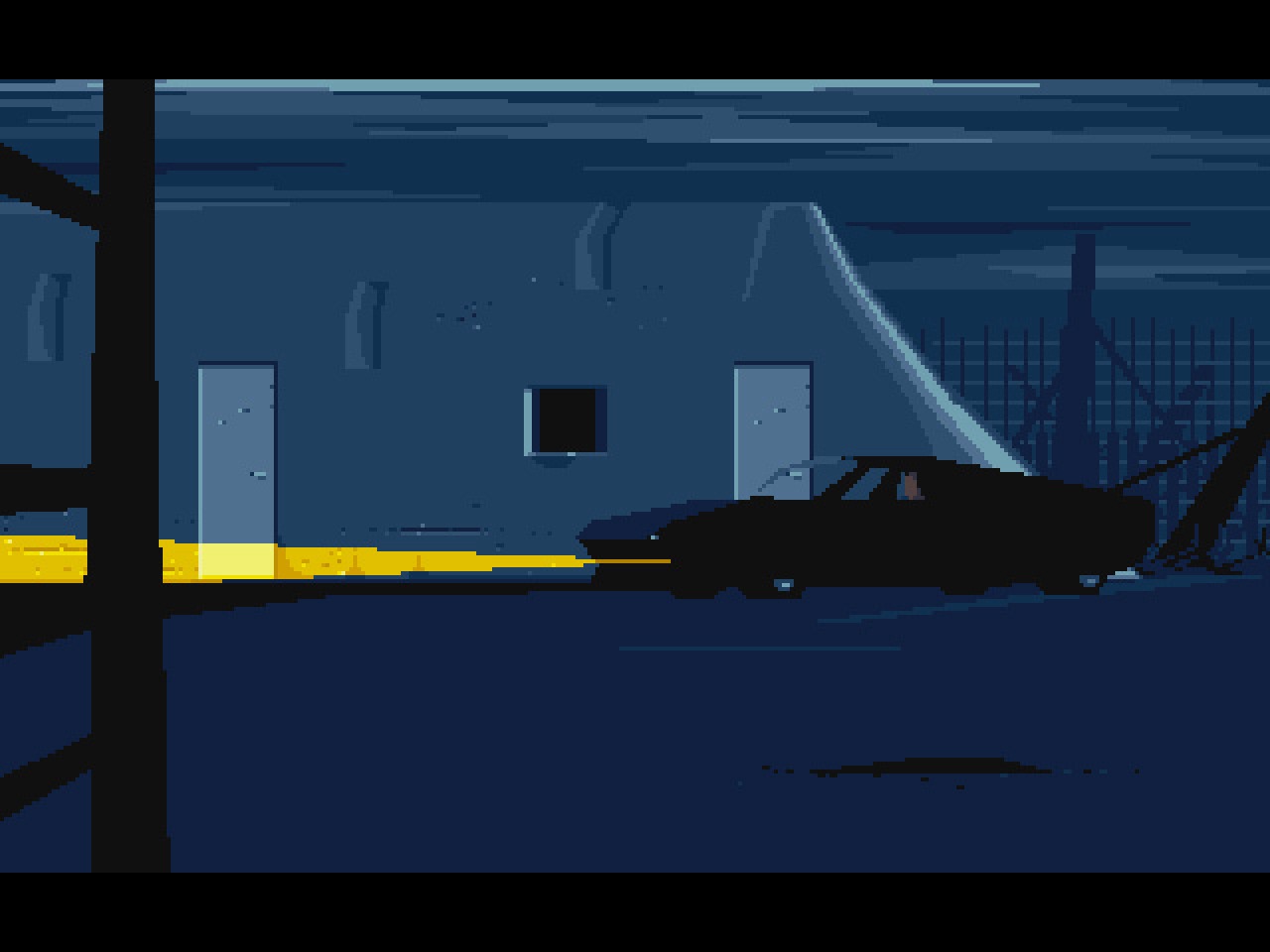
The most famous arrival in games: a storm, a laboratory, and a car traced from a toy. Frame via Fabien Sanglard’s Another World code review.
Sixteen Colours of Cinema
What those methods produced, in November 1991, was a game that refused every convention of its shelf-mates. No score. No lives counter. No HUD at all, beyond an oxygen gauge when Lester swims. No dialogue — the aliens bark in an invented language, and not one word of it is subtitled. The story is told the way films tell it: with framing, with cuts, with a camera that zooms to a face at the moment a face matters. A physicist is torn out of his laboratory mid-experiment and dropped in a pool on a hostile world, and the game simply watches him — and you — learn its rules by dying to them.
The set-pieces are still quoted because they are staged, not scripted at you: the Beast in the dark, the swinging cage over the mine, the laser pistol that fires, shields and charges, the flood, the bathhouse, the final crawl. Jean-François Freitas — the one collaborator, who composed the score — is deployed with a restraint that matches everything else: on the Amiga original, music belongs essentially to the opening and the ending, and the long dangerous middle is played in something close to silence. Deaths are instant and checkpoints are passwords you write down by hand. It is a short game that feels enormous, because every screen is a sentence you have to parse with your own body.
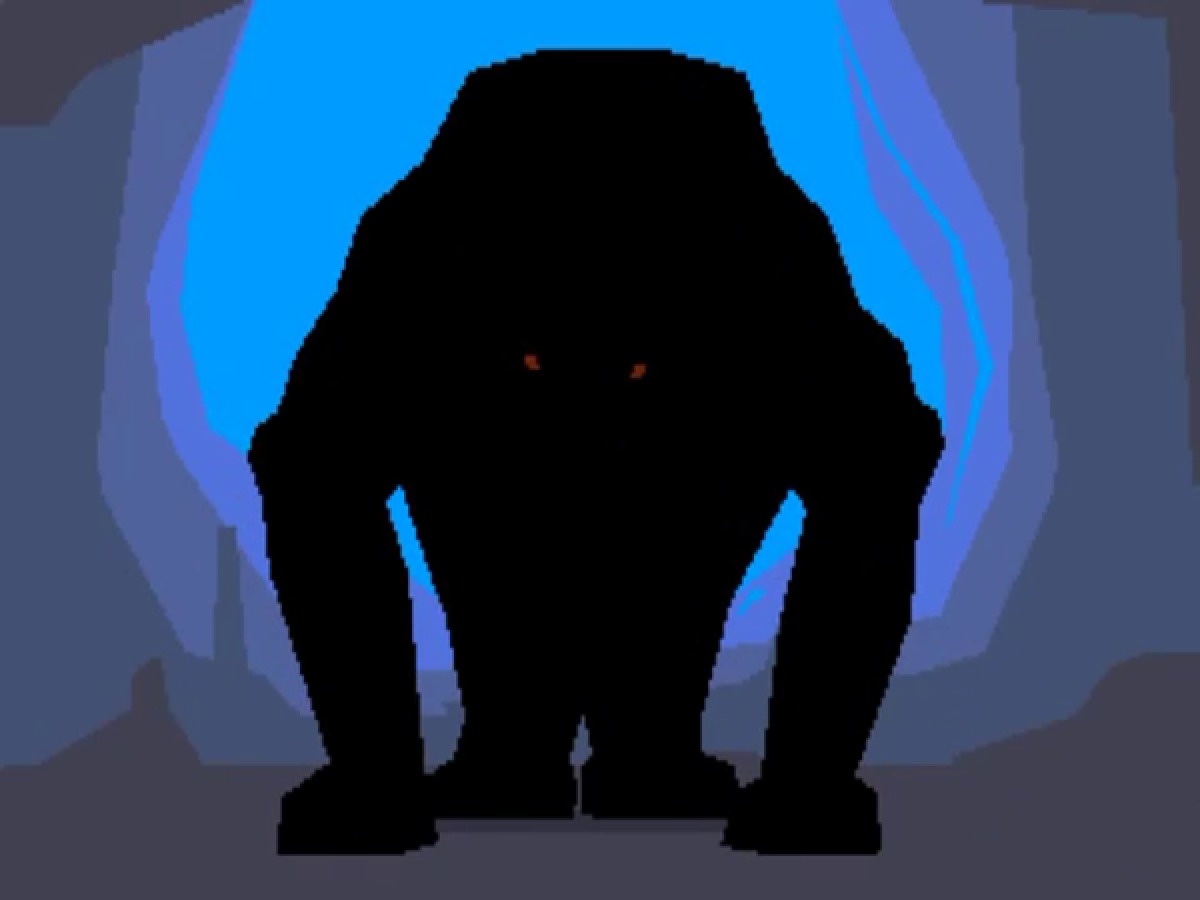
The Beast. No health bar, no tutorial, no words — just two red eyes in the dark. Screenshot via The Digital Antiquarian (Amiga).
Another World on the Amiga: November 1991
The last stretch was a fight for the game’s soul, and Chahi won it. Shopping the unfinished game around, he found Virgin enthusiastic but insistent that it become a point-and-click adventure; he refused. In June 1991 he accepted Delphine’s offer instead, with a November deadline, and storyboarded the remaining plot to finish on time — discarding, along the way, an ending in which Lester becomes leader of the alien world. And this time there was no argument about the box: burned by Future Wars, he had argued for his own cover art, and the painting he produced — Lester and Buddy on the cliff edge, the Beast’s jaws inside the letter O — is the image the game is still filed under in the mind.
The Amiga and Atari ST versions shipped together in November 1991, protected by the era’s most theatrical anti-piracy device, a cardboard code wheel. The Amiga original was the fullest expression of the pair: the sharper colours and the machine’s superior sound gave Chahi’s sixteen-colour compositions their best home. France, which had watched the game being made in its magazines, received it like a coronation — Joystick scored it 97%, Génération 4 94%, both in their November 1991 issues. The British Amiga press followed: 91% in CU Amiga, 93% in The One, 89% in Amiga Power. The recurring complaint was length — ninety minutes if you knew it, an evening of deaths if you didn’t — but the game sold in the region of a million copies across the decade, and Amiga World named it the number one new Amiga game of 1992.
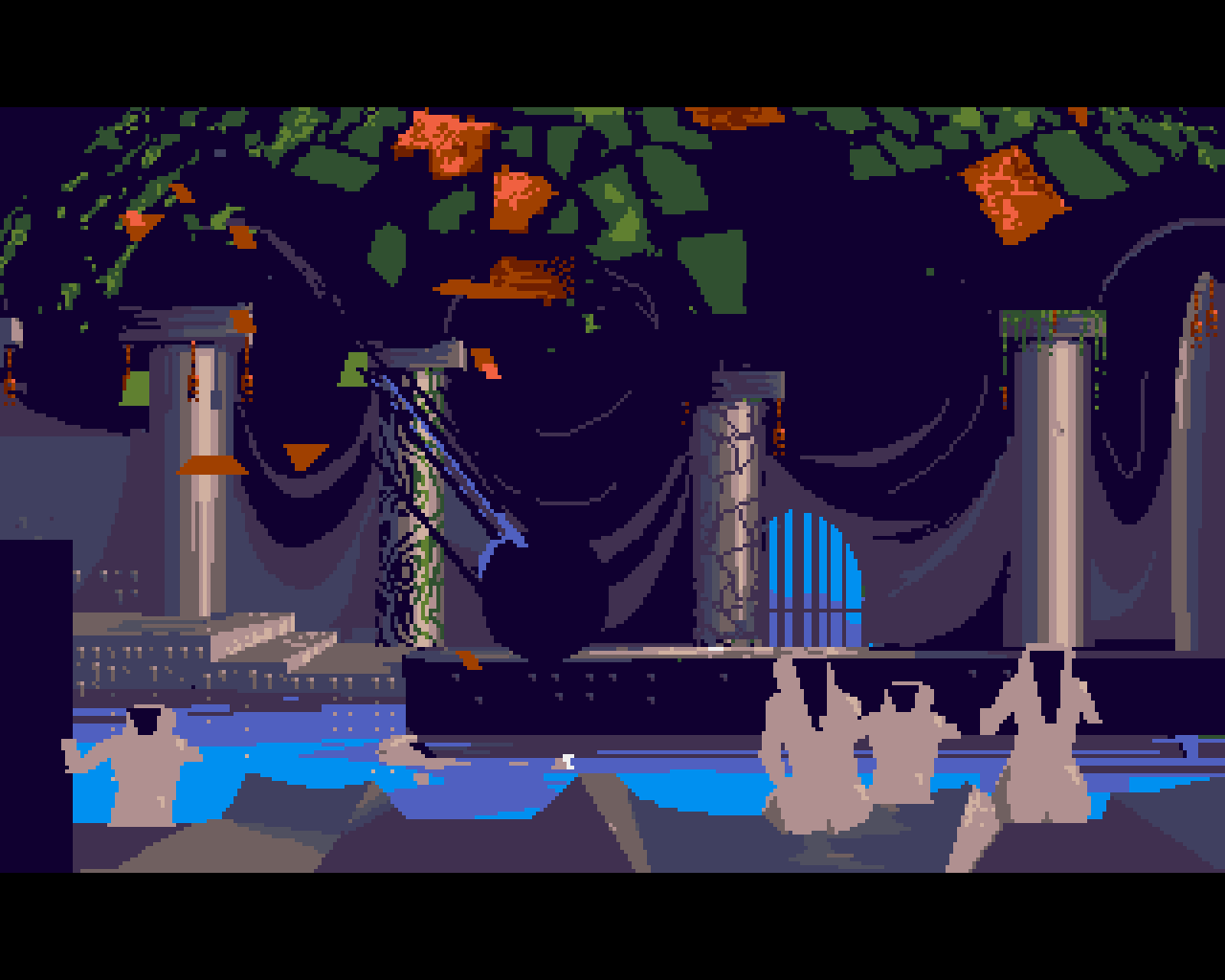
The bathhouse, gateway to the finale — the Amiga original at its most painterly. Screenshot via Wikipedia (Amiga version).
Out of This World
North America got the game in 1992 through Interplay — under a new name. Out of This World was chosen to avoid confusion with NBC’s long-running soap opera Another World, a precaution that landed it, by pure coincidence, on top of an unrelated sitcom of the same name. Interplay, to its credit, took the game seriously: where Delphine had only playtested the opening, Interplay tested the whole thing, and Chahi fixed what they found. Reviewers had called the game short, so he answered in the most Chahi way available — working sixteen-hour days for two months, he built an entirely new level, the rescue sequence that deepens Lester and Buddy’s partnership, which arrived with the 1992 MS-DOS version coded by Daniel Morais.
Not every battle went his way quietly. Interplay wanted the introduction music replaced; Chahi responded by sending their office an “infinite fax” — a looped sheet of paper reading “keep the original intro music” — and only Delphine’s lawyer, pointing out that Interplay legally could not change it, ended the argument. The console conversions spread the game’s fame: Rebecca Heineman’s Super NES and Apple IIGS versions performed the minor miracle of software-rendering polygons on a 65816 processor, and Nintendo of America’s content rules required a few scenes to be redrawn — the record notes, deadpan, that one naked alien’s bottom was reduced by three pixels.
The Sequel He Disowned
There is an official sequel, and its creator wishes there wasn’t. Interplay, eager to show off the CD-ROM medium, insisted on a follow-up for the Sega CD. Chahi, who had never intended one, contributed a genuinely elegant concept: replay the story from Buddy’s point of view, the alien in the foreground while Lester fights through the background of scenes you thought you knew. Interplay then developed Heart of the Alien (1994) entirely itself, and Chahi’s verdict, published on his own site, has never softened: “The concept was good but, alas, neither the animations nor the game, entirely developed by Interplay, were up to the job. It was a flop.”
He went further, publicly stating that the game did not represent his vision and disowning it as an official sequel — in interviews he has said he prefers the first game’s ending precisely because it leaves Lester’s fate uncertain. Heart of the Alien, released only in North America and bundled with a port of the original, lifted a veil he had spent two years carefully leaving down.
The Long Afterlife of a Two-Year Game
Delphine Software closed in July 2004, and Chahi reacquired the rights to Another World — which is why its afterlife has been curated by its author rather than strip-mined by strangers. He went back to his old Amiga to reprogram parts of the script for the 2005 mobile port. For the 15th Anniversary Edition in 2006, Emmanuel Rivoire raised the resolution to 1280×800 while Chahi repainted the backgrounds in finer detail and doubled the checkpoints; a 2007 CD edition added a development diary and the soundtrack. The 20th Anniversary edition — announced at GDC 2011, built with DotEmu — carried the game to iOS that September, to Steam in April 2013, to the consoles of 2014 and the Switch in 2018, always with the option to fall back to the original 1991 graphics.
In November 2012, New York’s Museum of Modern Art acquired Another World as one of the first fourteen video games in its permanent collection, in the Architecture and Design department — a selection made, the museum said, on criteria that included the elegance of a game’s code. By then its influence was already load-bearing in other people’s masterpieces: Fumito Ueda has named it the main inspiration for Ico — the cinematic cutscenes, the absent HUD, and above all an emotional bond between two characters built with almost no dialogue, which is Buddy and Lester’s partnership carried into a new century.
Chahi noted, when it was done, that his own exhaustion at finishing the game is mirrored in its ending — Lester half-dead, carried out of the burning city by his friend, flown off into an unresolved sky. It is the right ending for the story of its making, too. The box said it in 1991, in the proud boast printed over Chahi’s own painting: it took six days to create the Earth. Another World took two years — one man, one Amiga, and a toy car.