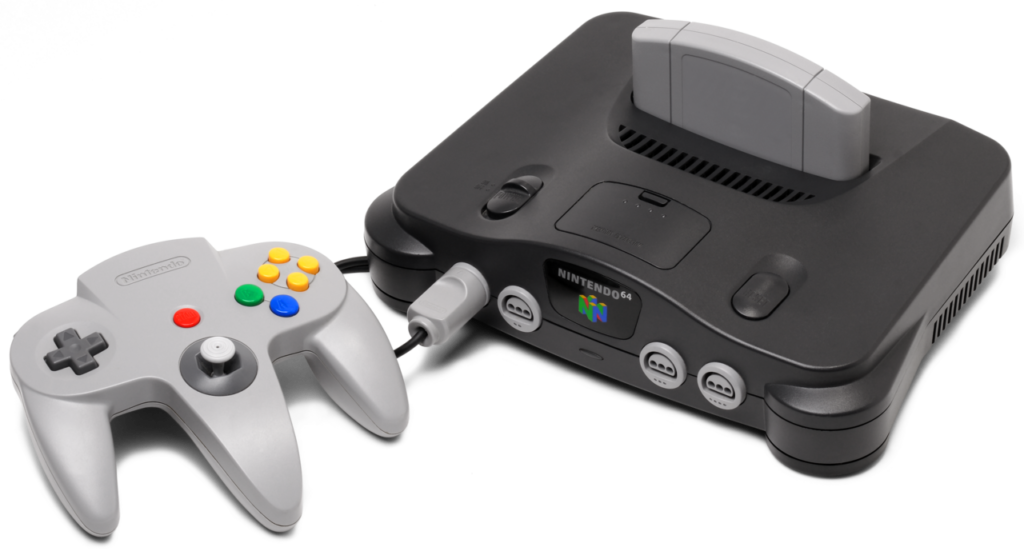
The Nintendo 64 lost. By the only scoreboard the industry kept in 1998, it lost badly – outsold three to one by the PlayStation, abandoned by most of the publishers who had made its predecessor rich, and remembered in the trade press as the machine that bet on cartridges in a CD world. And yet the N64 is the console that taught games how to move in 3D, put an analog stick and a rumble motor under the world’s thumbs, made four-player split-screen a birthright, and produced a top shelf – Mario 64, Ocarina of Time, GoldenEye – that still anchors “greatest games ever” lists a generation later. It sold 32.93 million units, made Nintendo enormous profits, and never once apologised. This is the complete story of the last cartridge standing: the Silicon Graphics supercomputer in a toy box, the bet on plastic that cost Nintendo an empire of third parties, and the small, strange, brilliant library that outlived the verdict.
Project Reality: A Supercomputer in a Toy Box
In August 1993, Nintendo announced the most audacious hardware partnership in games history. “Project Reality” would be built with Silicon Graphics Inc., the company whose workstations rendered Jurassic Park’s dinosaurs, on a MIPS RISC architecture derived from SGI’s reality engines. The promised numbers sounded like science fiction next to the SNES: a 64-bit CPU, CD-quality audio, and graphics throughput an order of magnitude beyond anything in a living room – all, Nintendo insisted, for under $250. The industry snorted; then the arcade boards appeared. Midway’s Killer Instinct and Cruis’n USA cabinets, badged “Ultra 64,” toured arcades in 1994 as proof of concept (the production cabinets ran different hardware, but nobody told the queues). The name itself didn’t survive: “Ultra” collided with Konami’s old Ultra Games label, and in February 1996 the machine was rechristened the Nintendo 64. What survived was the silicon. The finished console paired a 93.75 MHz NEC-built MIPS R4300i CPU with SGI’s Reality Co-Processor at 62.5 MHz, 4MB of RDRAM, and a design philosophy opposite to Sony’s: where the PlayStation was a friendly CD player with 3D acceleration, the N64 was a workstation that had been miniaturised, cost-reduced and aimed at your television. It was genuinely hard to program – deliberately so, in part, because Nintendo controlled the microcode keys – and genuinely powerful when mastered. Both facts shaped everything that followed.
The Bet on Plastic: Why Nintendo Chose Cartridges
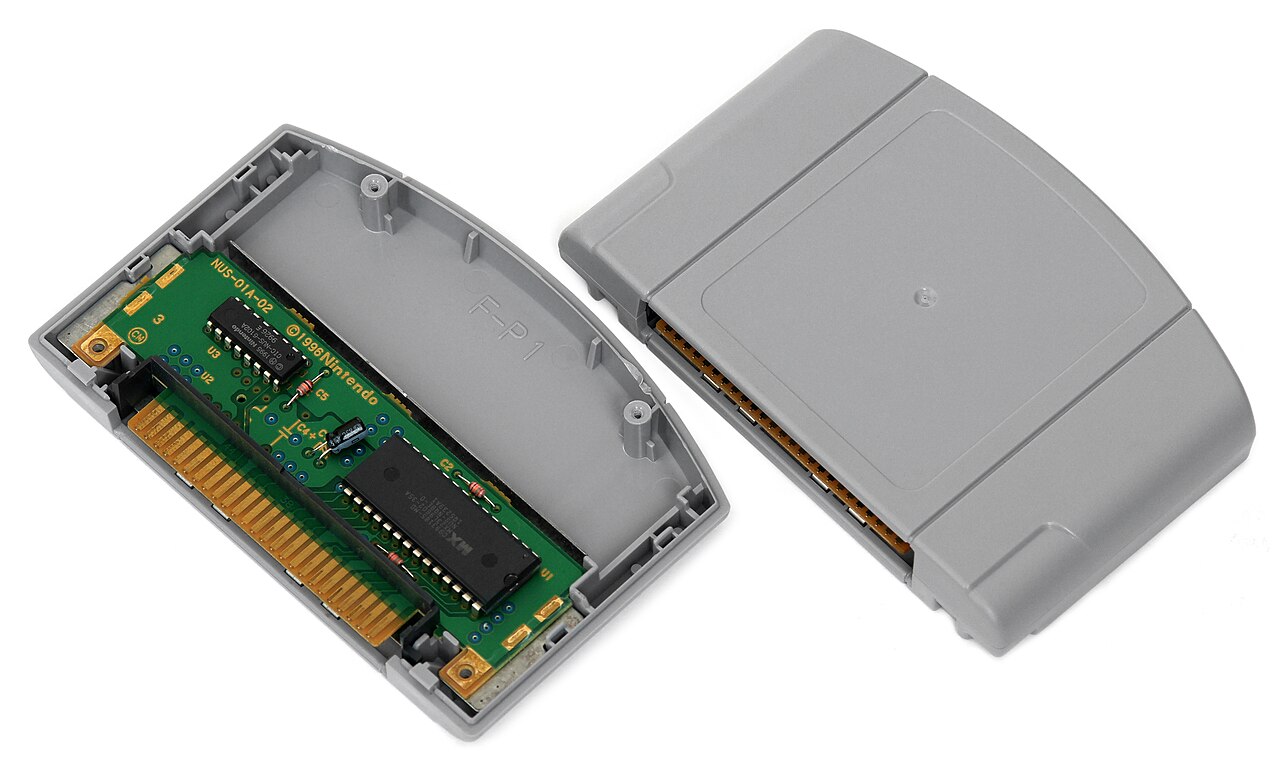
Every N64 story bends around one decision: no CD-ROM. While Sony and Sega stumbled over each other to embrace the disc, Hiroshi Yamauchi’s Nintendo looked at the CD and saw load times that broke game flow, discs a child could scratch or pirate with a home burner, and a format Nintendo could not control or tax the way it controlled cartridge manufacturing. Cartridges were instant, durable, save-capable without memory cards, and – not incidentally – profitable: publishers bought their Game Paks from Nintendo at prices that made a CD’s dollar-a-disc economics look like another planet, which is why N64 games retailed at $60, $70, sometimes $80 while PlayStation discs slid toward $40. The engineering case was real. The commercial case collapsed the moment developers did the maths. A launch-era N64 cartridge held 8 megabytes; a CD held 650. Square’s Final Fantasy VII – designed first for the N64, with a famous SGI-rendered tech demo of Final Fantasy VI’s cast to prove it – simply could not fit its ambitions, its cinematics, or its economics into a Game Pak, and in 1996 Square announced it was leaving for PlayStation, taking the defining RPG of the generation with it. Enix’s Dragon Quest VII followed. The defections made headlines because they were verdicts: the cartridge had stopped being a technology choice and become a loyalty test, and much of the industry failed Nintendo on purpose. What Nintendo got in return was a console with no loading screens, a library shaped by compression genius rather than storage sprawl, and a decade-long lesson it would not repeat: the GameCube, five years later, ran on discs.
Launch: Two Games and a Stampede
The N64 launched in Japan on June 23, 1996, and in North America on September 29 – with some retailers breaking the date and selling out anyway – at $199.99, fifty dollars under the announced price. The North American launch line-up was two games deep: Pilotwings 64, a gentle flight-school showcase, and Super Mario 64. Two games turned out to be enough, because one of them was a revolution you could hold. Super Mario 64 didn’t merely adapt Mario to 3D; it wrote the grammar – the camera as a character, the hub world, the stick-driven analogue movement where Mario walked, tiptoed or sprinted by pressure – that every 3D game since has spoken. Nintendo sold more than 500,000 consoles in the first weekend in Japan and moved a million in North America inside three months, with Mario 64 attaching at a rate that made it look less like software than like a pack-in that cost extra. The droughts came later; the launch itself was a coronation. By Christmas 1996 the N64 was the hardest console in America to find, and the PlayStation – a year older, a hundred dollars matched, a library a hundred games deep – had a real fight on its hands. That the fight ended the way it did was decided not by demand but by supply: of games, from anyone who wasn’t Nintendo or Rare.
Three Handles, One Revolution
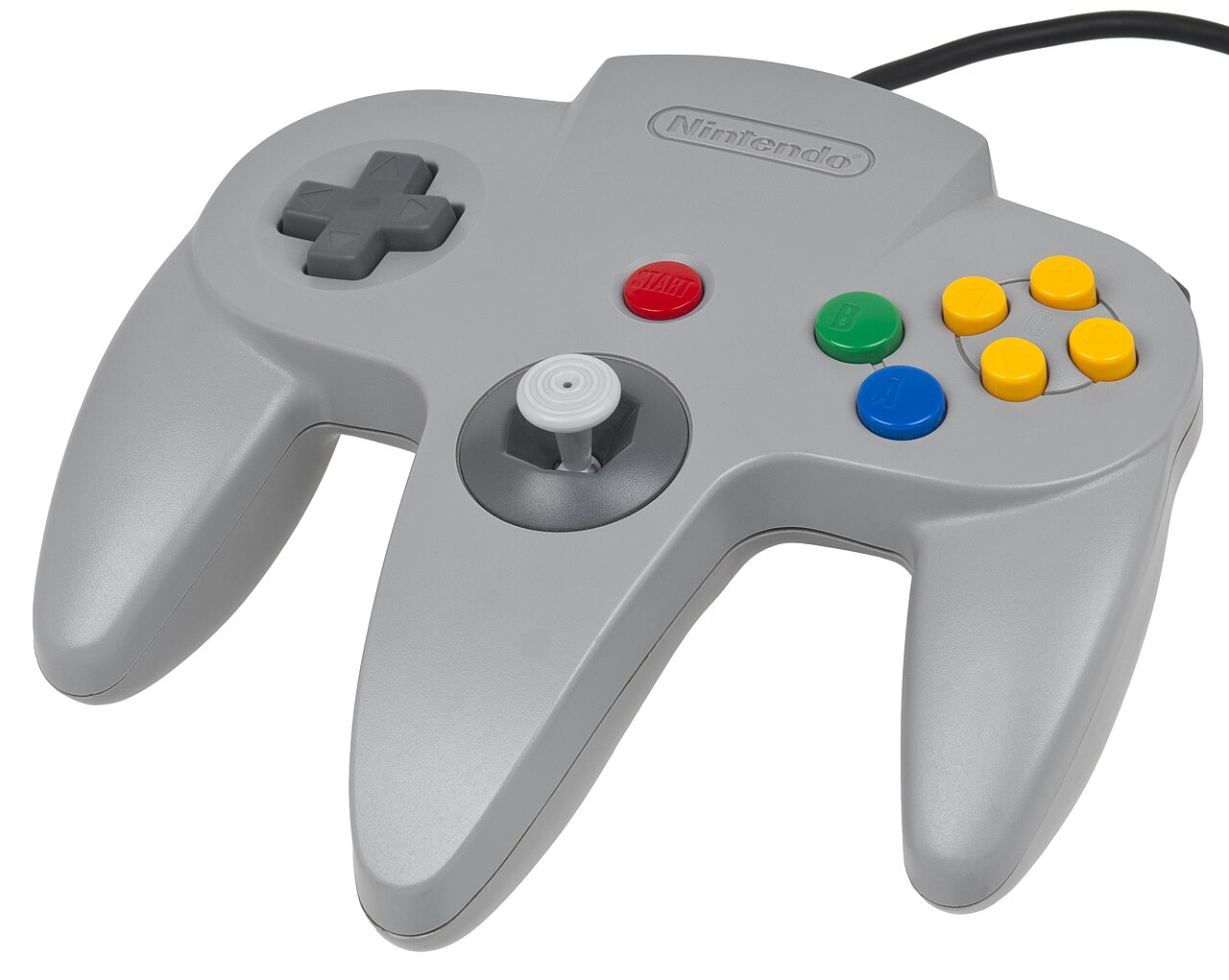
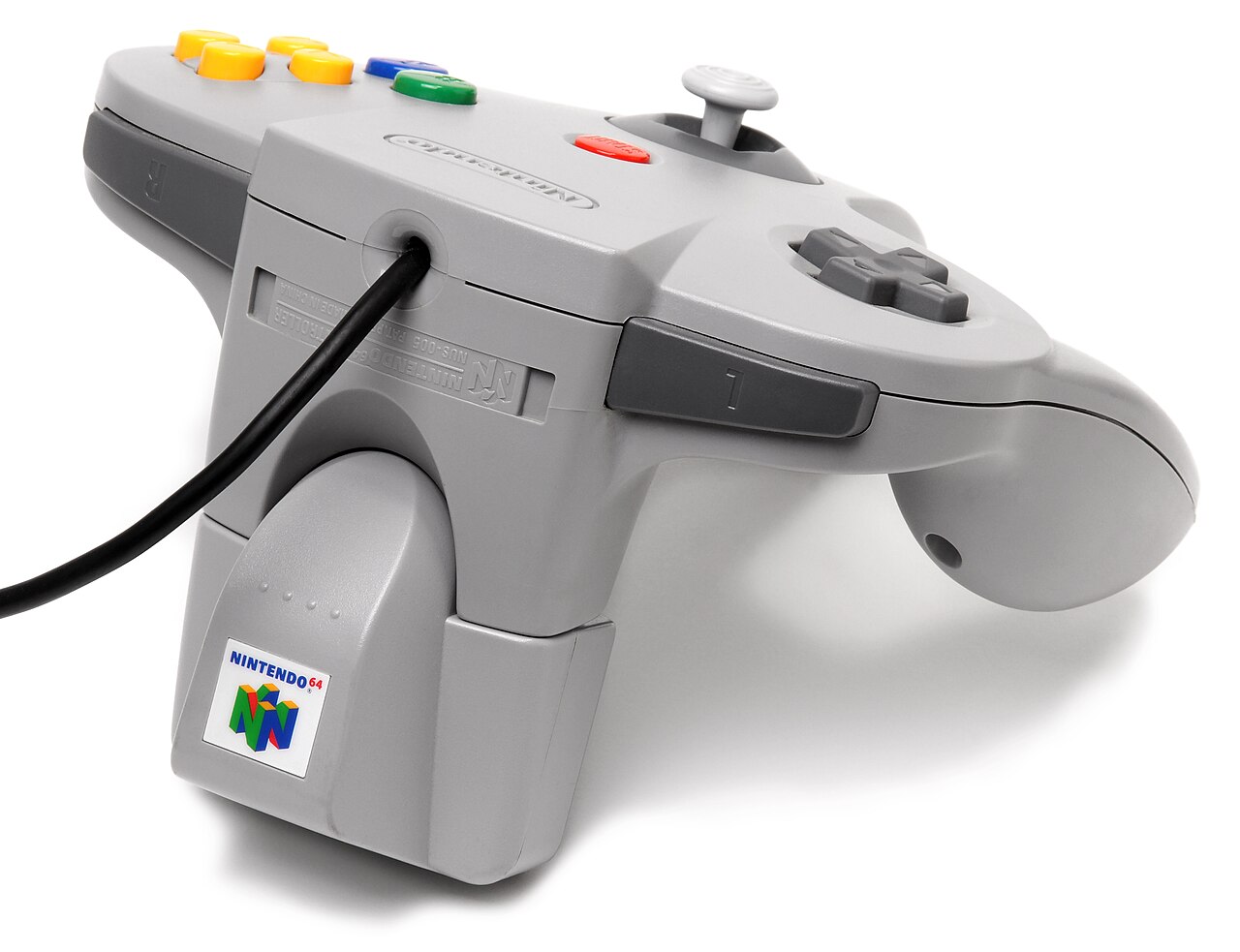
The controller looked like a trident and held like an argument – left hand on the D-pad prong for 2D, middle prong for 3D, right hand always on the buttons – but its centre stick changed games permanently. The N64’s analog stick (a digital encoder mechanism wearing an analog interface, which is why originals wear loose and gritty) gave movement a throttle for the first time in console history: Mario’s tiptoe-to-sprint range was a design space no D-pad could express. Around it sat the C-button cluster, conscripted as camera controls in Mario and as a second stick by GoldenEye’s strafing configurations; the under-slung Z trigger, shaped for a forefinger and destined for Ocarina’s lock-on; four controller ports built into the console, a multiplayer manifesto in hardware; and a rear slot that became the machine’s expansion bus. Into that slot went the Controller Pak (memory-card saves for third parties who begrudged cartridge battery space), the Transfer Pak that let Pokemon Stadium read your Game Boy cartridges, a microphone for Hey You, Pikachu!, and in 1997 the Rumble Pak – bundled with Star Fox 64 in North America, sold on the immortal pitch of force feedback in your hands. Rumble, like the stick, is now so universal that its birthday is forgotten. The stick had one dark footnote: Mario Party’s stick-spinning minigames blistered so many palms that Nintendo settled with New York’s attorney general in 2000 and mailed protective gloves to America. A controller that required safety equipment had, at minimum, made its point about intensity.
Fog, Blur and Genius: Programming the Beast
Ask a PlayStation programmer about 1997 and you’ll hear about freedom; ask an N64 programmer and you’ll hear about the 4KB texture cache. The Reality Co-Processor could transform and shade polygons at rates the PlayStation couldn’t touch, but every texture had to squeeze through a 4-kilobyte on-chip cache, RAMBUS latency punished sloppy memory access, and Nintendo’s standard microcode – the low-level instruction set that decided how the RCP actually drew – was tuned for safety, not speed. The results are burned into the era’s visual memory: the N64’s signature blur (hardware anti-aliasing smeared across low-resolution textures), the fog that swallowed Turok’s jungles at twenty paces – partly atmosphere, mostly draw-distance triage – and a softness that stood in permanent contrast to the PlayStation’s sharp, wobbling, texture-warped polygons. The masters treated the constraints as an instrument. Rare’s teams coaxed GoldenEye and Perfect Dark out of the machine with custom optimisation; Factor 5, refused the microcode it wanted, wrote its own – Nintendo, astonished, licensed the tools – and shipped Star Wars: Rogue Squadron and Indiana Jones and the Infernal Machine looking a generation ahead. And when Capcom’s two-CD Resident Evil 2 needed to live on a cartridge, Angel Studios compressed roughly 1.2 gigabytes of game and full-motion video into a 64MB Game Pak – still the largest N64 cartridge ever made – with every frame of video intact. The N64’s ceiling was higher than anyone’s but Nintendo’s and Rare’s floor; its tragedy was how few developers could afford the climb.
The Golden Age Was Real
Now the other ledger. Super Mario 64 sold 11.9 million copies and remains the design document for 3D movement. The Legend of Zelda: Ocarina of Time (1998) translated the most beloved 2D series into 3D without losing its soul, invented Z-targeting to make 3D combat legible, and became the first game ever to score 40/40 in Famitsu; its time-travelling structure and its ocarina-as-instrument are quoted by games to this day. GoldenEye 007, built by a young Rare team mostly new to the industry, sold 8 million copies – the console’s third-best seller – and proved the first-person shooter belonged on consoles and that four friends on one couch, split-screen, Oddjob banned by house rules, was a social platform unto itself. Mario Kart 64, Super Smash Bros. (a HAL skunkworks project that became a franchise), Banjo-Kazooie, Star Fox 64, F-Zero X at a locked sixty frames per second, Wave Race 64’s still-beautiful water, Paper Mario, and Majora’s Mask – Ocarina’s haunted, three-day-cycle sequel, the strangest thing Nintendo has ever shipped under its own name. Rare’s run alone – Banjo, Jet Force Gemini, Donkey Kong 64, Perfect Dark, Conker’s Bad Fur Day – would be a career for most publishers; Microsoft bought the studio in 2002 for $375 million largely on the strength of these five years. The N64’s library is famously top-heavy: about 388 games against the PlayStation’s thousands. But density at the summit matters. Count the generation’s consensus all-timers and the “losing” console keeps winning the argument its sales figures lost.
Losing the War Nintendo Could Afford
The totals, for the record: 32.93 million N64s worldwide against 102 million PlayStations; in Japan the N64 was outsold even by the Sega Saturn, and its software catalogue in any genre Sony courted – RPGs, fighting games, survival horror – reads as a list of absences and miracles (Ogre Battle 64, the RE2 port) that prove the drought. Through 1997 especially, months passed between notable releases, and the rhythm of the console’s life became Nintendo’s own release calendar: wait for Mario, wait for Zelda, wait for Rare. Third parties who stayed faced $30 cartridge costs against $2 discs, Nintendo’s manufacturing queue against Sony’s open presses, and a family-friendly reputation that made the N64 a hard sell for the teenage market Grand Theft Auto and Resident Evil were busy inventing – Turok: Dinosaur Hunter, gory and glorious, sold three million copies partly by sheer novelty of blood on a Nintendo machine. And yet: Nintendo made money in every year of the N64’s life, on hardware sold at a profit and first-party software with margins the CD business couldn’t match. The N64 didn’t ruin Nintendo; it redefined what Nintendo was – no longer the industry’s landlord, but its most profitable boutique. The GameCube’s discs and the Wii’s humility both begin as answers to this console’s questions.
The 64DD: Tomorrow, Sold by Subscription
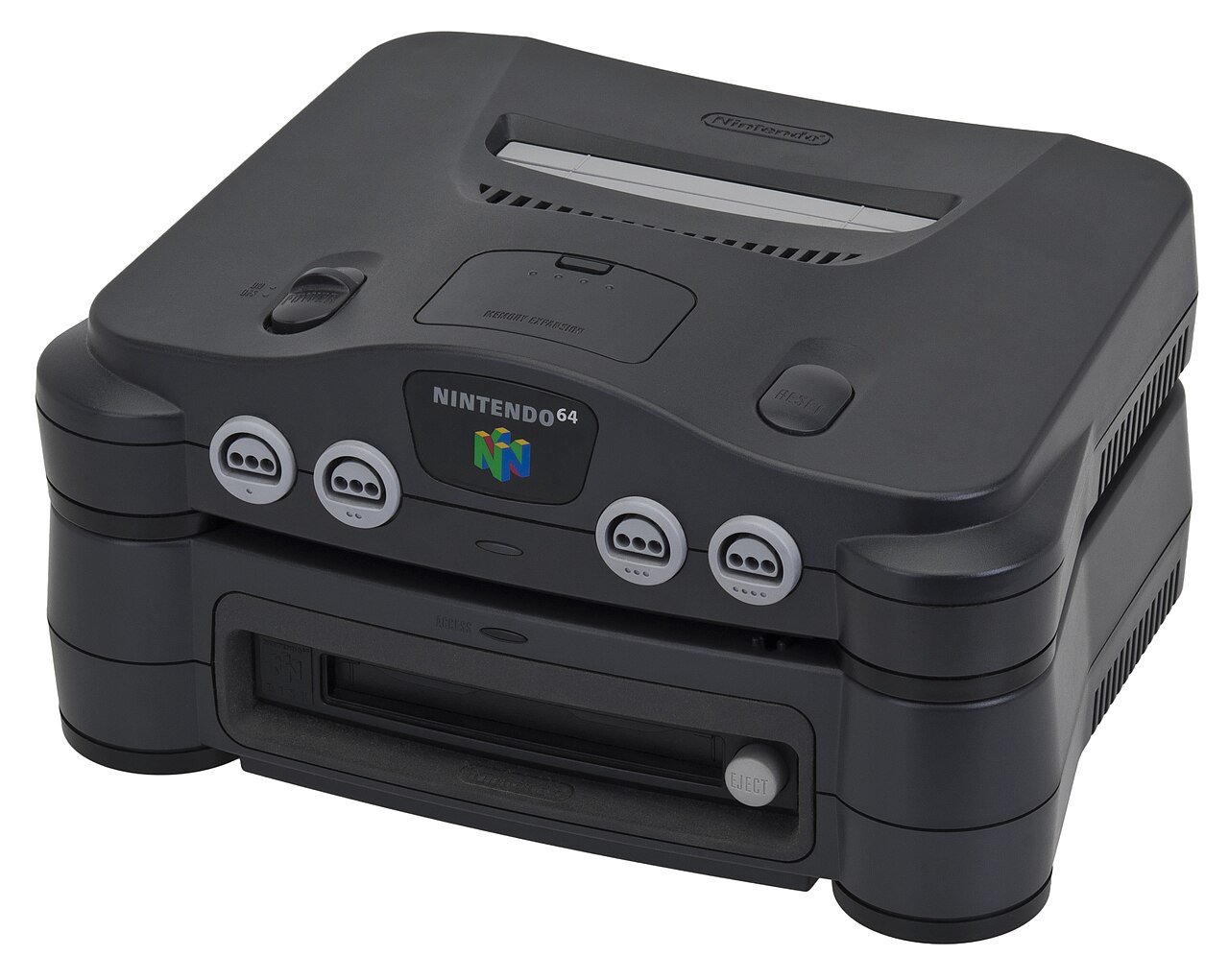
Nintendo knew the cartridge was a cage, and spent five years promising a key. Announced in 1995, the 64DD was a magnetic-disk drive that docked beneath the console: 64MB rewritable disks, a real-time clock, a modem, and a Randnet online service – in 1999, years before Xbox Live. It launched in Japan in December 1999 as a subscription product, which is another way of saying it arrived too late, too expensive and too Japanese-only to matter. The software list is a museum of beautiful might-have-beens: the Mario Artist creative suite, F-Zero X Expansion Kit’s track editor (the best reason to own the thing), SimCity 64, a Japan Pro Golf Tour, and the ghost of Mother 3, which died with the platform before resurrecting on Game Boy Advance. Fewer than a hundred thousand units found homes; North America never saw it at all. Its sibling accessory fared better: the Expansion Pak, a 4MB RAM upgrade for the memory slot, began as a performance booster (Turok 2’s hi-res mode), then became a hard requirement – Donkey Kong 64 bundled it after it was found to mask a game-breaking bug, Majora’s Mask refused to boot without it, and Perfect Dark locked most of itself behind it. The 64DD remains the purest expression of N64-era Nintendo: a genuinely visionary answer, delivered on proprietary media, through a subscription, four years after the question had been settled by everyone else.
The Afterlife: The Console That Refuses to Emulate
The N64 wound down in colour: the translucent Funtastic series (Jungle Green, Atomic Purple, Watermelon Red) turned the ageing hardware into shelf candy in 2000, Pokemon Stadium and Snap converted the Pokemon phenomenon into living-room events, and the last North American release, Tony Hawk’s Pro Skater 3, arrived in August 2002 – by which time the GameCube’s discs had inherited the earth. The afterlife has been unusually active. The collecting market delivered its own late verdict. Boxed N64 games – cardboard boxes, crushed flat by a generation of children – now trade at premiums their jewel-cased PlayStation contemporaries rarely match; a ClayFighter: Sculptor’s Cut or a sealed launch-day Mario can fund a small holiday, and the loose cartridges that filled bargain bins in 2003 have become the shelf jewellery of the retro hobby: chunky, colourful, region-hacked with a pair of pliers, and apparently indestructible. The N64 is famously the hardest mainstream console to emulate well – its SGI architecture, microcode variety and per-game quirks defeated the plug-in era’s approximations – which is one reason original hardware, HDMI mods, and FPGA recreations like the Analogue 3D (announced 2023, shipped 2025, rendering the library in 4K on cycle-faithful silicon) command such devotion. Nintendo’s own Nintendo Switch Online + Expansion Pack service (2021) brought the library to subscription streaming with a faithfully recreated wireless trident controller – and launched to criticism of its emulation that Nintendo has been patching ever since. Meanwhile the fan engineers finished the job: the 2019 Super Mario 64 decompilation produced native PC ports and a thousand mods, and 2022’s Ship of Harkinian did the same for Ocarina. Speedrunners backwards-long-jump up staircases that were never meant to be climbed; GoldenEye’s Dam is still being optimised, second by second, by players who weren’t born when it shipped. The scoreboard says the N64 lost. The scoreboard is not wrong. But the analog stick in your hand, the rumble in your controller, the four ports’ worth of friends the machine assumed you’d bring – the modern console is built from N64 parts, and the cartridges, true to their design brief, still boot instantly.