
Ask anyone to name the Atari 5200’s best games and you will hear the same litany: Pac-Man redeemed, Ms. Pac-Man perfected, Robotron in its twin-stick tray, Centipede on the Trak-Ball. All true, all essential — and all liable to make the SuperSystem’s library sound about twelve cartridges deep. It is not. Beneath the famous arcade ports sits a second shelf of games that most 5200 owners never played, because they came from smaller publishers, arrived as the market collapsed, or simply never had an arcade marquee to borrow fame from. These are the hidden gems: ten games beyond the arcade-port canon, every one of them a reason to own the big black box in 2026.
1. Gremlins

Atari’s last big film licence for the system is also one of its strangest and best. Released in 1986 — two years after Atari discontinued the console, which tells you everything about its rarity — Gremlins is a night-by-night defence game: mogwai are multiplying in the dark, gremlins are converging on the house, and you, sword in hand, spend each night herding the cute ones to safety, fencing the nasty ones off, and racing the clock to 6 a.m. It has the structure of a modern wave-defence game, a genuinely tense risk balance — do you chase the stray mogwai or hold the line? — and presentation full of character. The two-phase nights are the clever part: in the first, mogwai wander and multiply if they eat after midnight, and every one you fail to pen becomes tomorrow’s problem; in the second, the gremlins themselves advance on the house in force, and your sword work has to be economical, because the nights lengthen and the waves thicken. It even supports a second player joining the defence. That Atari shipped something this assured for a console it had already discontinued is one of the library’s strangest footnotes — and the game’s scarcity means most owners meet it first on a multicart, which does nothing to diminish it. Copies are uncommon and priced accordingly, but on a multicart it is an essential play: the 5200’s own afterlife release, hiding in its original catalogue.
2. H.E.R.O.

Activision’s helicopter-pack rescue game is a jewel on every system it touched, and the 5200 version is one of the finest. As Roderick Hero you descend into volcanic mineshafts — prop-pack humming, laser zapping cave creatures, dynamite for the walls that block you — to reach the trapped miner at the bottom. The 5200’s colour and resolution do John Van Ryzin’s design proud: the shafts are moody, the creatures are characterful, and the controls are tight enough for the game’s most delicate manoeuvre, the inch-perfect hover above lava. It sold in modest numbers and never got the fame of the 2600 original, but as a pure test of touch and nerve it stands with anything in the library. The later levels introduce the full toolkit of torments — walls that can only be passed by timing a dynamite blast, lantern-lit dark sections where your lamp’s glow is the only warning of what shares the shaft with you, and lava pools whose crossing demands the prop-pack be feathered in single, patient bursts. Twenty levels in, H.E.R.O. is asking questions of your fine motor control that modern games ask of a thumbstick; that it asks them this gracefully on 1984 hardware is the whole argument for Activision’s golden-age craft.
3. Montezuma’s Revenge
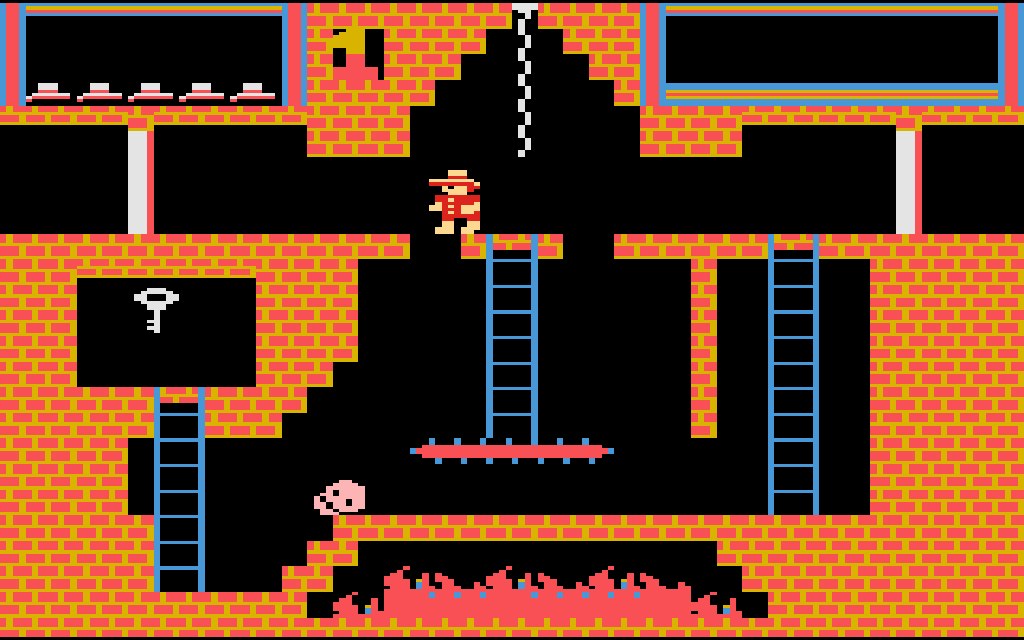
Robert Jaeger’s pyramid explorer is one of the founding documents of the exploration platformer — a vast Aztec tomb of ladders, ropes, conveyor belts, rolling skulls and treasure rooms, explored by a little adventurer named Pedro with a finite supply of torches and lives. The 5200 version, from Parker Brothers, brings the pyramid home in fine form: the rooms are colourful, the hazards are exact, and the sense of a real place — a hundred connected chambers with their own logic — still impresses. It is tough, occasionally unfair in the period style, and utterly absorbing. What elevates it above the era’s other climbers is the inventory thinking: keys open specific doors, swords deal with specific guardians, torches burn down, and amulets and potions each bend one rule of the pyramid in your favour — so a deep run becomes a plan, revised room by room, rather than a test of reflexes alone. Pedro himself is a delight, all hat and determination, and the pyramid’s colour-coded depths give the exploration a geography you genuinely learn. This is the game on the list most likely to consume a whole weekend once it has you. Every Metroidvania you have ever loved has a little of this game’s DNA, and the 5200 is one of the best places to meet the ancestor.
4. Star Wars: The Arcade Game

Parker Brothers took on the impossible: converting Atari Games’ vector-graphics Star Wars cabinet — the Death Star trench, the TIE fighter dogfights, the towers — to home hardware. The 5200 version is the best of the home attempts of its era. The vectors become clean raster lines, the three-stage structure survives (dogfight, surface towers, trench), the shield management and wave escalation are intact, and it moves with real pace. It cannot be the arcade experience — nothing at home could, in 1984 — but as a fast, structured, score-driven space shooter wearing the most valuable licence of the age, it is far better than its footnote reputation, and it flatters the 5200 stick, which finally gets a game that wants to be flown. The trench run itself is the set piece: fireballs coming down the channel, catwalks and gun turrets narrowing your line, the exhaust port arriving with the shield gauge where you left it — a faithful little drama in three acts. Parker Brothers made several home versions of this licence across the systems of the day, and the 5200’s is the one that history should have kept.
5. Rescue on Fractalus!

The Lucasfilm Games legend needs little introduction among 5200 faithful, but it still qualifies as a gem for one reason: too many collections stop at the arcade ports and never reach it. David Fox’s rescue game puts you in a Valkyrie fighter skimming fractal mountains, hunting downed pilots, managing a full instrument panel — and occasionally opening your airlock to discover that the “pilot” outside is a Jaggi alien about to come through your canopy, in gaming’s first great jump scare. The fractal landscape was revolutionary in the mid-eighties and the 5200 version, released in the system’s twilight, is a superb conversion. If you play one game on this list, play this one — at night, with the sound up. It also rewards a word about its difficulty design: the early planets are gentle teachers — short hops, clear signals, pilots who are actually pilots — and the game spends that trust carefully, so that when the first Jaggi does appear, it lands on a player who has been thoroughly lulled. The instrument panel, meanwhile, is a Lucasfilm signature in miniature: everything on it works, from the energy and systems gauges to the airlock protocol itself, and learning to fly by it is half the pleasure. Few games of any era make a cockpit feel this inhabited.
6. Meteorites
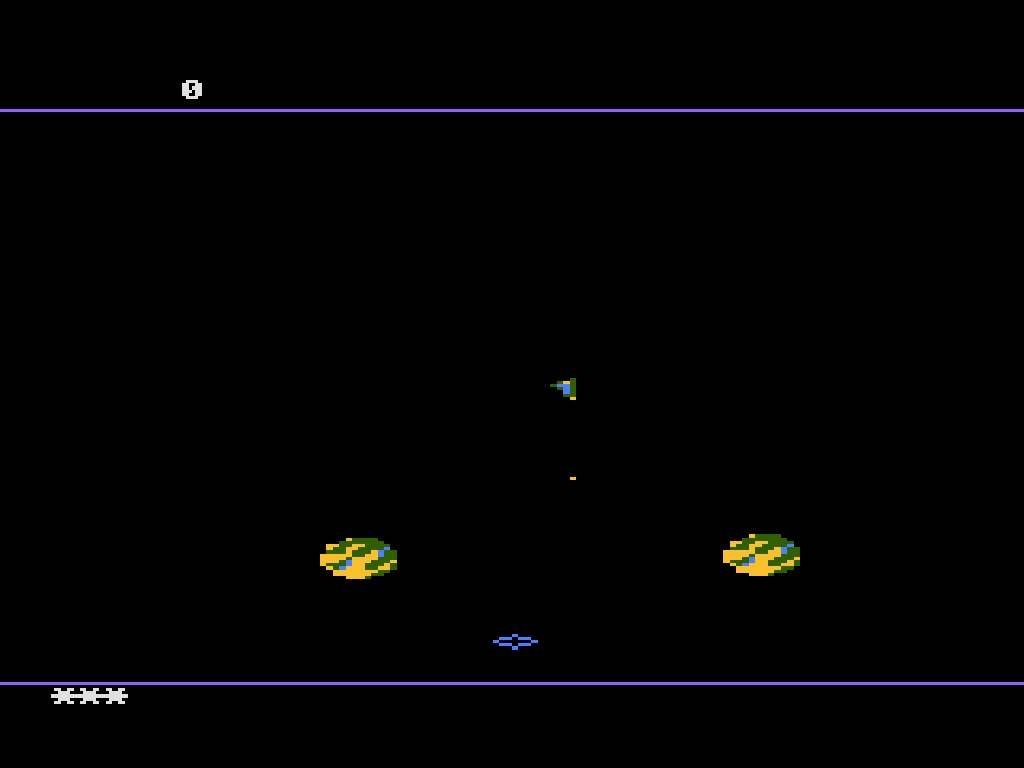
Every successful system of the era got its Asteroids answer, and the 5200’s came from a tiny outfit, Electra Concepts — which is why almost nobody played it. A shame, because Meteorites is a deft, colourful take on the formula: your ship in the centre of a rock field, big meteors splitting into faster fragments, saucers intruding, the whole thing rendered in a brighter palette than Atari’s own mooted version (which, remarkably, never shipped for the 5200 at all). It controls well on the analogue stick — thrust-and-turn games forgive its wander — and it fills a genuine hole in the library. Third-party, small-run and quietly excellent: the definition of a hidden gem.
7. K-Razy Shoot-Out

CBS Electronics’ K-Razy Shoot-Out, from K-Byte, is Berzerk rebuilt with a clock and a meaner streak. You are in a maze of barriers with robots hunting you, as in Stern’s classic — but here every room is a race: clear the robots against a strict timer for bonus points, and survive escalating rooms where the robots get faster, smarter and start shooting back harder. The time pressure changes the game’s whole character from Berzerk’s patient herding into something breathless and score-obsessed. It is one of the strongest third-party cartridges on the system, it is far less common than the first-party games it outplays, and head-to-head with the official Berzerk port it makes a genuine fight of it.
8. Ballblazer
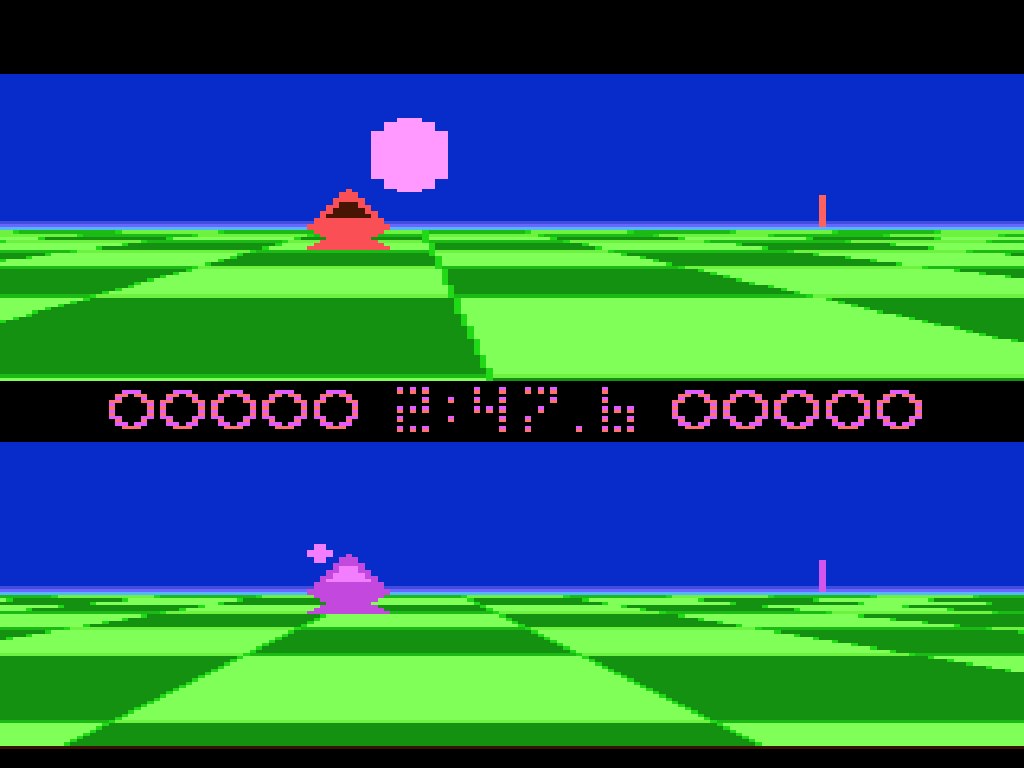
The second Lucasfilm game is a sport from the far future: one-on-one, split-screen, first-person, in hover-tanks called rotofoils, chasing a floating plasmorb and blasting it through moving goalposts. Ballblazer on the 5200 is fast and smooth in a way that 1980s hardware had no right to be — the chequered field streams beneath you, the goals drift, and the whole match has a physical snap to it, helped by David Levine’s generative music system that improvises a riffing soundtrack that never repeats. Against a friend it is one of the great two-player games of the 8-bit era; against the computer it is a stern examination. Released late, loved by everyone who found it, and still startlingly modern to play.
9. The Dreadnaught Factor
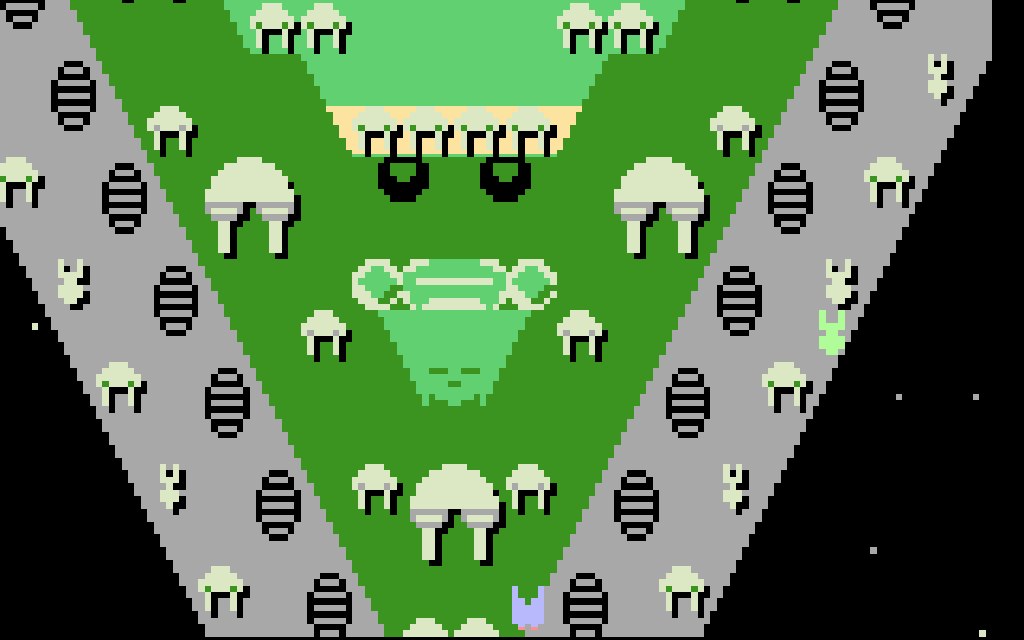
Tom Loughry’s Activision shooter gives you a starfighter, a scrolling capital ship the size of the screen’s horizon, and a single instruction: disable the dreadnaught before it reaches your planet. You strafe along its hull knocking out gun turrets, radar dishes, engines and — if you are precise — the vents that feed its reactor, all against a distance counter that measures how long your world has left. It is a boss fight stretched into an entire game, years before that became a genre habit, and the 5200 version is a strong conversion with big, bold graphics and a mounting sense of scale. Multiple dreadnaught classes and difficulty levels give it legs. A genuine original in a catalogue of conversions.
10. Zenji

We close with the quietest game on the list. Matthew Hubbard’s Zenji, from Activision, is a puzzle of connection: a grid of maze tiles, each holding a section of path; rotate the tiles to link them all into one unbroken network flowing from the source, against the clock, while hostile faces patrol the completed paths. It is meditative, elegant and unlike anything else on the 5200 — a game about flow and pattern from the designer of some of the 2600’s cleverest cartridges. The 5200 version is crisp and colourful, and its escalating grids will bend your spatial reasoning in the nicest possible way. Every library needs a game for the hour when you do not want to shoot anything. This is the 5200’s.
A few near-misses deserve their names read out, because a list of ten is a list with regrets. Pitfall! brought David Crane’s jungle to the system in fine shape for anyone who missed it elsewhere. Choplifter’s rescue runs flatter the analogue stick in a way few games manage. Keystone Kapers, Activision’s department-store chase, is as bright and precise as anything on the system, and Megamania — the surreal shooter whose enemy waves include bow ties and hamburger patties — plays at a tempo the 5200 handles beautifully. Any of the three could anchor an evening, and a second list could be built from the shelf this one had to leave behind.
Ten games, ten arguments that the SuperSystem’s story is bigger than its pack-ins. Hunt the cartridges, load the multicart, and give the second shelf its due — that is where the 5200 keeps its surprises.