
At a glance: The 5200 homebrew scene · Atari 5200 · AtariAge and the community, 2000s–today · Feature
Most discontinued consoles get an obituary. The Atari 5200 got a second career. The machine Atari abandoned in 1984 has spent the last two decades accumulating something its commercial life never gave it: a growing library. Through the AtariAge community and a loose worldwide network of programmers, artists and hardware tinkerers, the SuperSystem has received brand-new cartridge releases, completions of games its original era left unfinished, conversions of titles it always should have had, and fresh production runs in proper boxes with manuals. No curling irons required — this is the story of the scene as a whole, and of how a console with sixty-odd commercial cartridges became a platform that is still, in 2026, receiving new software.
Why the 5200, of all machines?
The scene exists because the 5200 is unusually buildable. Its hardware is the Atari 8-bit computer architecture, one of the best-documented and best-loved 8-bit platforms in existence, with mature cross-development tools and decades of programming knowledge in the community. A game written for the 5200 stands on forty years of accumulated 6502 craft. Just as importantly, the machine’s story has gaps that invite filling: famous prototypes to complete, beloved 8-bit computer games that never crossed over, arcade classics the catalogue lacked. Homebrew feeds on unfinished business, and the 5200 has more unfinished business than any console of its generation.

The games that headline the scene
Two releases have become the scene’s calling cards. Beef Drop, Ken Siders’ loving conversion of the arcade’s BurgerTime concept, gives the 5200 the game Data East never licensed to it in period: you play a chef walking burger ingredients off platforms while hot dogs and pickles give chase, and it is done with such polish — colour, music, escalating mazes, a high-score table — that visitors regularly mistake it for a lost commercial release. It is not a tech demo; it is simply one of the most playable games on the system, full stop.
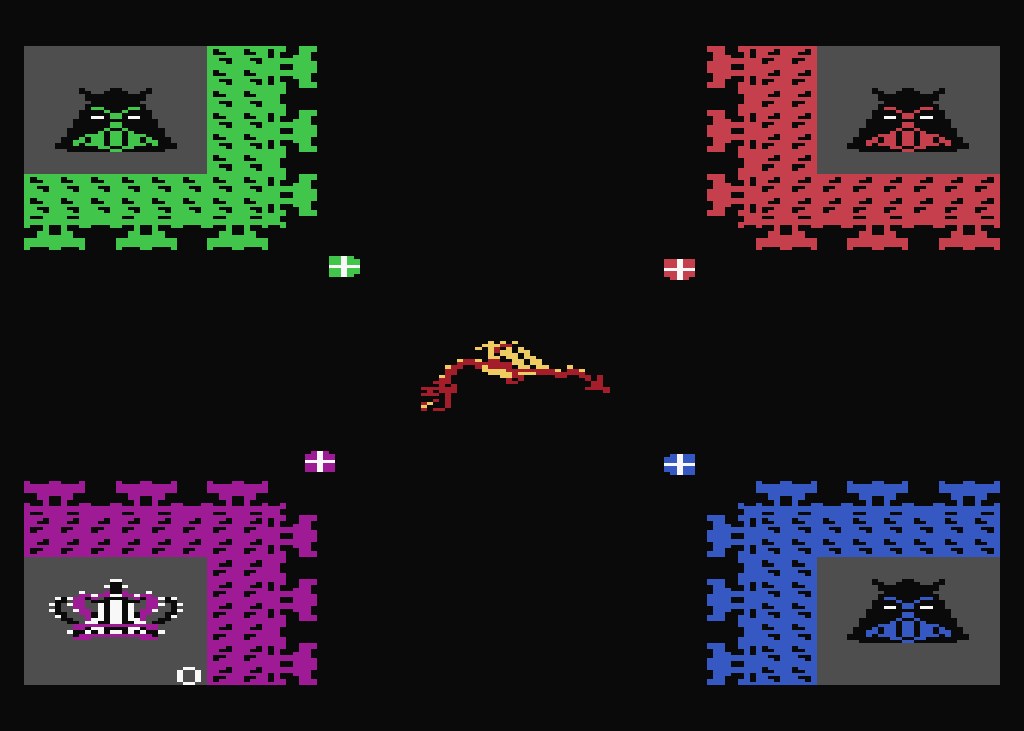
Castle Crisis, by Bryan Edewaard, answers a different what-if: it is a faithful home version of Warlords, Atari’s own four-player paddle classic that the 5200 never received in its commercial life. Four castles, four kings, a fire-breathing dragon hurling the ball, and — in the machine’s finest multiplayer tradition — support for up to four players at once, exactly the kind of game the four-port console was built for and the 1980s never gave it. Both titles were produced as real cartridges through AtariAge, in boxes, with manuals, alongside a catalogue of other releases — puzzle games, conversions from the 8-bit computers, completed prototypes — that has quietly doubled the effective size of the 5200’s quality library.
Completions, conversions and the long tail
Beyond the headline releases, the scene’s texture is in its variety. Programmers have finished and released versions of games the original era abandoned mid-development — most famously bringing the 5200’s own Tempest prototype to a completed, polished state decades after Atari shelved it. Others have ported favourites from the Atari 8-bit computers, machines whose code often needs more adaptation than outsiders expect despite the shared silicon, since the 5200 lacks the computers’ keyboard, operating system and memory map. There are demoscene-flavoured experiments, holiday one-offs, and steady hardware work alongside the games: multicarts that hold the whole library on one board, controller test and calibration utilities, and newly manufactured parts that keep the original machines themselves alive.

Two more names for the shelf
The headline pair are not alone, and two further releases show the scene’s range. Adventure II takes the most famous name in the 2600’s library — Warren Robinett’s Adventure, the game with the first famous Easter egg — and builds a full sequel for the 5200: new kingdoms, new mazes, the dragons’ descendants, designed with a reverence for the original’s logic that makes it feel less like a tribute and more like a recovered manuscript. At the other end of the tonal scale sits Koffi: Yellow Kopter, a whimsical rescue game about a little helicopter fighting forest fires and saving animals, developed in the open on the community forums — a reminder that the scene produces originals as well as archaeology. Between the completions, the conversions, the sequels and the originals, the modern 5200 catalogue has a breadth across genres that the commercial library, for all its conversion quality, never achieved in twenty months. The scene did not just preserve the system. It rounded it out.
Why it matters beyond the 5200
The scene’s significance runs wider than one console. The 5200 is the proof of concept for a proposition the whole retro hobby now runs on: that a platform’s life is not defined by its manufacturer’s support window, and that a small, organised community with good tools can sustain — and improve — a machine indefinitely. Everything the modern retro ecosystem takes for granted, from flash cartridges to reproduction packaging to community-funded production runs, was worked out in scenes like this one, on machines like this one, by people whose only budget was their own enthusiasm. The 5200 homebrewers were early to all of it because their machine needed them earliest. It is a debt the wider hobby rarely itemises, but the SuperSystem’s second life is one of the places the template was written — and new chapters, on real cartridges, are still appearing.
A library that is still growing
How the scene actually works
For readers who have never followed a homebrew scene, the mechanics are worth a paragraph. Development happens on modern computers with cross-assemblers and emulators, but it is validated the old way — on real 5200 hardware, through flash cartridges and test boards — because the machine’s timing and its analogue controllers forgive nothing. Releases are typically small, announced on the AtariAge forums, sold as bare cartridges or in full period-style packaging, and priced like the labours of love they are: nobody is getting rich selling hundreds of cartridges for a console discontinued in 1984, which is precisely why the quality control tends to be fanatical. The community’s feedback loop — public works-in-progress, beta testing by forum regulars, post-release revisions — is the same loop modern indie development runs on, conducted at 1.79 megahertz.
The scene also sustains the machine itself. New-old-stock parts, reproduction controller components, multicarts, video modifications and repair knowledge all circulate through the same channels as the games, so the homebrew ecosystem doubles as the 5200’s preservation infrastructure. A console whose owners are also its developers does not die; it just changes management. That, more than any single release, is the scene’s achievement — and it is still compounding, with new projects announced every year for a machine now well into its fifth decade.
The result is that the 5200 a collector assembles in 2026 is a materially better console than the one Atari sold in 1982. Its commercial catalogue told a story of great conversions and strange omissions; the homebrew era has filled the omissions, completed the unfinished, and given the machine the BurgerTime, the Warlords and the Tempest it always deserved. There is something fitting about it. The SuperSystem was built from computer technology by a company that never quite decided what it was for. Its community eventually decided for it: it is a platform, and platforms are for making games on. The 5200’s second life is not a footnote to its first. For a growing number of owners, it is the main text.