
The Atari 7800 has the strangest biography of any console ever made: it was finished before its generation began, and by the time it reached shops, its moment had already been given away. Designed in 1983, announced in May 1984, it spent two years sitting in warehouses while its new owner decided whether it should exist at all — and while Nintendo, unopposed, rebuilt the American games industry in its own image. When the 7800 finally launched in 1986 it was a good machine with an impossible job: backward compatible with the largest library in the world, armed with superb arcade conversions, and three years too late. This is the story of the console that waited — the pirate engineers who built it, the tycoon who shelved it, and the long, strange afterlife that proved its best idea was decades ahead of its time.
The Pirates of General Computer
The 7800 was not designed by Atari. It was designed by the young company that had beaten Atari in court and then been hired for its talent. General Computer Corporation — GCC — began as MIT students making upgrade kits for arcade cabinets: their Super Missile Attack board souped up Atari’s Missile Command, Atari sued, and the settlement turned into one of the great deals in industry history. GCC dropped the kits, and Atari put its tormentors on retainer as outside designers. The first fruit of that arrangement was Ms. Pac-Man — conceived by GCC, polished into the best-selling American arcade game of all time. When Atari needed a new home console to succeed the ageing 2600 and the disappointing 5200, it did not look inward. It called the pirates.
GCC’s brief was everything the 5200 had failed to be. That machine — big, incompatible with the 2600’s library, saddled with fragile controllers — had taught the industry a lesson the 7800 was built to answer: never orphan the games people already own. So GCC designed a console with two machines inside it. The new graphics chip, codenamed Maria, handled the modern work — a 320-by-240 display, a rainbow of moving objects inherited from arcade design, sprite counts that embarrassed everything at home. But the board also carried the 2600’s own silicon, so that a 7800 could play the entire existing 2600 catalogue — hundreds of games — the day it came home. It was the first time a console maker had treated backward compatibility as the headline feature. It would not be the last; it would eventually become the industry’s default expectation, from the PlayStation 2 to the Game Boy’s descendants to today’s machines. The idea was born here, in a console almost nobody bought.
There was one compromise, and it was sound. Literally. To hold the price down, the 7800 reused the 2600’s wheezing TIA audio rather than the POKEY chip from Atari’s computers and arcade boards. GCC’s workaround was elegant: put the POKEY in the cartridge, for games that justified it. Ballblazer and Commando did exactly that, and sound magnificent for it. Every other 7800 game bleeped like it was 1977 — a small, daily reminder that this machine was designed by geniuses working under a budget set by accountants.
Announced to a Dying World
Atari announced the 7800 ProSystem on 21 May 1984, with a launch planned for that summer and a price of $140. The timing could hardly have been worse. The North American video game crash was at full depth: retailers were dumping stock, the press was writing the industry’s obituary, and Warner Communications was looking for the exit. On 2 July 1984, Warner sold Atari’s consumer division to Jack Tramiel — the Commodore founder who had just been pushed out of his own company and wanted revenge more than he wanted video games. Tramiel’s empire would be computers: the Atari ST was his weapon against Commodore, and the games business was, to him, a distraction with warehouses full of other people’s ideas.
So the finished, announced, manufactured 7800 went into storage. The reasons were layered — Tramiel’s computer focus, his famous instinct to renegotiate every inherited obligation, and a genuine dispute with GCC over development payments that took until 1985 to settle. Pallets of consoles sat. The small test production gathered dust while, in October 1985, a grey Nintendo box with a robot and a zapper began appearing in New York shops, and the industry the 7800 had been built to lead was re-founded without it. There is no sadder sentence in console history than the 7800’s launch window: announced into a crash, released into a monopoly.
1986: Released Into a Nintendo World
What finally freed the 7800 was fear. By late 1985 the NES was unmistakably a phenomenon, and Tramiel’s Atari — whatever its founder’s feelings about games — could not leave the industry’s growth market to a competitor. GCC was paid, the warehouses were opened, and after a quiet test run the 7800 launched nationally in 1986 at $78.99, bundled with Pole Position II. Consider what that bought: a console that played every 2600 cartridge ever made plus its own growing library, for less than the price of the Nintendo box alone. On value, it was arguably the best deal in gaming. It didn’t matter. Nintendo’s licensing regime had locked up the third-party developers, the retailers’ shelf space, and the culture. The NES had Super Mario Bros. The 7800 had superb conversions of arcade games from 1982.
That library deserves its due, because for a certain kind of player it was close to perfect. GCC’s arcade blood ran through it: the home versions of Ms. Pac-Man, Centipede, Joust, Asteroids, and Galaga on the 7800 were the finest of their generation, crisp and fast and faithful in a way the 2600’s charming approximations never were. Food Fight — a GCC arcade original — is a small masterpiece of chaos. And the machine played every 2600 game its owner already had, which meant its real launch library numbered in the hundreds. But the market had moved. Players in 1987 wanted the new worlds Nintendo’s licensees were building under exclusivity — and Atari, locked out, filled the catalogue with the past. The 7800 sold respectably into the space Nintendo left — budget-conscious families, Atari loyalists — and ended its run with fewer than four million consoles sold and just 59 official games released in North America. Nintendo enforced a rule that its licensees could not publish for rivals; Atari sued, the decade turned, and the 7800 was discontinued on New Year’s Day 1992, the last of the original Atari line.
One cartridge showed what the hardware could do in the right hands. Ballblazer came from Lucasfilm Games — George Lucas’s young games division, whose first two titles were statements of intent — and its one-on-one future-sport duel remains the 7800’s showcase: smooth, fast, and carried by a POKEY chip in the cartridge playing a soundtrack that was, famously, composed by algorithm as you played, a solo generated live and never repeated the same way twice. In 1986, on a console designed in 1983, that is not a port. That is a dispatch from the future the machine was supposed to have.
Atari Corp’s wider strategy made the 7800’s position stranger still. Tramiel’s company sold games machines the way it sold computers — cheaply, in every direction at once. In 1987 it launched the XE Game System, a repackaged 8-bit computer with a light gun; the 2600 itself, redesigned as the slim 2600 Junior, kept selling at $49 to the budget end; and the 7800 sat between them, the premium option in a line-up that confused retailers and split its own audience three ways. Atari sued Nintendo for antitrust in 1988, arguing the licensing lock was a monopoly’s weapon; it lost, in stages, over years. The honest verdict on the strategy is in the numbers: Atari made money in those years — the ST computers and the budget hardware saw to that — but the 7800, the one machine in the range built to lead, was managed as a sideline. GCC had handed Atari a console that could have contested 1985. By the time anyone contested anything, it was 1987, and the contest was over.
The Machine Itself
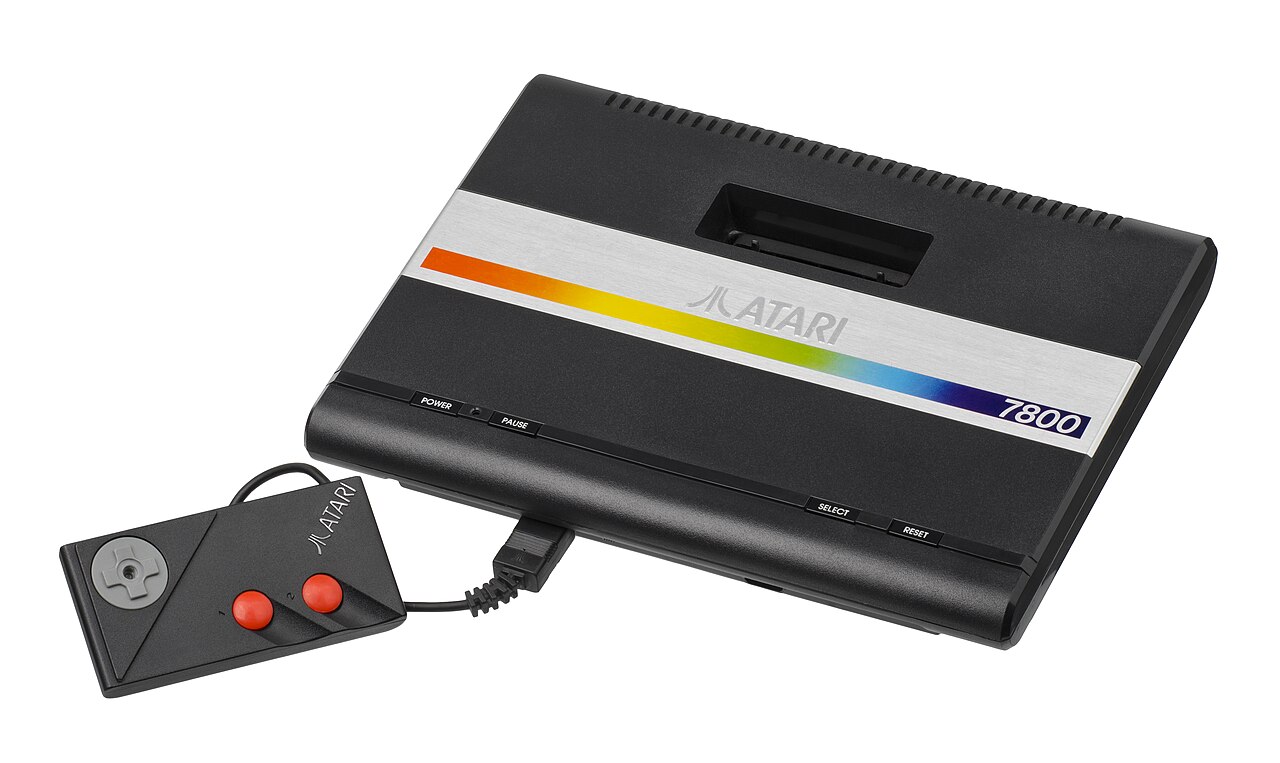
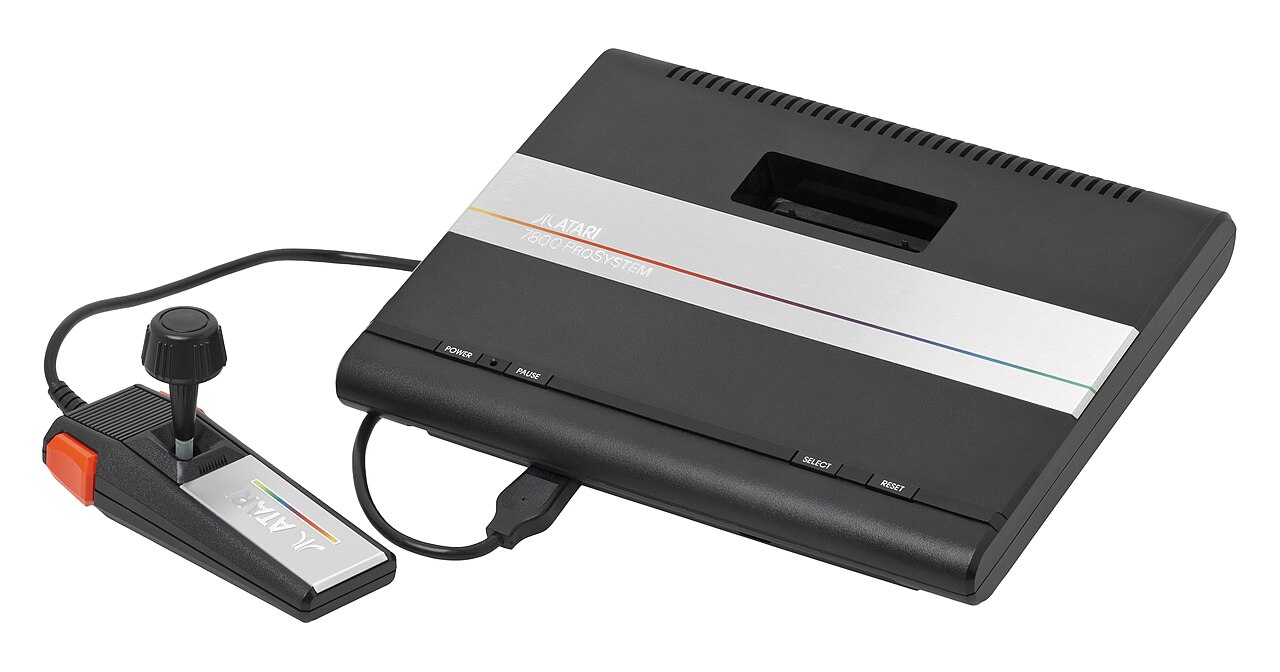
Spend time with a 7800 and its character is all in the details — brilliant where GCC’s arcade instincts ruled, pinched where the budget did. Maria, the graphics chip, worked the way arcade hardware did: instead of a tiled background with a handful of sprites, it drew from display lists of objects — dozens of independent moving elements, in up to 256 colours at its best, with an ease the NES’s architecture couldn’t match for sheer numbers on screen. Games like Asteroids and Food Fight, built around swarms of independent objects, feel effortless on it. The catch was memory and money: Maria wanted RAM and ROM the cartridge budgets of the day begrudged it, and the sound — that reused 2600 audio — undercut the visuals in every game that didn’t carry its own POKEY chip. The 7800 is a machine of visible compromises, and the compromises are the biography: designed by the best in the business, priced by the most frugal man in it.
The controllers tell the same story in your hands. The North American ProLine joystick — a slim wand with two fire buttons, one on each side — was notorious within the decade and has not been forgiven since: an hour of Joust on a ProLine is a hand workout with a legal defence. Europe, characteristically, got the better deal: the CX78 joypad, a proper two-button pad that anticipated where every controller was going. And the machine is littered with futures that never shipped. An expansion interface on the side promised a computer keyboard module that would turn the console into an Atari computer; a High Score Cartridge was designed to save scores and was cancelled; a version of the system with games built in was planned. The 7800’s spec sheet is a museum of 1984’s ambitions. What actually shipped was the console, the compromises, and the compatibility — and in the end, the compatibility is what history kept.
The Library’s Late Bloom
The official catalogue’s tail is where the machine’s personality lives. As the 1980s closed, Atari’s remaining developers — freed from competing with Nintendo’s licensed armies — made stranger, more personal games. Ninja Golf does exactly what its title promises: nine holes, and between strokes you fight ninjas. Scrapyard Dog gave the platform a scrappy mascot adventure. Alien Brigade (1990) was a light-gun-style shooter of genuine ambition. And Midnight Mutants, also 1990, put Al Lewis — Grandpa Munster himself — on the box and in the game as your mentor against a Halloween apocalypse, in one of the largest adventures the hardware ever hosted. Europe, where the 7800 lingered longest as a budget machine, kept the faith a little longer. It wasn’t an afterlife. It was a long, eccentric twilight — and then, decades later, the surprise: the twilight wasn’t the end.
The 1985 That Never Happened
It is irresistible to run the counterfactual, because the 7800’s window was real. Imagine the warehouses opening on the original schedule: a summer 1984 launch, into a market with no Nintendo in it yet. The machine’s offer would have been formidable — a new console that honoured the largest installed library in the world, arcade conversions of a fidelity nothing at home could touch, designed by the team that had just made Ms. Pac-Man, at a moment when retailers were desperate for a reason to believe in video games again. Nintendo’s American beachhead in late 1985 succeeded partly because the shelf was empty; a healthy 7800, two Christmases established, makes that beachhead a battle. And the design had one more quiet advantage for the long war: GCC itself. Nintendo’s empire was built on controlling what third parties could make. GCC’s Atari was built by third parties — an outside team with arcade instincts and a royalty deal, exactly the kind of partner ecosystem that might have kept the industry’s centre of gravity in America a little longer.
The counterfactual has limits, and honesty requires them. Tramiel’s Atari was chronically undercapitalised for a marketing war with Nintendo’s American arm, and the 7800’s sound compromise and launch library — heavy on 1982’s arcade, light on the side-scrolling adventures the market was about to demand — would have needed fixing fast. Sega’s Master System showed both halves of the truth: a well-made challenger could win whole continents (Europe, Brazil) while still losing America to Nintendo’s lock on developers and shelf space. The fairest verdict is not that the 7800 would have won. It is that it never got to play the match it was built for — the only one of the era’s major consoles of which that is true. The NES’s triumph was earned. It was also, in part, unopposed, and the opposition was sitting in a warehouse in Sunnyvale, finished, boxed, and waiting for a phone call that came two years too late.
The Afterlife: The Warehouse Kid Grows Old Gracefully
Of all the 1980s consoles, the 7800 may have aged the most gracefully, precisely because so little was expected of it. Its backward compatibility reads today like prophecy — the feature the whole industry eventually adopted as standard practice was pioneered by a machine in a warehouse. Its clean, arcade-first design made it a homebrew favourite: through AtariAge and a devoted scene, the 7800 has received dozens of new games in the 2000s and 2020s — sequels, ports, originals — a second library rivalling the first in size and often exceeding it in ambition. Collectors prize it for the same reason players did in 1986: one box, two generations of cartridges, no fuss.
And in 2024 the story came fully around. The modern Atari — a company that trades on this heritage — released the Atari 7800+, an HDMI tribute console that plays original 2600 and 7800 cartridges, bundled with a brand-new game. The machine had already taken its seat in the official canon via the Atari 50 anniversary collection, and its lost prototypes — finished games like the shooters Sirius and Plutos, cancelled in the Tramiel years and recovered by collectors decades later — had been published at last, an official library quietly completed by archaeology. Forty years after GCC’s engineers finished their work, the machine they built was being manufactured again, celebrated as a classic, and sold on the strength of the exact idea it had pioneered in 1984: your old games still count. Forty years after GCC’s engineers finished their work, the machine they built was being manufactured again, celebrated as a classic, and sold on the strength of the exact idea it had pioneered in 1984: your old games still count. The 7800 lost its generation before it was allowed to compete in it. But every console since that has welcomed its predecessor’s library — every player who has slid an old cartridge, disc, or download into a new machine and found it honoured — is living in the world the warehouse kid imagined first.