
In the autumn of 1989, two handheld consoles went on sale in America. One had a colour screen you could see in the dark, a processor that could scale and stretch sprites like an arcade machine, graphics hardware that could count its colours in the thousands, and networking for sixteen players. The other had a green screen, four shades, and a puzzle game. The green one sold a hundred and eighteen million. The miracle sold perhaps two million, and its maker was out of the business within six years. The Atari Lynx is the great what-if of handheld gaming — a machine that correctly predicted everything about the future of portable play, a decade before the future could afford it. This is its story: the Amiga engineers who built it in secret, the dying publisher that sold it to Atari, and the library — small, strange, and still growing — that refused to let it die.
The Handy: Amiga Men in a Garage
The Lynx began as neither Atari’s nor a Lynx. It was the “Handy,” built inside Epyx — the California publisher of Summer Games and Impossible Mission — by two engineers with remarkable pedigrees. RJ Mical and Dave Needle had been core architects of the Amiga computer at Commodore, one of the most advanced home machines of its age, and they carried its philosophy with them: custom silicon doing in hardware what everyone else did slowly in software. Through 1987 and 1988, in conditions of near-secrecy, they designed a handheld around two chips. “Mikey” handled the CPU — a 65C02 running at 16 MHz — sound, and the system’s housekeeping. “Suzy” was the marvel: a graphics engine that could scale, stretch, and distort sprites as a native trick, draw from a palette of 4,096 colours with 16 on screen at once, and blit with collision detection in hardware. Nothing portable — and very little that plugged into a wall — could do what Suzy did in 1989. Home consoles of the day faked scaling with pre-drawn frames; the Handy just did it, live, the way the arcade’s best boards did.
Epyx showed the Handy privately at the January 1989 Consumer Electronics Show, behind closed doors, and the industry understood immediately: this was the machine that made Nintendo’s just-announced Game Boy look like a calculator with a screen. But Epyx was a publisher in trouble. Years of expensive development and the collapse of its peripherals business had left it bleeding money — it would file for bankruptcy protection that same year — and manufacturing a console requires capital Epyx no longer had. The Handy needed a buyer with factories and shelf space. It found the one company desperate enough to bet big: Atari Corporation, still chasing the console glory Nintendo had taken from it, bought the hardware rights and put its name on the most advanced handheld in the world.
The Numbers Behind the Marvel
Suzy deserves her own paragraph of awe, because what she did in 1989 handheld hardware still reads like a misprint. The Lynx’s screen resolved 160 by 102 pixels — fewer than the Game Boy’s, a fact Nintendo’s partisans quoted endlessly — but resolution was the least interesting number on the sheet. Suzy drew sprites from a linked list in memory, effectively without a hard count: where rival hardware rationed moving objects by the dozen, the Lynx’s limit was how much memory your scene could hold, and each sprite could be scaled from a speck to screen-filling, stretched, skewed, and flipped, with collision detection thrown in free. She had a hardware maths unit for the multiplications and divisions that pseudo-3D devoured. This is why the Lynx did racers and flight games so fluently — STUN Runner’s bending tunnels, Blue Lightning’s rolling ground, Road Riot’s hills — effects the home consoles of the day achieved with vastly more expensive tricks, if at all. Mikey matched her in miniature: four channels of genuine digital-to-analogue sound, capable of sampled voices and music with a richness the Game Boy’s beeps couldn’t approach. The Lynx’s constraints were never imagination or engineering. They were the two numbers on the till receipt — $179.99, and four hours. Developers noticed one more thing about the machine: it was the first handheld that felt like a computer — properly documented, programmable in C, its hardware tricks described in manuals rather than reverse-engineered — which is why so many Lynx games read as demonstrations of technique rather than compromises with limitation.
Launch: The Future at $179.99
The Atari Lynx launched in September 1989 at $179.99 — more than double the Game Boy’s $89.95 — and everything about it argued it was worth the difference. A 3.5-inch colour screen, backlit, the first on any handheld. A body built to be flipped: left-handed players could turn the machine upside down, invert the screen, and play with the controls reversed — a courtesy no console has offered before or, shamefully, since. The ComLynx cable linked up to sixteen machines for multiplayer, at a time when the Game Boy’s link cable managed two. The pack-in, California Games, was pure Epyx — surfing, BMX, footbag, half-pipe — a catalogue of California cool rendered in scaling sprites. As a demonstration of what portable hardware could be, it was total. As a product in 1989, it had three problems, and they were the only three that mattered: it cost twice as much as the rival, it drank six AA batteries in about four hours, and the rival had Tetris.
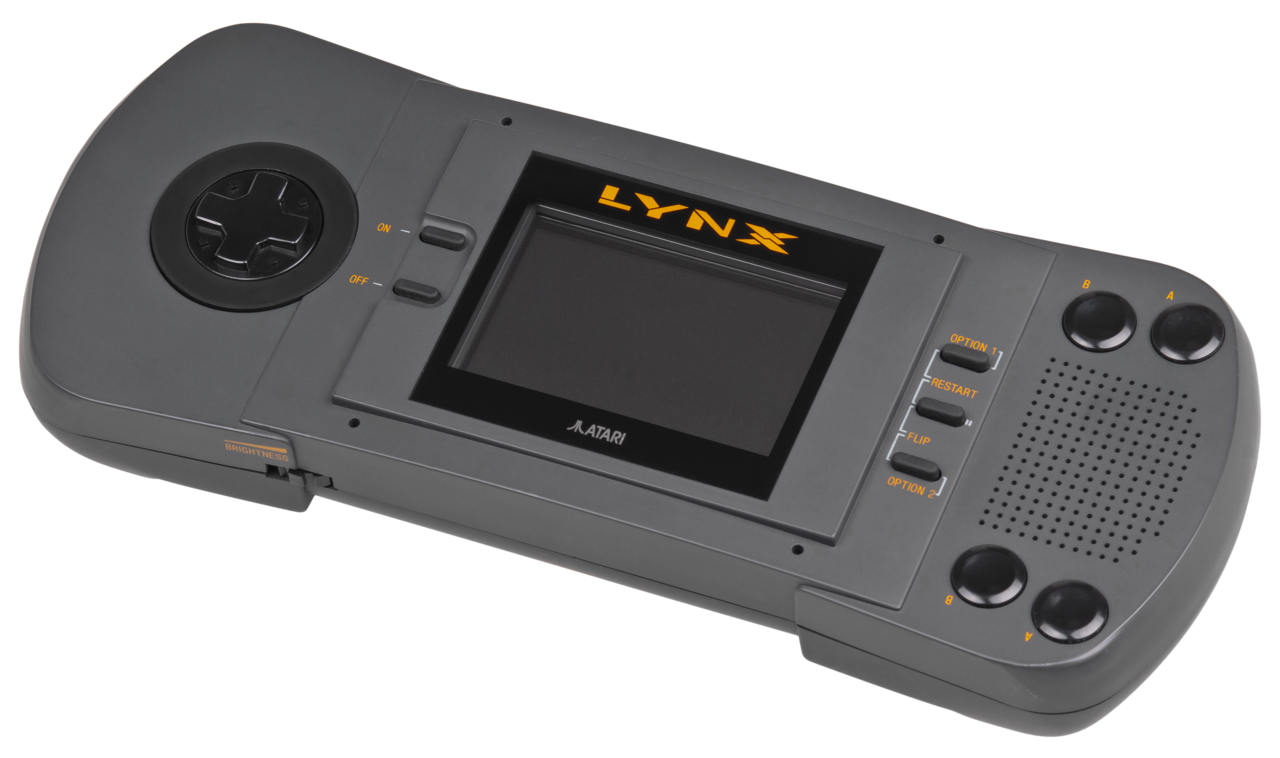
Atari’s position made everything harder. This was Jack Tramiel’s Atari Corp, a company run on margins, competing against Nintendo’s marketing ocean and, from 1990, Sega’s Game Gear — a second colour handheld with the Master System’s library and Sega’s money behind it. The Lynx was squeezed from both directions: too premium to fight the Game Boy on price, too lonely to fight the Game Gear on shelf presence. Production shortages hurt its first year; software arrived in a trickle where Nintendo’s arrived in a flood. The Lynx’s technology was a generation ahead. Its ecosystem was a generation behind. In platform wars, ecosystems win.
The Library: Small, Strange, Superb
The Lynx library closed at just over seventy official releases — a shelf you can know completely, which is part of its charm — and its best games have a flavour nothing else in 1989 offered. The Epyx soul ran deepest: California Games distilled the publisher’s multi-sport formula into a perfect handheld cartridge, and Chip’s Challenge — a tile-based puzzler of 148 levels, ported from Epyx’s computer catalogue — became the machine’s quiet masterpiece, a game of pure logic that has been converted to everything since and still plays best where it started. Blue Lightning, a launch showcase, wrapped an After Burner-style jet game around Suzy’s scaling until the ground itself seemed to roll. Electrocop and Gates of Zendocon showed the machine doing moody, atmospheric action the Game Boy couldn’t dream in grey.
Atari’s own arcade heritage filled the second rank gloriously — Klax in its definitive handheld form, Rampage with its monsters rendered huge, Xybots, Paperboy, STUN Runner bending its polygons around corners — and the multiplayer stories were a generation early. Warbirds put up to eight ComLynxed players into World War I dogfights, a wire-full of handhelds running a portable LAN party in 1991. Todd’s Adventures in Slime World supported eight-player cooperative exploring. This was networked gaming when the term barely existed, on a machine whose owners could seldom find one other owner, let alone seven — the Lynx’s tragedy in miniature: its signature experiences required a crowd its sales never gathered. Later releases had real ambition — Batman Returns rode the 1992 film, Checkered Flag chased the racers, and publisher Telegames kept the faith with releases straggling into the late 1990s, years after Atari itself had walked away.
The First Year: Shortages and the Squeeze
A launch is a supply chain before it is a celebration, and the Lynx’s first year was hobbled by the oldest problem in hardware: Atari couldn’t make enough of them. The machine that reviewers praised through the autumn of 1989 was genuinely difficult to find that Christmas, and a console that isn’t on the shelf in December is a rumour by January. Worse, the company that had designed it was vanishing. Epyx — which was to be a pillar of the Lynx’s software line, the house studio that understood Suzy best — collapsed into bankruptcy in 1989 and restructured as a shadow of itself; the Handy had been sold precisely because Epyx was dying, and its death still cost the platform its most natural developer. Atari, meanwhile, was fighting with one hand: Tramiel’s company was simultaneously pushing the ST computers, the Portfolio palmtop, and the remnants of the 7800 and 2600 lines, with marketing budgets that were a rounding error next to Nintendo’s.
Then the squeeze closed. Nintendo’s answer to the colour future was not colour at all — it was $89.95, thirty hours of battery, Tetris in the box, and Super Mario Land on the shelf, a combination aimed with lethal precision at parents. Sega’s answer, the Game Gear, arrived in 1990 with colour, a backlight, a TV tuner gimmick, and the Master System’s catalogue behind it: technically a lesser machine than the Lynx — no scaling hardware, a smaller effective palette of tricks — but backed by Sega’s money and momentum. The Lynx now occupied the worst seat in the market: the connoisseur’s choice, the one the magazines admired and the fewest children owned. Reviewers kept saying the same sentence — the best handheld hardware in the world — and the sentence kept not mattering. Japan, where the Lynx launched in 1990, shrugged almost entirely; the machine’s American-arcade soul and thirsty batteries played badly in the Game Boy’s homeland. By the time supply, software, and price all aligned in the Lynx II of 1991, the audience had been assigned. Platform wars are not won by the best machine, nor even the cheapest, but by the one whose ecosystem compounds — and by 1991 Nintendo’s was compounding at a rate no rival’s engineering could outrun.
Lynx II and the Fade
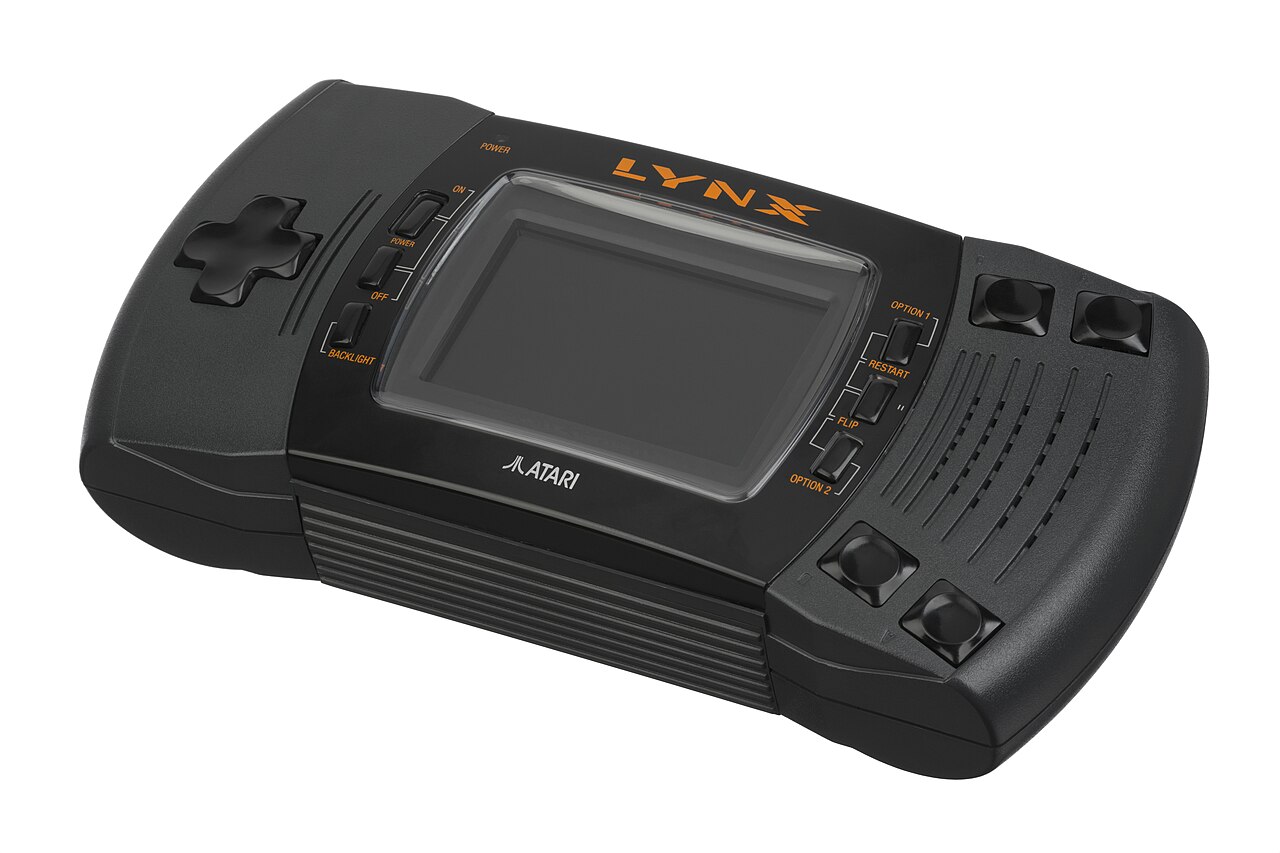
Atari answered the hardware complaints in 1991 with the Lynx II: a smaller, smarter body, stereo sound, a clearer screen, a battery-saving pause, and a price that slid from $149 toward $99 as the years turned. It is the version most players remember, and by most measures the machine had been fixed. But the war had already been decided by the things a redesign can’t cure — shelf space, software flow, the Game Boy’s price, the Game Gear’s marketing. Sega’s handheld, itself a distant second to Nintendo, still outsold the Lynx several times over. Atari’s finances narrowed to a single bet: in 1993 the company launched the Jaguar home console and poured everything into it, and the Lynx — the older, smaller bet — was left to Telegames and the faithful. Official support ebbed away by the middle of the decade. Total sales are estimated at somewhere under three million: not a failure of engineering, not even really of games. A failure of arithmetic, twice over — the price of the future, charged in 1989’s money and 1989’s batteries.
The Canon: A Shelf You Can Hold in Two Hands
California Games (1989) — the pack-in and still the machine’s signature: surfing, BMX and footbag in scaling colour. Chip’s Challenge (1989) — 148 levels of pure logic; the puzzle game the platform is remembered by. Blue Lightning (1989) — the launch showcase, a jet game that rolled the whole world beneath you. Electrocop (1989) — moody, atmospheric, impossibly ambitious for a launch title. Gates of Zendocon (1989) — a shooter with 51 levels and a password to each. Todd’s Adventures in Slime World (1990) — exploration built for eight linked players, a party waiting for its crowd. Klax (1990) — Atari’s own puzzler, definitive in this form. Warbirds (1991) — eight-player biplane dogfighting over a nest of cables; the multiplayer future, demoed in 1991. Crystal Mines II (1992) — the thinking player’s dig-’em-up, endlessly deep. Shadow of the Beast (1992) — the Amiga’s graphical flex, in your hands. Batman Returns (1992) — the movie tie-in that treated the hardware like a console. Checkered Flag (1994) — the racer that showed the sprite engine still had gears left. Lemmings (1993) — the Amiga-born phenomenon, perfectly at home on hardware built by Amiga people. Seventy games, and the canon is a third of the library: there has never been a platform where the essential shelf was so much of the whole.
The Afterlife: The Future, Eventually
Here is the thing about being right too early: if you wait long enough, the world catches up and calls you a pioneer. Every defining feature of the modern handheld — colour screen, backlight, hardware built for scaling and effects, multiplayer networking, a library that lives on flash storage — is in the Lynx’s 1989 spec sheet, itemised. The industry did not reject the Lynx’s vision. It adopted it wholesale, one battery breakthrough at a time.
There is a coda the sales figures can’t see. A working Lynx in 1989 was a compromise you managed — the backlight that drank batteries, the screen you shielded from the sun. A working Lynx in 2026 is, increasingly, a machine its owners have finished: modern LCD replacements (the McWill and BennVenn mods are the famous ones) give it a bright, crisp, efficient display that finally matches Suzy’s ambitions, and flash cartridges carry the whole library on one card. Prices for the original hardware and its best games have climbed accordingly — the Lynx has crossed the line from curiosity to collectible, the fate of everything that was right too early. To hold one today, modded screen blazing, is to play the counterfactual: this is what the playground would have felt like if the batteries had been ready.
The machine’s community refused the obituary first. Songbird Productions has published brand-new Lynx games since 1999 — the longest-running publisher the platform has — and a homebrew scene of real depth keeps the catalogue growing into the 2020s. The official world returned too: the Evercade’s Atari Lynx collections put the library on modern cartridges in 2020, and Atari 50 (2022) brought Lynx games into the canonical anniversary line-up — the machine taking its seat in its maker’s own museum at last. Owners retrofit modern LCD screens that finally give Suzy’s graphics the display they deserved in 1989, FPGA cores preserve the hardware exactly, and the little library — its seventy-odd originals plus three decades of descendants — sits complete and knowable in a way the giant platforms never can. The Lynx lost to a calculator with a puzzle game. But take the measure of what a handheld is in 2026 — colour, light, power, connection — and you are reading the Lynx’s design brief. It didn’t lose the argument about the future. It just had to wait thirty years for the verdict.