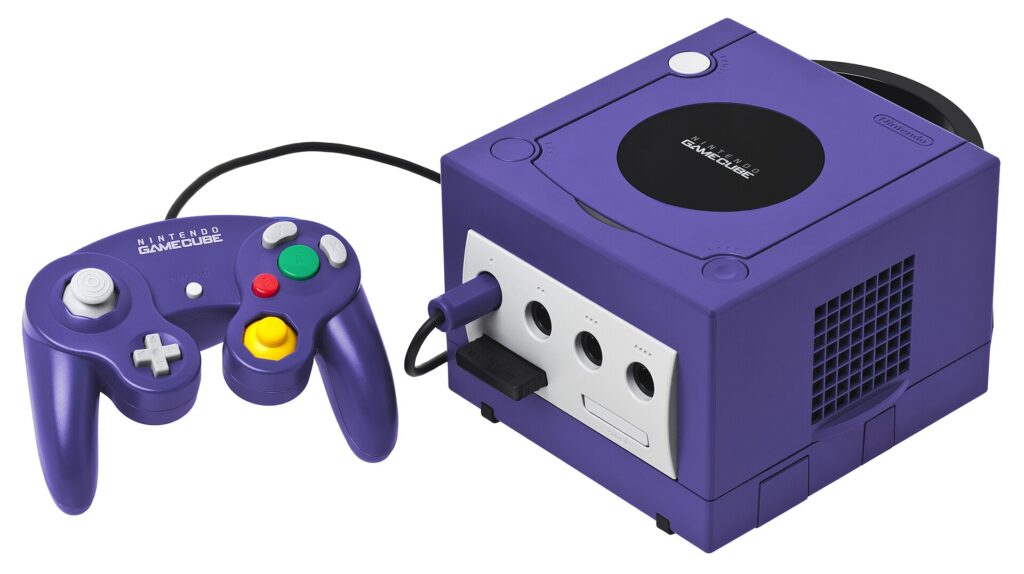
It had a handle. That was the joke, and for a while it was the whole conversation: Nintendo’s great hope for the new century was a purple plastic cube with a carrying handle, and the industry called it a lunchbox, a handbag, a toy. Sony’s PlayStation 2 was a black monolith that played DVDs and looked like the future. Microsoft’s Xbox was a green slab of PC muscle. Nintendo’s entry looked like something a child would carry sandwiches in. The joke aged badly. The lunchbox turned out to be one of the most thoughtfully engineered consoles ever made, home to a library whose reputation has done nothing but climb for twenty years — Metroid Prime, Resident Evil 4, The Wind Waker, Eternal Darkness, Melee. The GameCube lost its war decisively, finishing a distant third. Then it won the argument, slowly, in public, until the console everyone mocked became the console everyone missed.
After the Cartridge Winter
To understand the cube you have to remember the winter before it. The Nintendo 64 had been a machine of masterpieces and estrangement: its cartridges preserved Nintendo’s control and profits while driving away the third-party developers who had made the Super Nintendo an empire. Square was gone. Capcom was mostly gone. The PlayStation had sold a hundred million consoles by doing everything Nintendo refused to do. So the GameCube was designed as a correction — not a surrender, because this is Nintendo, but a genuine change of heart. Development would be easy. The tools would be friendly. The partners were blue-chip: IBM built the processor, a PowerPC chip called Gekko running at 486 MHz; the graphics came from ArtX, a team of Silicon Graphics veterans whose Flipper chip ATI acquired along with the company mid-project. Nintendo courted developers with competitive royalties and a machine whose architecture programmers praised as clean, balanced, and honest — no bottlenecks bought cheap, no exotic silicon to wrestle.
And then, being Nintendo, it kept one hand on the brake. The GameCube would finally abandon cartridges — but not for DVDs. Its discs were a proprietary 8-centimetre format holding 1.5 GB, developed with Matsushita, engineered so that a standard DVD drive couldn’t read them and pirates couldn’t press them. The decision is the whole console in miniature: technically elegant, commercially costly. The discs were fast and the piracy genuinely was minimal, but the PlayStation 2 in the next room played movies, and in 2001 that fact sold consoles to people who had never bought a game. Nintendo’s position — a games machine should play games — was philosophically pure and strategically expensive. The purple cube would not play your DVDs. It would barely apologise for it, either.
Launch: No Mario, No Apology
The GameCube launched in Japan on 14 September 2001 and in North America on 18 November, at $199 — a hundred dollars less than its rivals. The launch made one statement so bold it still startles: there was no Mario platformer. Instead, the flagship title was Luigi’s Mansion, a gentle, strange game about a frightened younger brother vacuuming ghosts in a haunted house — a showcase for lighting, physics, and charm, and a deliberate signal that this machine would do things its own way. Around it sat one of the strongest launch benches Nintendo ever fielded: Wave Race: Blue Storm’s water, Star Wars Rogue Squadron II’s impossible space battles, and — a sentence that would have been treason five years earlier — Super Monkey Ball, made by Sega. The old enemy’s first big game for a Nintendo console was a launch title, and it was superb. The cartridge winter was over; former rivals were queuing up.
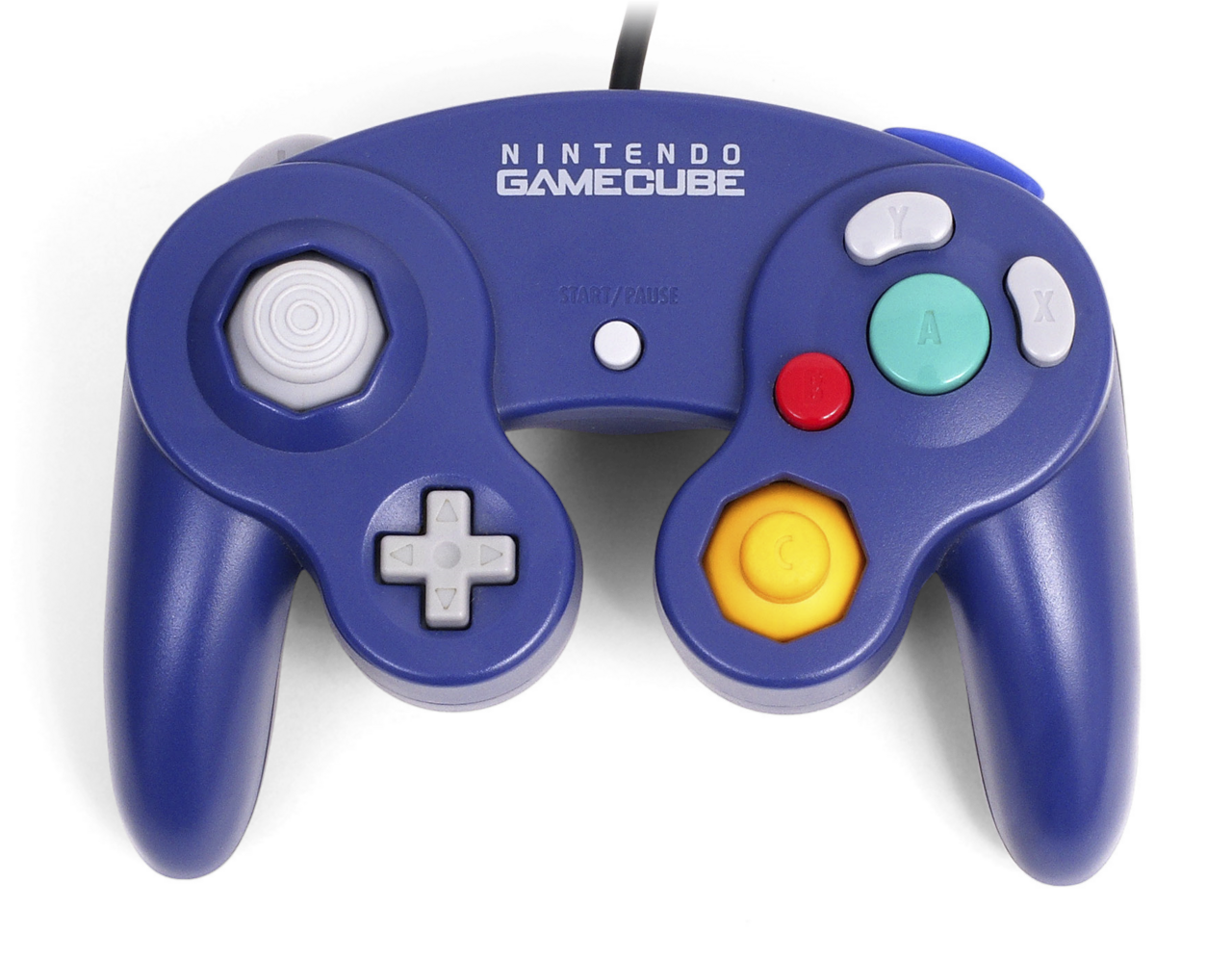
The hardware invited the jokes and then embarrassed them. Yes, there is a handle — retractable, sturdy, unashamed. Under it sat a console that was compact, quiet, and famously reliable, with load times that embarrassed the disc-based competition Nintendo had supposedly been foolish to join late. The controller split opinion and then conquered: an octagonal gate around the stick, a giant green A button placed where the thumb naturally rules, analogue triggers that clicked at the end of their travel, and a small yellow C-stick that everyone forgave because everything else felt so considered. It remains, for a large and vocal population, the best controller Nintendo ever made — a claim the company itself keeps ratifying by re-releasing it for every new generation of Super Smash Bros.
The Handheld in the Room
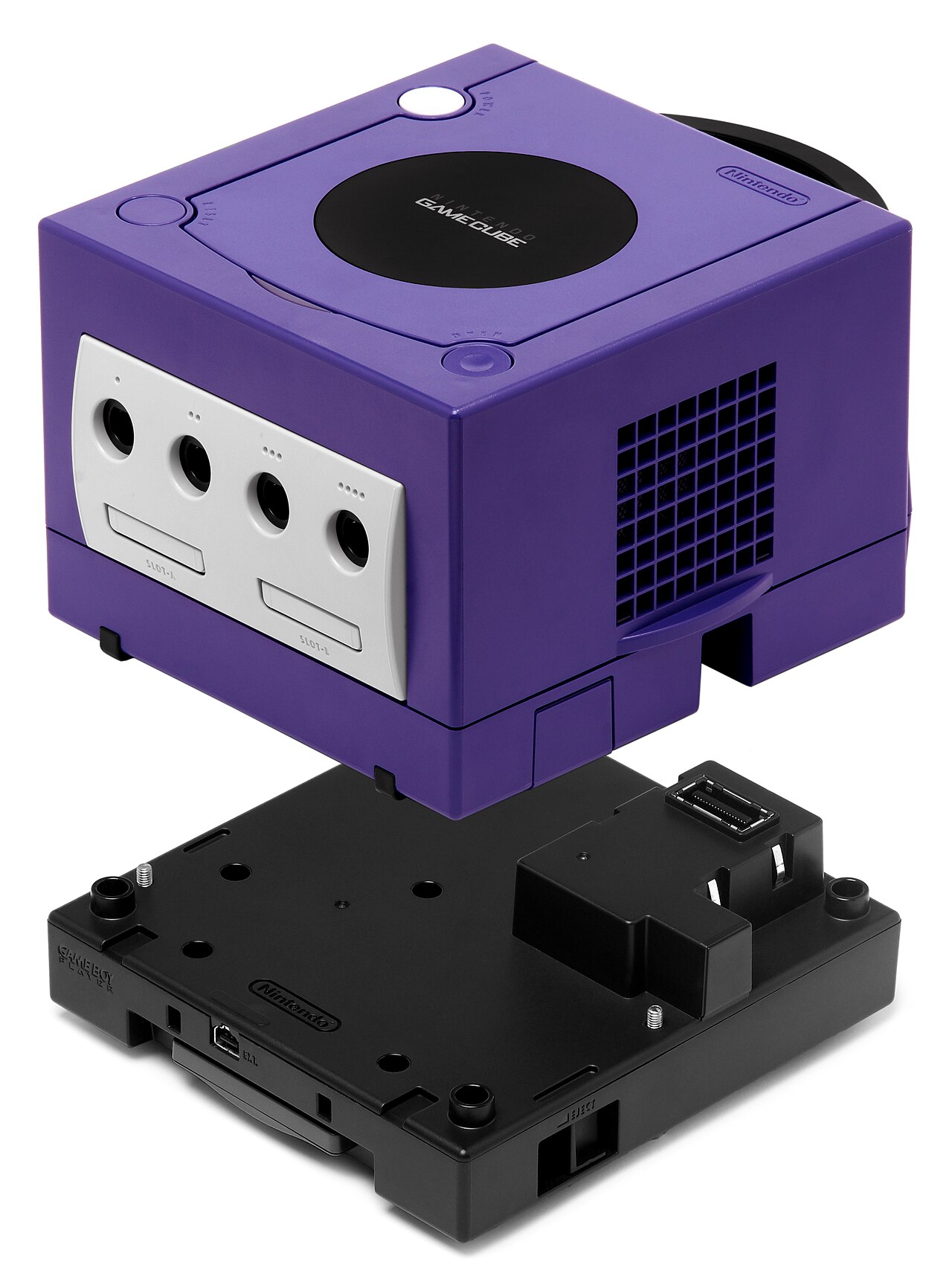
Nintendo’s strangest and best idea for the cube was to plug its other console into it. The Game Boy Advance link cable turned the handheld into a controller, a private screen, a second display for secrets — the Tingle Tuner in The Wind Waker, the radar in Pac-Man Vs. (a Shigeru Miyamoto-designed party game given away almost as an afterthought and still the best thing in any room), and most ambitiously Final Fantasy Crystal Chronicles and The Legend of Zelda: Four Swords Adventures, which asked four players to bring four Game Boy Advances and four cables and built cathedrals of cooperation on that absurd requirement. Then, in 2003, Nintendo released the Game Boy Player: a base that snapped under the console and played the entire Game Boy, Color, and Advance library — some two thousand games — on the television, through the cube’s own controller. The GameCube had the smallest disc library of its generation and, with one accessory, one of the largest playable libraries of any machine ever sold. Nobody else was thinking like this. Arguably, nobody has since.
Partners, Departures and New Blood
The cube’s library was shaped as much by studios arriving and leaving as by Nintendo itself. The era’s loudest exit was Rare’s. The British studio had defined the N64’s later years — GoldenEye, Banjo-Kazooie, Perfect Dark — and its single GameCube release, Star Fox Adventures (2002), began life as an original game called Dinosaur Planet before Miyamoto suggested the Star Fox cast move in. Weeks after it shipped, Microsoft bought Rare for $375 million, and a partnership that had produced a generation of classics ended with a whimper of a farewell game. Nintendo’s second-party model — the loyal studios orbiting the mothership — never really recovered its old shape; the cube was where it dissolved.
What replaced it was more interesting. Retro Studios, founded in Austin in 1998 and absorbed into Nintendo’s orbit, spent years as an industry cautionary tale — four projects cancelled, staff churning, a Metroid game everyone assumed would be a disaster — before Metroid Prime silenced all of it in a single release. Factor 5, the German-American team behind the Rogue Squadron games, became so fluent in the hardware that Nintendo licensed their sound tools as the console’s standard; Rogue Leader’s Hoth remains a launch-window flex without equal. Silicon Knights made Eternal Darkness, a horror game that attacked the player’s sanity with fake memory-card deletions and phantom volume changes — ideas only possible on a machine whose maker would let a partner weaponise the hardware itself. And Sega, the former enemy, was suddenly everywhere: Super Monkey Ball at launch, F-Zero GX by 2003, Sonic finding his post-Dreamcast home disproportionately on the cube. The GameCube’s ecosystem in one image: Nintendo’s oldest rival, Nintendo’s newest studio, and Nintendo’s departing legends all shipping classics on the same purple box at the same time.
The War It Couldn’t Win
None of it was enough, and the reasons were decided before the cube launched. The PlayStation 2 had a year and a half’s head start, a DVD player in every box, and the loyalty of the developers who had won the previous generation; it would pass 160 million units. Microsoft bought its way in with Halo and money. Nintendo’s machine, for all its virtues, arrived third into a two-horse narrative, and the industry wrote it off in the cruel shorthand of the time: a toy for children, purple in a black-console world. Third-party support, so warmly courted, cooled as the sales gap widened — ports arrived late or not at all, and when they did arrive they often sold worst on the cube, a self-fulfilling pattern we’ve examined in the sales data: only two of the GameCube’s ten best-selling games in America came from third parties. Nintendo cut the price to $99 in 2003 and kept making masterpieces into a headwind. The final tally — 21.74 million consoles — made the GameCube Nintendo’s lowest-selling home system to that point, a commercial failure with an asterisk the size of its library.
The Canon: Masterpieces in a Losing Cause
Because here is the thing the sales concealed: the first-party and exclusive library is outrageous. Super Smash Bros. Melee (2001) was built in thirteen months and became the console’s best-seller and a competitive institution that players refused to let die for two decades. Metroid Prime (2002) handed Nintendo’s most atmospheric series to an unknown Texas studio, Retro, and produced a first-person adventure of such craft that it redefined what the genre could be. The Legend of Zelda: The Wind Waker (2002) provoked outrage with its cel-shaded look — “Celda,” the forums sneered — and is now routinely named the most beautiful game of its generation, its supposed crime reclassified as genius. Resident Evil’s remake (2002) rebuilt the original as a gothic masterpiece, and Resident Evil 4 (2005) rewrote the third-person shooter wholesale — even as its timed exclusivity collapsed in the famous Capcom Five affair, it premiered on the cube, and the cube is where its legend was made.
Keep going: Pikmin grew a new genre out of Miyamoto’s garden. Animal Crossing, a translated N64 afterthought, became a way of life. Eternal Darkness twisted the player as deliberately as the story. Mario Sunshine divided opinion like a proper artwork. Double Dash weaponised Mario Kart with two riders per kart. Paper Mario: The Thousand-Year Door told the funniest story Nintendo has ever published. F-Zero GX — built by Sega’s Amusement Vision, an alliance unthinkable five years earlier — remains the fastest-feeling racing game ever made. SoulCalibur II put Link in the definitive version of the generation’s best fighter. This is not the library of a failed console. It is the library of a great one that had the misfortune to share a generation with the best-selling machine of all time.
The Quiet Machine
Live with a GameCube for a week and a quality emerges that no spec sheet captured: it is fast in the ways that matter daily. The little discs seek quickly, the memory architecture — a pool of fast 1T-SRAM sitting alongside main RAM — was balanced rather than merely big, and first-party games load with a snappiness that made the era’s CD-waiting feel antique. This was deliberate. Nintendo and its partners had designed for the experience of the machine, not the brochure: Gekko and Flipper were not the most powerful chips available, but they wasted nothing, ran cool and quiet, and let a console the size of a tissue box trade blows with a machine twice its volume. The philosophy — performance through balance, not brute force — became the template for everything Nintendo made afterward, from the Wii’s modest silicon to the Switch’s tablet chip. The GameCube was the last Nintendo home console that even tried to win on power, and it is quietly the ancestor of the strategy that replaced power entirely.
Even its oddities were considered. Two versions of the hardware exist because Nintendo put a digital AV port beside the analogue one — component video, in 2001, for the handful of televisions that could use it — then removed it to save money when almost nobody did; today that port is why original component cables are treasure. Japan got the Panasonic Q, a stainless-steel GameCube that played DVDs, as if to prove the omission had been a choice rather than a limitation all along. And the cube went online the way Nintendo does everything: reluctantly, experimentally, and slightly ahead of the meaning of it. A broadband adapter, a modem, a keyboard controller like a plank — and Phantasy Star Online, Sega’s console-MMO pioneer, thriving on the machine in defiance of its maker’s indifference. Mario Kart: Double Dash could be networked across consoles in LAN for eight players, a feature demonstrated at shows and used by almost no one, because almost no one had two cubes, two televisions, and the manual’s optimism. The GameCube’s online story is a footnote — but it is the footnote where modern Nintendo, the one of friend codes and cautious networks, visibly begins.
The personality went all the way down to the firmware. The console’s menu ambience — that slow, drifting synth wash players left running while they swapped discs — is the Famicom Disk System’s jingle stretched to a sixteenth of its speed, a piece of Nintendo history hidden in the machine’s idle hours. The boot animation had its own secrets: hold Z on one controller and the famous orchestral hit becomes a child’s squeaky toy; hold it on four and you get a kabuki shout. No competitor was burying jokes in the startup screen. The cube’s designers were, because the machine was built by people who expected to be loved by the few rather than merely bought by the many — and built it to reward exactly the kind of attention that notices such things.
The Afterlife: Two Cubes Duct-Taped Together
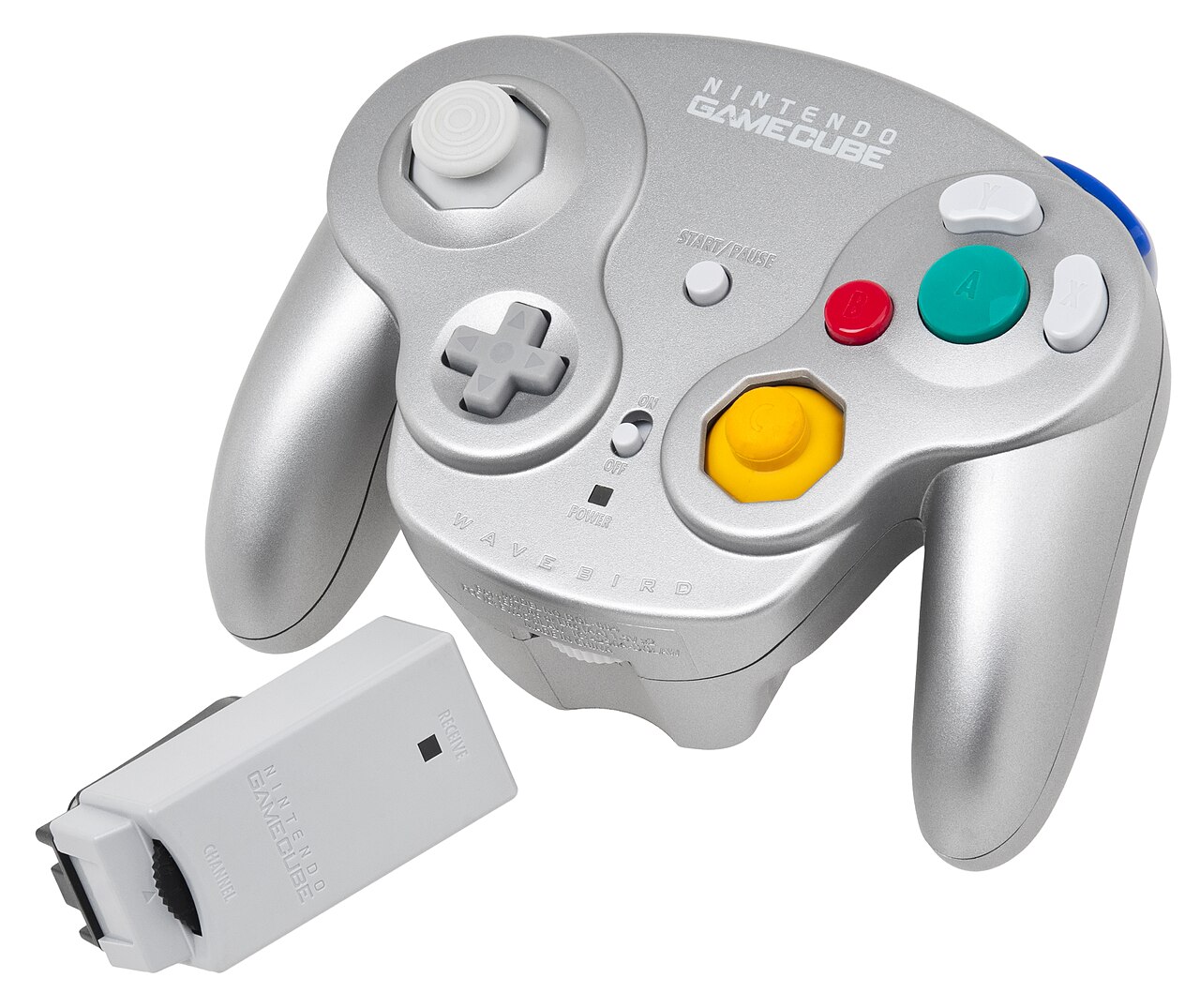
The industry’s favourite insult about Nintendo’s next console — that the Wii was “two GameCubes duct-taped together” — was more literally true than the joke intended, and it was the cube’s revenge. The Wii kept the architecture, added motion, played every GameCube disc, and sold 101 million units. The cube’s ideas kept resurfacing: its controller was reissued for the Wii U and again for the Switch because Smash players would accept no substitute (an adapter saga we were covering back in 2014), and the Switch 2 has brought the library back officially through Nintendo Switch Online — with the system’s games, controllers, and cult classics once again in the conversation, as when one of its most beloved cult classics stirred back to life after 24 years. Meanwhile the original discs became collectables with real teeth — a market where the question “Would You Pay $300 for This GameCube Game?” stopped being hypothetical years ago.
Judge the GameCube by its generation and it finished third. Judge it by what lasted and it is hard to name a more durable machine: the controller players still demand, the library collectors still chase, the architecture that powered a hundred-million-selling successor, and a design — purple, handled, unembarrassed — that looks less like a joke every year and more like the last console built entirely without fear. The lunchbox won. It just took twenty years to count the votes.