At a glance: Atari Karts · Atari Jaguar · Miracle Designs / Atari, 1995 · Kart racer · Score: 7.5/10
Every console of the nineties needed a kart racer, because Mario Kart had rewritten the rules of multiplayer — and the Jaguar’s entry is better than its reputation, and better than it had any right to be given when it arrived. Atari Karts, from Belgian studio Miracle Designs, landed in late 1995 as the system was circling the drain, got reviewed as a competent clone, and then spent decades being rediscovered as one of the smoothest, most charming racers on the machine — and one of its most expensive cartridges, a fate no mediocre game earns.
The clone that did the work
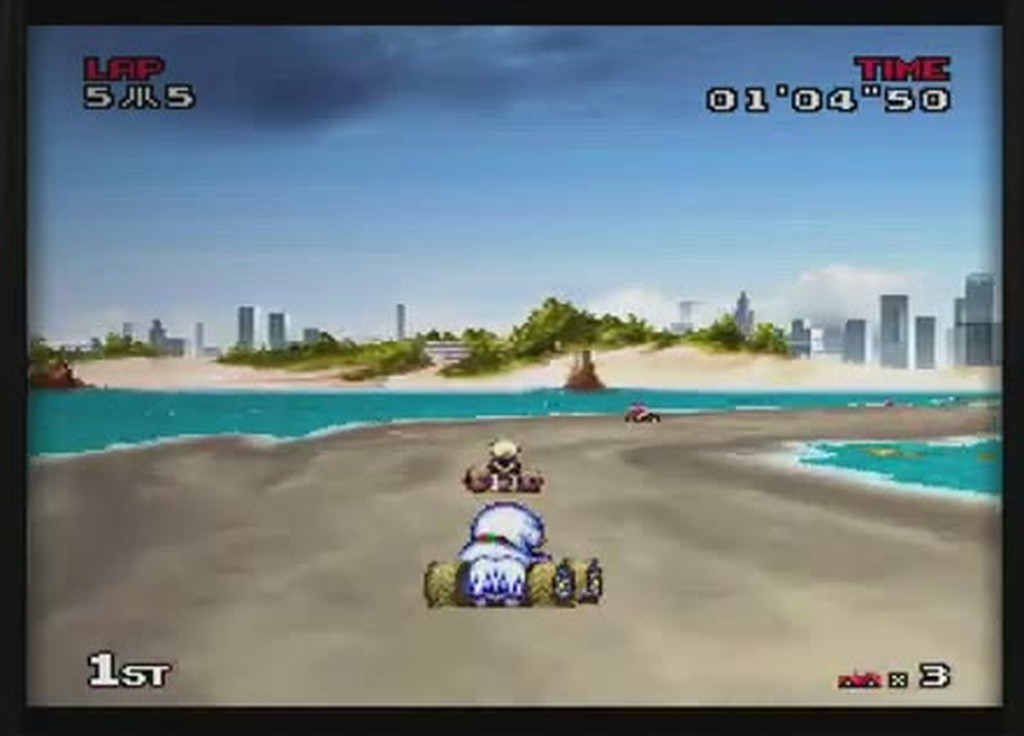
The debt to Mario Kart is worn openly: mascot racers (led by Bentley Bear, a refugee from Atari’s arcade Crystal Castles), themed circuits, power-ups scattered on the track, and cups to win across escalating engine classes. What Miracle Designs understood is that a clone lives or dies on feel, and Atari Karts feels right. The karts drift with a readable, catchable slide; the tracks flow with wide, banked corners rather than the hairpin cruelty of some rivals; and the whole game runs at a smoothness that shame-facedly exposes the Jaguar’s polygon racers, built — like Super Burnout — on the sprite-scaling strengths of the hardware rather than against them.
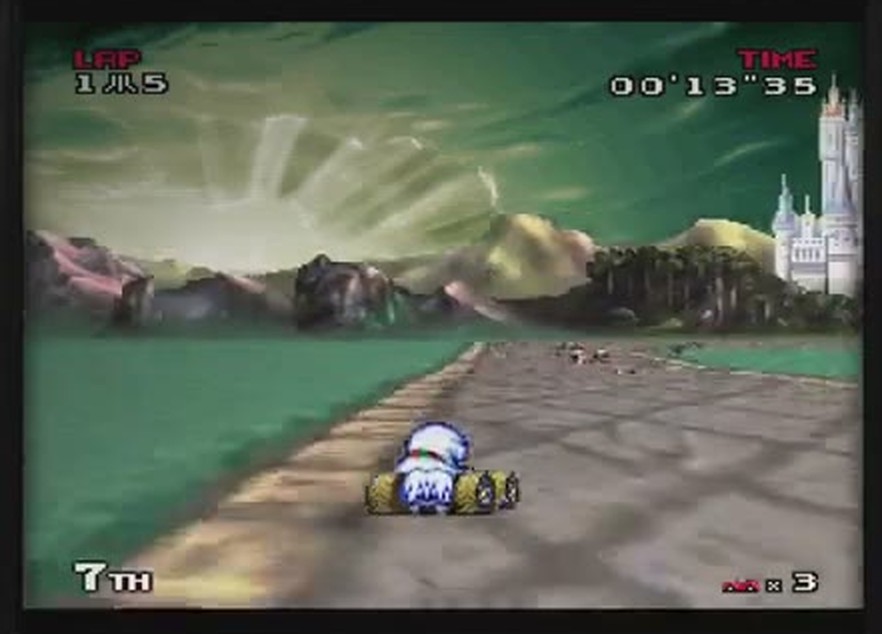
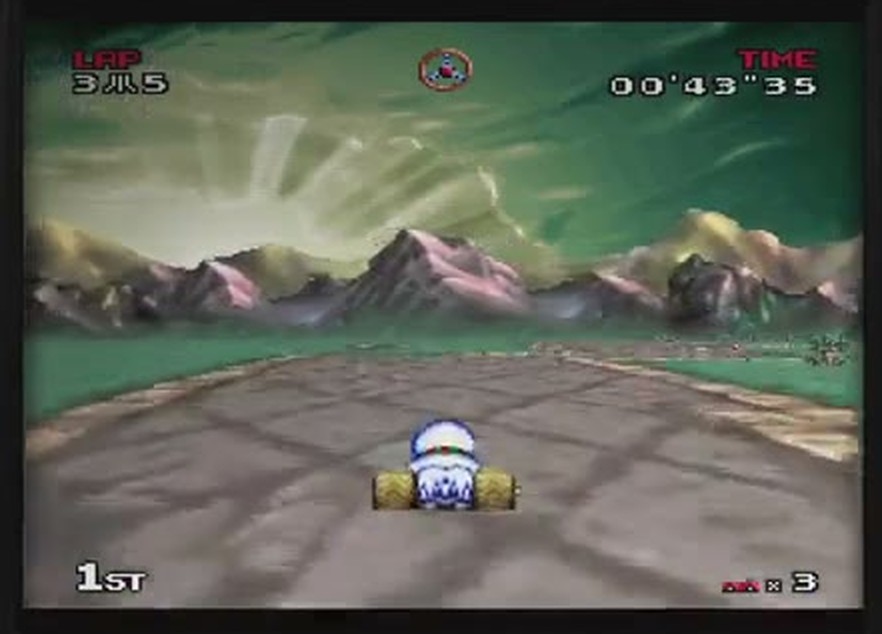
The tracks themselves are a cheerful tour — beaches, snowy passes, haunted and fantastical detours among the cups — drawn in big, bold, primary-coloured sprites that still look fresh, and the rubber-band rivalry of the AI field keeps races honest into the final lap in the way the genre demands. Power-ups run to boosts, temporary invincibility and track hazards rather than Nintendo’s copyrighted menagerie, and while nothing here has the shell-game depth of Mario Kart’s item ecology, the racing underneath the items is sound enough to carry the game when the novelties run dry.
Where it wins and where it thins
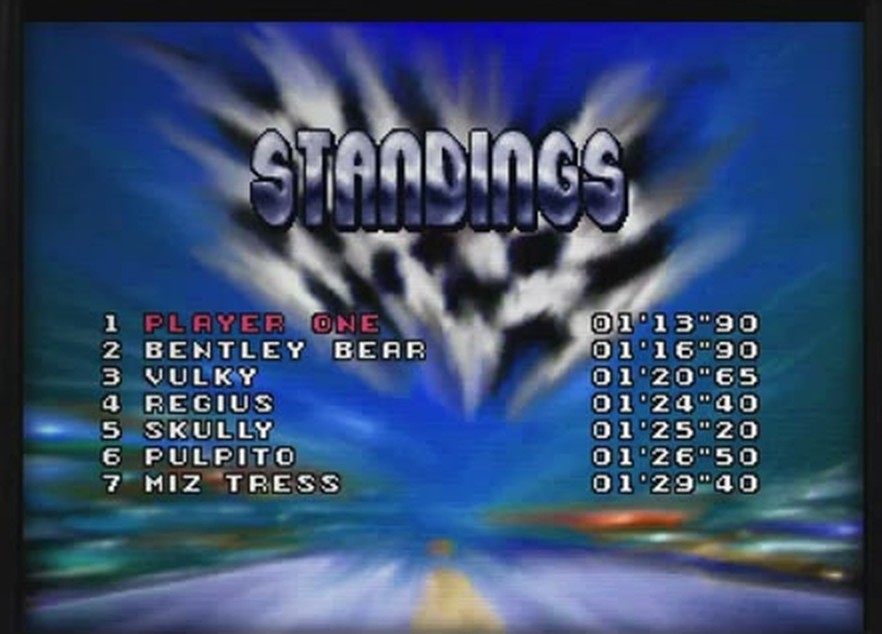
Two-player split-screen is present, smooth and exactly as much fun as the format promises — Atari Karts is, quietly, one of the better sofa games on the Jaguar, and households got their value from it in 1995. The single-player ladder is a thinner offering: the cup structure is conventional, the roster of racers is personality-light beyond Bentley (the others are cheerful inventions rather than a mascot stable, because Atari simply didn’t have one to draw on), and there is no battle mode to extend the multiplayer life — an omission that Mario Kart veterans will feel within the first evening. Difficulty, too, is pitched gentle: experienced karters will take the top class apart faster than they’d like, and the game’s long-term challenge rests on lap times and company rather than on a stern campaign.
None of that stopped the cartridge from becoming one of the library’s collector centrepieces — a late, modest-selling release on a dying console does that arithmetic by itself — but price is not why it endures in recommendation lists. It endures because the Jaguar’s racing shelf is a minefield, and Atari Karts is one of the three or four entries on it that a new owner can buy with confidence: a finished, polished, good-humoured game that does its job at full speed. In the context of 1995, “the Jaguar’s Mario Kart clone is genuinely good” was a headline Atari desperately needed more of, earlier.
A word on the team
Miracle Designs deserve their footnote in the system’s history. A small European studio working at the platform’s twilight, they delivered one of its most technically assured sprite engines, and would go on to be among the few developers still producing Jaguar work into the aftermarket era. Atari Karts has their fingerprints all over it — not in self-indulgence, but in craft: the scaling is immaculate, the presentation is clean, the frame rate never lies. If the Jaguar had attracted a dozen studios of this calibre in 1993 instead of 1995, the retrospective on the machine would read very differently.
Set against the modern kart landscape, of course, it is a modest game: a handful of cups, a simple item set, no online anything, no unlockable universe. But modesty, executed this smoothly, ages better than ambition executed at fifteen frames per second — which is, in one sentence, the story of the entire Jaguar library, and why Atari Karts keeps winning its small, persistent fanbase.
The fine print for buyers and players
Two practical matters shape the Atari Karts experience in 2026. The first is the famous one: original cartridges are scarce and priced accordingly, a consequence of that late, small release — which makes this among the library’s strongest arguments for the modern flash-cart route, where the game can be played nightly rather than insured. The second is happier: what you get, however you get it, is complete in a way its modern descendants often aren’t. No downloadable anything, no season pass, no live-service sunset on the horizon — the cups, the racers, the two-player mode, all pressed into a cartridge in 1995 and all still exactly where Miracle Designs left them. For a party game that is not a small virtue. It is, increasingly, the whole ballgame.
New players should also know the learning curve is measured in minutes. The drift is generous, the tracks are readable at a glance, and the game’s one real skill — choosing your moment with a boost on the long, banked straights — announces itself within a single cup. That accessibility is why Atari Karts has quietly become a gateway cartridge: the Jaguar game you hand to a visitor who thinks the console is a trivia answer. Five minutes later they are leaning into the corners of a snow circuit, shouting at a bear. The console could have used a hundred conversions that smooth in its lifetime. It got this one, and it counts.
The cups, and the long tail of a race
The cup structure rewards a second look, because it is where the game’s craft hides. The early circuits teach the drift on wide, forgiving tarmac; the middle cups introduce the themed hazards and the tighter scenery that punish a lazy line; and the final tier combines the fastest engine class with the tracks whose corners arrive in combinations rather than singly. It is a teaching curve borrowed from the best of the genre and paced with unusual care for a small team’s late-era release — nothing in Atari Karts is thrown at the player before the game has shown them the tool for it. Even the results screens and podium rituals, those tiny ceremonies by which party games live, are given their due: quick, bright and funny enough to make the loser demand the rematch that the whole genre exists to produce. A kart racer is a machine for generating rematches. This one still runs.
In short: the clone that outlived the sneers, built by a team that cared, on hardware that finally had a game designed for its strengths. Bentley Bear deserved a sequel. He got a legacy instead.
Verdict
A bright, smooth, good-hearted kart racer that does the simple things at full speed — the Jaguar’s best party racer, and one of its most likeable cartridges. Score: 7.5/10