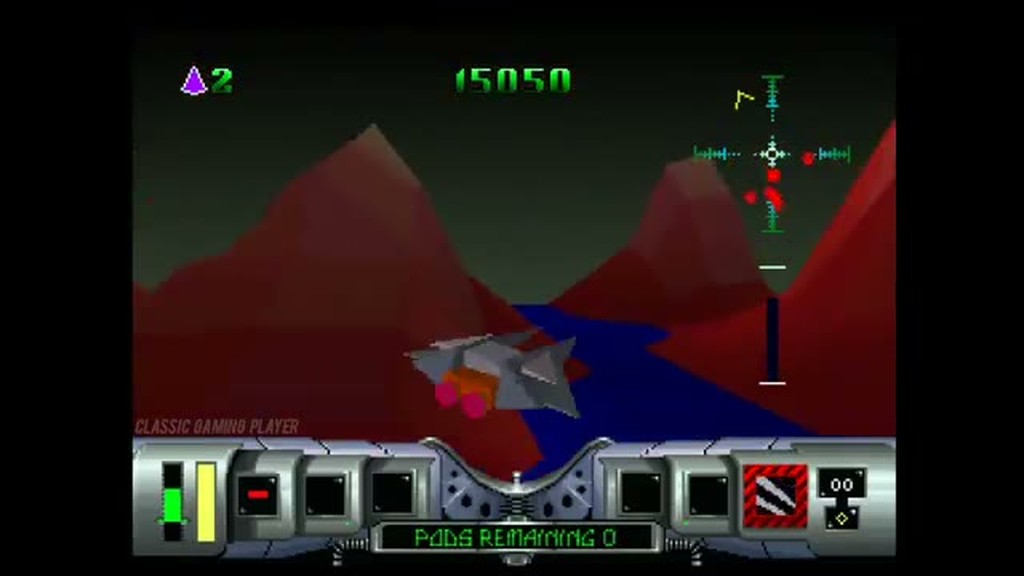
At a glance: Cybermorph · Atari Jaguar · Attention to Detail / Atari, 1993 · Free-roaming shooter · Score: 6.5/10
No pack-in game has ever been argued about like Cybermorph. It was the game in the box with the Jaguar at its November 1993 launch — the first thing the “64-bit” revolution showed its buyers — and it arrived carrying impossible expectations, a striking morphing spacecraft, a draw distance you could measure in feet, and a ship’s computer named Skylar whose signature question, “Where did YOU learn to fly?”, became the most quoted insult in console history. Thirty years on, Cybermorph deserves a fair trial: neither the disaster of legend nor a secret masterpiece, but a flawed, ambitious, historically fascinating launch game.
The mission and the morph
The concept was genuinely forward-looking. The evil Pernitia empire has scattered the resistance’s supply pods across fifty worlds; you pilot the Transmogriffon, here shortened to the T-Griffon, a craft that re-shapes itself for the terrain, flying free-roaming 3D missions over flat-shaded polygon planets to recover pods, rescue stranded craft and fight the empire’s defences. Free-roaming 3D flight, on a home console, in 1993 — there was nothing else like it in a living room, and the sense of lifting off a planet’s surface with the whole map theoretically yours to explore was a real glimpse of where games were going, delivered by a small British team at Attention to Detail who were learning the eccentric Jaguar hardware in public.
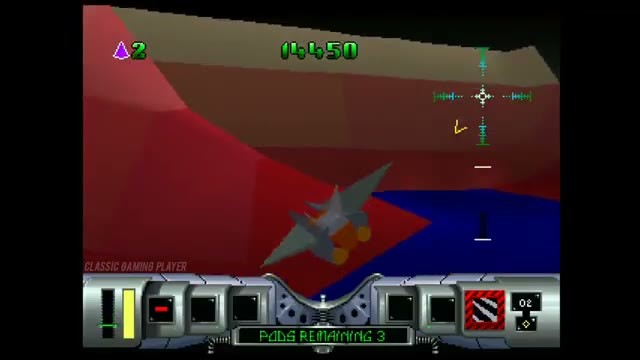
The morphing hook itself is more modest than the box promised — the craft’s transformations are context-driven flourishes rather than a deep system — but the core loop has a scruffy charm that the jeers forget: skim the canyons, read the scanner, dive on a cluster of pods with turrets waking up around you, bank away with the cargo and the alarms ringing. When Cybermorph flows, usually in its earlier, gentler worlds, it flows like nothing else of its year.
The famous problems, itemised
And then the case for the prosecution, which is substantial. The draw distance is the first count: terrain resolves out of fog at ranges that make navigation guesswork and turn some missions into a lottery of sudden mountainsides. The frame rate labours exactly when the action peaks. The difficulty is launch-era savage — your craft is fragile, enemies are plentiful, and the game’s structure asks for repeated long missions with limited forgiveness. The flat-shaded worlds, bold at first sight, repeat their moods across fifty planets until the mid-game becomes a slog of similar horizons. And Skylar: the onboard voice, intended as character, was mixed so prominently and triggered so relentlessly that Atari itself addressed the balance in later production runs — the rare launch game whose own publisher quietly patched its personality. Players who met the early version’s commentary at full volume have never entirely forgiven it, and they are not wrong.

Context, though, is the defence’s whole case, and it is a good one. Cybermorph was a launch title for bizarre, undocumented-feeling hardware, built to a console launch deadline, attempting a genre — free-roaming 3D — that the PlayStation’s launch line-up would still be fumbling two years later. Its contemporaries on rival hardware were 2D platformers and ports. Judged as a 1993 proof of concept that every Jaguar buyer got for free, it is ambitious, distinctive and intermittently thrilling. Judged as the flagship argument for a self-declared 64-bit super-console selling against the SNES’s library, it was never going to be enough, and the ridicule it attracted — much of it from people who never played past the first planet — says as much about the Jaguar’s marketing overreach as about ATD’s game.
The sequel as verdict
The most eloquent review of Cybermorph ever published is Battlemorph, ATD’s own Jaguar CD sequel, which reads like a point-by-point apology and improvement pass: longer draw distances, proper saves, gentler difficulty, toned-down voice, richer worlds, CD audio. Studios do not fix what was not broken, and Battlemorph quietly confirms every count in this review — while also confirming that the bones underneath were worth building on. Played as a pair, the two games are the Jaguar’s most interesting development story: watch a team master a machine across two releases, in public, under impossible conditions.
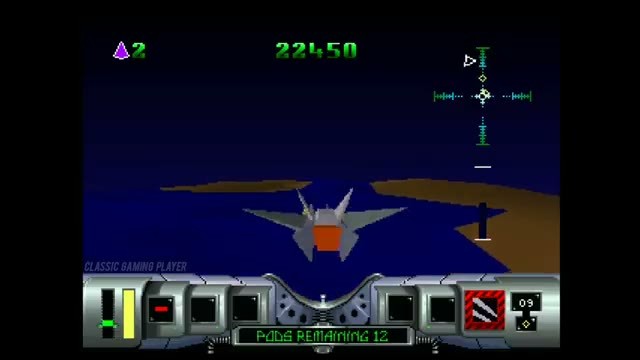
Today Cybermorph is cheap, common and historically load-bearing — the game that introduced a console, for better and worse, and the source of the Jaguar’s most durable meme. New owners should absolutely play it: briefly, in the right spirit, and preferably the later, quieter revision if the cartridge gods provide. Just don’t judge the whole Jaguar by its first, strangest cartridge.
How to play it now (and enjoy it)
Modern players can tilt Cybermorph’s odds in their favour, and should. Seek the later cartridge revision if you can — the rebalanced voice mix alone transforms the cockpit from comedy club to workspace — and play in short, deliberate sessions, treating the early worlds as the training the game never quite provides. Learn the scanner before the scenery: Cybermorph is a game of information starvation, and most of its famous cruelty is the cruelty of arriving at a fight already half-lost because you flew in blind. Fly in sighted, collect conservatively, and the game’s genuine charms — the strange beauty of its shaded worlds at dawn-of-3D simplicity, the satisfaction of a clean pod run under fire — have room to show themselves. Emulation, it should be said, has been kind to Cybermorph: the BigPemu generation of Jaguar emulation runs it beautifully, and more people have made peace with this game in the last five years than in the twenty before.
None of this reopens the verdict on its quality — the flaws itemised above are real, and the score below stands — but it reopens the verdict on its interest. Cybermorph is the most historically eloquent cartridge on the Jaguar: in its ambitions you can see the console Atari wanted to sell, and in its failures, the console Atari actually shipped. Every collection needs that document. Not every collection needs to finish all fifty worlds, and this review will not pretend otherwise in print.
There is also, fairness compels us to add, the matter of what Cybermorph was for the people who were there. A whole cohort of Jaguar owners remember the first flight over that first planet — the draw distance be damned — as the moment 3D gaming stopped being something arcades and PCs did and became something their television did. Launch games are promises before they are products, and broken-edged as the promise was, Cybermorph kept the essential part of it: the future is coming, and it looks a little like this. The PlayStation would cash that promise two years later with immeasurably better tools. The Jaguar wrote the cheque first, in a cartridge in the box, with a robot voice asking where you learned to fly.
Bring patience, bring the later revision if you can find it, and bring a sense of humour about the co-pilot. The game will supply everything else, including the argument.
Verdict
Ambitious, distinctive and genuinely historic — and saddled with a draw distance, a difficulty curve and a co-pilot that its makers spent a sequel apologising for. Fascinating at 6.5, and essential to the Jaguar’s story at any score. Score: 6.5/10