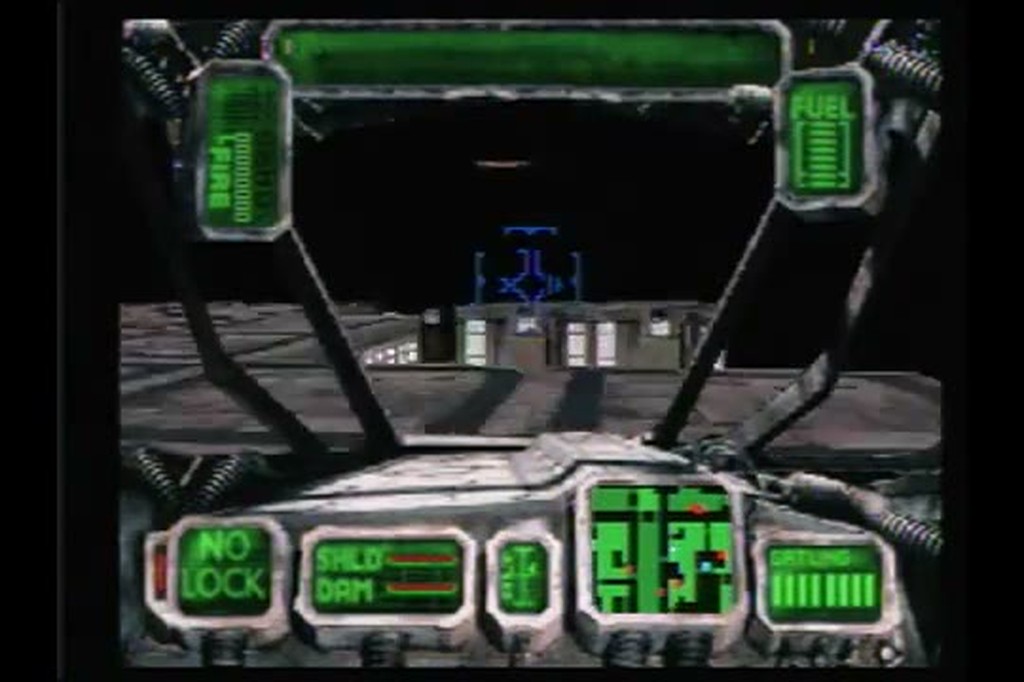
At a glance: Skyhammer · Atari Jaguar · Rebellion / Songbird Productions, 1999 · City combat flight sim · Score: 8.0/10
Skyhammer should not exist. Rebellion built this texture-mapped city-combat sim in the Jaguar’s dying days, Atari shelved it in the collapse, and it sat unpublished until 1999, when Songbird Productions — a small publisher that became the Jaguar’s afterlife — rescued it for the collectors who remained. The miracle is not that it was released. The miracle is what was in the box: the most technically ambitious game the Jaguar ever received, a Blade Runner city you fight through in a VTOL gunship, years ahead of the dead console it was buried with.
A city to fight in
The scenario is corporate dystopia rendered in neon and rain-slick shadow. Rival companies war over futuristic city districts, and you are a mercenary pilot in the Skyhammer, a vertical take-off gunship, flying contract missions through canyons of tower blocks: defend installations, hunt convoys, duel rival aircraft between the skyscrapers, and manage the unglamorous economics of fuel, ammunition and repairs that separate a campaign from an arcade cabinet. The game is structured as an open-ended campaign across multiple large city environments, with missions generated around your contracts and a difficulty that scales into genuine menace.
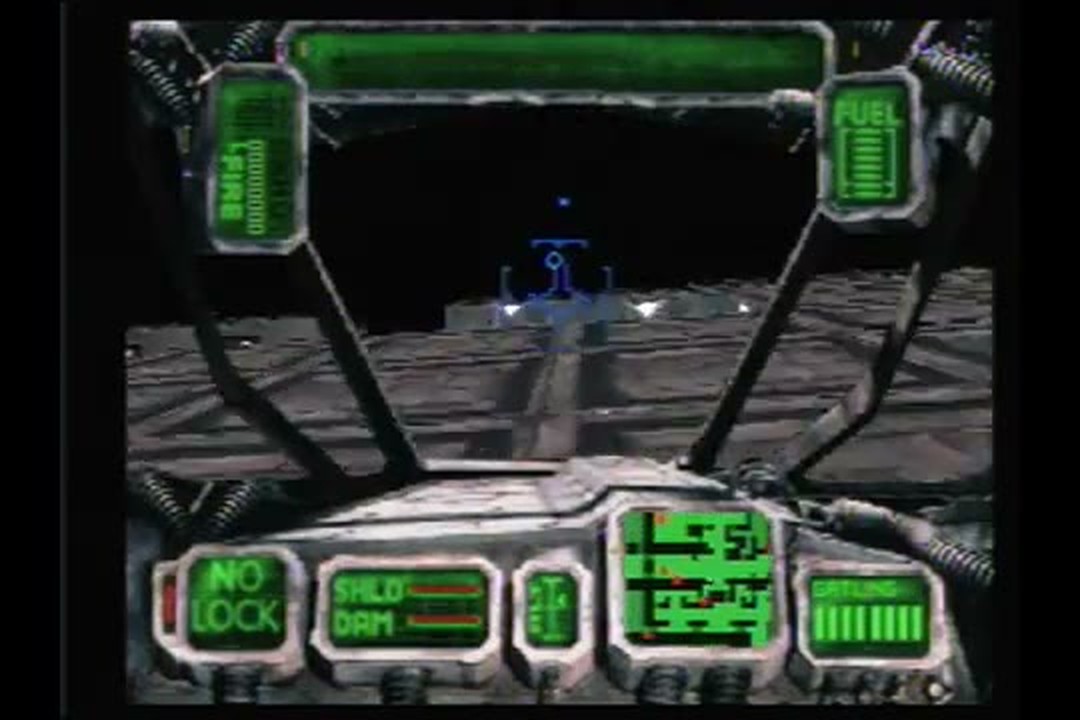
Technically, nothing else on the Jaguar looks like this. Full texture mapping on every building, a city that stretches to a convincing horizon, lighting that sells night operations — this is the hardware’s custom chips used with a sophistication that only Rebellion, the Alien vs Predator team, ever matched on the system, and in some respects Skyhammer pushes past even that famous game: AvP’s world was corridors, Skyhammer’s is a metropolis, drawn whole, at a frame rate that — while it works for a living and dips under load — holds together far better than a cancelled 1996 Jaguar title has any right to. The cockpit, the lock-on systems, the weather of neon signage reflecting down the avenues: it plays like a message from the Jaguar’s parallel-universe second generation.
Flying the thing
The gunship is a proper simulation-flavoured machine. It hovers, strafes laterally, climbs and dives, and fights with a weapons suite you manage like a budget — cannon for the cheap work, missiles for the expensive targets, and a constant eye on the fuel gauge that turns every long mission into a small logistics problem. Combat has weight: enemy aircraft and ground defences punish the pilot who flies like it’s an arcade game, and the missions reward route-planning through the canyons as much as reflexes. Between sorties, the contract-and-upgrade structure gives the campaign a mercenary rhythm that Rebellion would later revisit in spirit across its career — you are not saving the world, you are billing it.

The debits are the honest texture of an ambitious game finished under strange circumstances. The frame rate, heroic as its highs are, fluctuates; the city districts, for all their neon, reuse their architecture across a long campaign; and the difficulty curve assumes a commitment that a 1999 aftermarket release could demand but a 1996 retail one perhaps couldn’t have sold. The Jaguar pad is asked to be a flight controller and mostly rises to it, though the sim ambitions occasionally strain against a digital D-pad’s vocabulary. And the game’s commercial story guarantees it is among the more expensive cartridges in the library — a Songbird-era production bought, mostly, by people who already knew exactly what it was.
The afterlife game
Skyhammer matters beyond its own quality because of what it proved about the Jaguar’s long tail. The system’s commercial death in 1996 was not its actual death: Songbird, Telegames and the homebrew community kept it alive for years, and Skyhammer — a shelved first-party-calibre production, rescued and finished for love and a small market — was the emblem of that afterlife. It is also Rebellion’s Jaguar bookend: the studio that gave the system its most famous game in 1994 gave it its most advanced game in 1999, and the distance between Alien vs Predator’s corridors and Skyhammer’s city is the distance the hardware’s best developers travelled in five years.

For the modern player, the advice is simple. If you play one “late Jaguar” title — one game from the era after the obituaries — play this one. It is not a curiosity or a tech demo. It is a full, demanding, atmospheric combat sim that happens to have been published for a console that had been discontinued for three years, and it remains the single strongest argument that the Jaguar died before its developers were done with it.
What could have been, measured
It is tempting to file Skyhammer under the Jaguar’s what-ifs and move on, but the game itself resists that filing, because it is not a demo of an unmade future — it is a finished, full-length campaign of a quality the console’s commercial library rarely sustained. Consider the counterfactual honestly: had this shipped in 1996 as planned, into the teeth of the PlayStation’s first full year, it would still have been a remarkable object — a home-console city combat sim with an open campaign, a working economy and a metropolis to fight through, at a time when the genre lived on PCs with flight sticks. The Jaguar would not have been saved by it. Nothing could have saved the Jaguar by 1996. But the system’s final chapter would have read as a defiance rather than a dwindling, and Skyhammer’s three years in a vault remain the single most wasteful delay in the platform’s history.
For today’s player the practical notes are these: expect a long game, expect to learn its economy the hard way, and expect the middle hours — when the city opens up and the contracts start stacking consequences — to justify every story you’ve heard. The Jaguar produced very few games that reward a month’s commitment. This is one of them, and it arrived three years after the console it rewards it on was discontinued. History has few stranger sentences than that, and few better games hiding inside them.
The Rebellion signature
Students of Rebellion’s later career will find the studio’s whole future folded inside this cartridge: the open mission spaces, the mercenary framing, the fascination with cities as systems of cover and threat that would mature through their licensed shooters and sniper sandboxes in the decades after. Skyhammer is where that sensibility first flew. It is also, not incidentally, a game that treats its player as an adult professional from the first contract — no tutorial hand-holding beyond the manual’s counsel, no difficulty apology, a world that assumes you will learn its economics by surviving them. In 1999, for an audience of Jaguar loyalists who had survived everything the decade had done to their console, that respect landed exactly as intended. It still does.
Songbird’s rescue also preserved something no emulator menu can quite reproduce: the feeling of a discontinued console receiving, in 1999, a game that treated it as a going concern. Skyhammer is the Jaguar’s afterlife with the engine running.
File it, finally, with the Jaguar’s other rescued treasures — the prototypes, the posthumous discs, the homebrew labours — as proof of the library’s strangest statistic: some of its best games were published after the console was already history.
Verdict
The Jaguar’s most ambitious game, rescued from the vault and worth the rescue: a moody, demanding city-combat sim of real scale and atmosphere. Score: 8.0/10